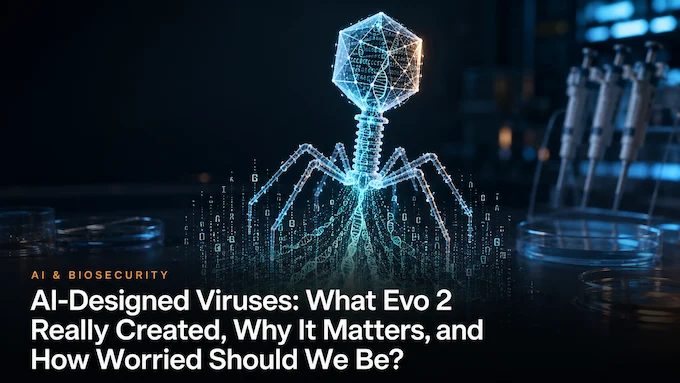
A headline saying that AI can now “create viruses” sounds like the opening scene of a techno-thriller. The real experiment is both less cinematic and more scientifically interesting.
Researchers from Stanford University and the Arc Institute used the genome language models Evo 1 and Evo 2 to generate candidate genomes for bacteriophages, viruses that infect bacteria. Humans then filtered those digital designs, selected candidates, had the DNA synthesized, assembled the genomes and tested them in the lab. Sixteen designs produced viable phages.
So yes, AI designed viruses in a meaningful sense. No, an AI chatbot did not independently invent a human pathogen and bring it to life. The experiment used the small bacteriophage ΦX174 as a template and targeted non-pathogenic E. coli. The bigger story is that generative AI has crossed from designing individual biological parts to producing whole-genome designs that can function after physical construction. That is a real milestone, with potential value for phage therapy and equally real questions for AI biosecurity.
Table of Contents
1. AI-Designed Viruses: What Actually Happened?
The work first appeared as a bioRxiv preprint on September 17, 2025. It has now reached peer-reviewed publication in Science, where the paper is titled “Generative design of bacteriophages with genome language models,” Science 393, eaec2657 (2026), DOI 10.1126/science.aec2657. The peer-reviewed publication is the reason the story surged again in August 2026.
The central result is straightforward: Evo-generated whole-genome sequences were turned into physical DNA and experimentally tested. Sixteen became viable bacteriophages. The original preprint describes this as the first generative design of viable bacteriophage genomes.
AI-Designed Viruses: What the Study Actually Shows
| Key Question | What the Study Actually Shows |
|---|---|
| What did AI generate? | Complete candidate genomes for ΦX174-like bacteriophages |
| Which models were used? | Evo 1 and Evo 2, including phage-focused fine-tuning |
| What organism was targeted? | Non-pathogenic E. coli used as a laboratory host |
| How many designs worked? | 16 of 285 experimentally tested designs produced functional phages |
| Did humans remain involved? | Yes, in filtering, selection, DNA synthesis, assembly, and validation |
| Could these phages infect humans? | The study did not design or demonstrate a human-infecting virus |
| Why does it matter? | It shows generative AI can contribute to functional whole-genome design |
Arc Institute reports that 16 of 285 tested designs successfully propagated and inhibited the intended bacterial strains while sparing unrelated strains. You may also see the number 302 in discussions of the broader candidate set. The useful distinction is that 285 designs reached the experimental testing workflow. Treating the result simply as “16 out of 302” blurs those stages.
2. Did AI Really Create A Virus?
“AI created a virus” is great headline language and mediocre process description.
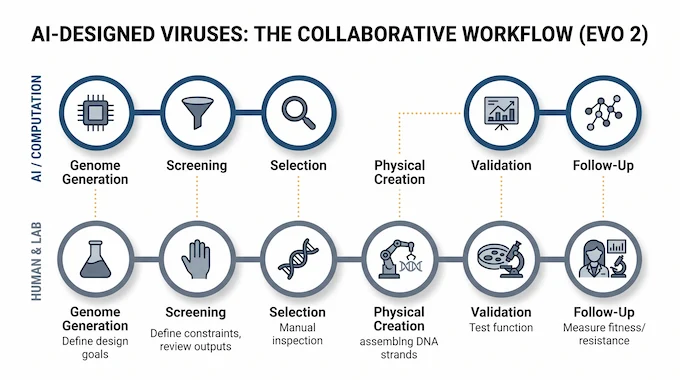
The AI’s job was to propose genome sequences. The researchers’ job was everything required to turn those sequences into a biological experiment. The supplementary methods show three layers of computational constraints, covering sequence quality, host specificity and diversification, followed by manual inspection before designs were selected for DNA synthesis.
How AI-Designed Viruses Move From Digital Genome to Working Phage
| Stage | AI Or Computation | Human And Laboratory Role |
|---|---|---|
| Genome Generation | Evo produced candidate DNA sequences | Researchers chose model settings and design goals |
| Screening | Computational filters checked plausibility and host-targeting features | Researchers defined constraints and reviewed outputs |
| Selection | Models narrowed a huge search space | Humans manually inspected candidates |
| Physical Creation | None | DNA was synthesized and assembled |
| Validation | Computational analysis supported interpretation | Researchers tested whether phages actually functioned |
| Follow-Up | Models helped analyze designs | Humans measured fitness, host range, structure, and resistance |
That makes AI-designed the right phrase. “AI-made” is too vague, and “AI autonomously created life” is wrong.
There is another distinction worth keeping. A synthetic virus is not automatically an AI-designed virus. Scientists have synthesized viral genomes for decades. ΦX174 itself has an unusual place in that history: it was the first complete DNA genome sequenced and later one of the first whole genomes chemically synthesized. What is new here is using a generative genome model to propose complete viable genome designs rather than reconstructing a known viral sequence. Arc frames the progression neatly as reading DNA, writing DNA, then designing it.
3. How Evo 2 Designs A Whole Viral Genome
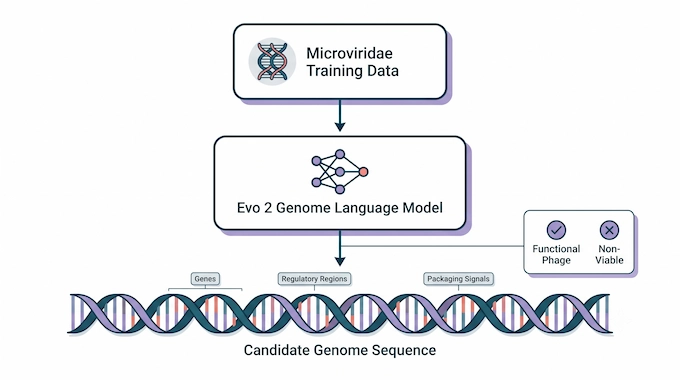
Calling Evo 2 “ChatGPT for DNA” is helpful for about ten seconds. Then the analogy starts to leak.
A language model learns statistical relationships between tokens. Evo works over biological sequence, learning patterns across nucleotides and genomic structure. In this study, the base models were further specialized using a curated set of Microviridae genomes related to the small phage ΦX174. The supplementary material says the researchers collected 14,466 filtered Microviridae genomes and split them into training, validation and test sets for fine-tuning.
Why is whole-genome generation harder than designing one protein? Because a working genome is a coordination problem. Genes overlap. Regulatory regions matter. Packaging, replication, host recognition and timing all have to remain compatible. A locally sensible mutation can break something elsewhere.
That is why the study’s importance is not that Evo can output a long DNA string. Any program can output DNA letters. The important result is that some generated sequences survived the jump from plausible-looking sequence to functioning biological system.
The researchers also found that pretraining plus phage-specific fine-tuning were important for coherent phage generation. In other words, scale alone was not magic. Specialization, constraints and experimental selection did a lot of the work.
4. Why 16 Viable Phages Matter More Than The Success Rate Suggests
At first glance, 16 successful phages from 285 tested designs sounds unimpressive. If an image generator returned 269 broken images, nobody would call that state of the art.
Biology is less forgiving.
A phage genome has to remain internally consistent across many interacting components. The researchers were deliberately asking the model to explore sequence space while preserving enough structure to produce a working virus. Sixteen designs passed that physical reality check.
Arc says every functional genome carried between 67 and 392 novel mutations relative to its nearest natural genome. Thirteen contained mutations the researchers could not attribute to known natural sequences. One design, Evo-Φ2147, had 93 percent average nucleotide identity to its closest natural relative, enough to cross some thresholds used to distinguish viral species.
Still, the success rate should not be turned into a benchmark victory lap. A 2025 PREreview praised the molecular biology but argued that the original study lacked sufficiently explicit lightweight baselines. Without those comparisons, “16 worked” does not by itself tell us how much better the generative model is than simpler ways of exploring nearby sequence space.
The final supplementary work includes null analyses against random mutational expectations, which strengthens the case that viable designs are not trivial random accidents. But the broader lesson remains: functional validation is impressive, while the exact size of Evo’s advantage over every alternative design strategy is a separate question.
5. Why The Evo-Φ69 Virus Stood Out
The Evo-Φ69 virus has become the study’s celebrity phage because it did more than merely survive.
In competition experiments, researchers mixed the generated phages with the natural ΦX174 and tracked their abundance over six hours. The supplementary methods define relative fitness from changes in each phage’s abundance over time. Reporting on the experiment found that Evo-Φ69 increased roughly 16 to 65 times from its starting level across replicate competitions, compared with roughly 1.3 to 4 times for ΦX174.
That does not mean Evo-Φ69 was “65 times deadlier.” It means it showed stronger competitive fitness under a particular laboratory assay against a bacterial host.
This is an important distinction whenever an AI virus story starts compressing technical measurements into alarming adjectives. Faster replication in E. coli under controlled conditions is not a measure of danger to humans.
6. How Novel Were The AI-Generated Viruses?
The designs were not copied versions of ΦX174, but neither were they genomes invented from biological nothingness.
The model was trained on natural sequence data and fine-tuned on Microviridae. The design pipeline intentionally retained traits needed for the target host. So some resemblance to known phages was part of the specification.
The interesting part is how Evo combined variation while maintaining function. Evo-Φ36 is the clearest example. Its DNA-packaging J protein closely resembles the version found in the more distant phage G4, while the surrounding genome is much closer to ΦX174-like phages. Follow-up tests found that this J protein functioned in one compatible genomic context but not when simply dropped into ΦX174.
That is much more interesting than “AI found mutations.” It suggests the generated genome captured context-dependent combinations that are hard to design one component at a time.
This is also where “AI generated virus” should be understood carefully. Generative models are recombiners of learned biological structure, but useful generation is not the same thing as copying a training example. The scientific question is whether the model can navigate to combinations that are both different and functional. These 16 phages provide evidence that, within this narrow system, it can.
7. Can These AI-Designed Viruses Infect Humans?
For the phages in this study, the direct answer is no evidence says they can.
Bacteriophages infect bacteria. The researchers chose the lytic phage ΦX174 and non-pathogenic E. coli C precisely because the system is well studied and comparatively safe. They also used host-tropism constraints designed to keep the generated phages focused on the intended bacterial host. None of the 285 tested assemblies showed activity against the off-target E. coli K-12 strains used in that validation.
That does not justify the sloppy statement that “phages can never matter to human biology.” The narrower point is enough: this experiment did not create a human-infecting virus.
The team also withheld viruses with eukaryotic hosts, including human pathogens, from Evo’s training data and fine-tuned the models specifically on bacteriophages. Those choices matter when evaluating the immediate risk of the experiment.
8. Why Scientists Want AI-Designed Phages
The medical motivation is antibiotic resistance.
Phage therapy uses viruses that attack bacteria. It has existed for more than a century, but finding the right phage for the right bacterial strain can be difficult, and bacteria can evolve resistance to phages just as they evolve resistance to antibiotics.
This study hints at a different workflow: generate many candidate phage genomes, test them, and create a diverse pool from which useful variants can emerge.
In the experiments, cocktails containing the generated phages were tested against ΦX174-resistant E. coli. The preprint reports that generated-phage cocktails overcame resistance in three strains. Arc says the successful counter-resistant phages combined genetic material from multiple AI-generated designs, giving evolution more raw material to work with.
That is promising, but it is not a clinical result. Evo-Φ69 and its siblings are not approved therapies. The study does not establish dosing, safety in patients, immune effects, manufacturing reliability or clinical efficacy. The leap from an elegant bacterial experiment to a medicine is enormous.
The near-term value is more modest and still useful: AI may become a better search tool for building phage libraries and exploring designs that human intuition would rarely propose.
9. AI Bioweapons And AI Biosecurity: What The Study Changes
This is where the story stops being merely clever biology.
The researchers themselves say complete generative phage design requires new attention to biosafety, containment and biosecurity. They also acknowledge that applying related frameworks to other virus classes might eventually be feasible, while stressing that such work would require much more careful oversight.
What has been demonstrated is narrow: AI-assisted design of small bacteriophage genomes that target bacteria.
What remains plausible but unproven is broader application to more complex or eukaryotic viruses.
What remains speculation is the idea that anyone can now type a prompt into an open model and produce a pandemic pathogen.
The study used layered safeguards, including training-data exclusions, phage-specific fine-tuning, host constraints, institutional biosafety review and commercial DNA-synthesis screening. The authors also point to improved synthesis screening and sequence tracing as important future defenses.
Still, AI biosecurity cannot rest on one safeguard. Independent researchers later showed that some misuse-relevant Evo 2 capabilities could be partially recovered by fine-tuning the open model on human-infecting viral data. That does not prove an AI bioweapon can be generated on demand. It does show that “we removed dangerous training data” should not be treated as a permanent security boundary.
The sensible response is layered defense: safer training and release practices, research review, DNA-synthesis screening, laboratory controls, capability evaluations and governance that evolves with the models.
10. What The Evo 2 Study Proves, And What It Does Not
The cleanest way to read this paper is to separate the milestone from the mythology.
It does show that a genome language model can generate candidate whole phage genomes, some of which become functional bacteriophages after humans select, synthesize, assemble and test them. It shows that generated designs can contain substantial sequence novelty, that some can outperform the natural template in specific laboratory fitness measurements, and that a diverse generated phage pool can help overcome bacterial resistance.
It does not show that AI created life from scratch. It did not create a human pathogen. It did not prove that Evo 2 can design arbitrary viruses. It did not turn synthetic virology into a push-button process. And it certainly did not demonstrate a ready-made route to AI bioweapons.
That balance is why the result matters. The immediate experiment is less frightening than the most dramatic headlines suggest. The underlying capability is more consequential than the dismissive “it only made a bacteriophage” response suggests.
AI designed viruses have moved from a hypothetical idea to experimentally validated biology, but within a tightly constrained, human-operated system. The next questions are no longer just whether genome models can generate long DNA sequences. They are whether those models can reliably design larger systems, how quickly useful designs can move toward real therapies, and whether safety infrastructure can keep pace as the models improve.
For readers tracking that intersection of AI, biotechnology and real-world capability, Binary Verse AI will keep separating what the models actually demonstrated from what the headlines merely imply. Follow our latest research explainers for the evidence, the limitations and the signals that matter before the next breakthrough becomes tomorrow’s panic cycle.
1. Can AI really create viruses?
AI can generate candidate viral genome sequences, but it does not independently create physical viruses. In the Evo 2 study, researchers filtered and selected the AI-generated designs, synthesized the DNA, assembled the genomes, and tested them in the laboratory
2. Can AI-designed viruses infect humans?
The viruses created in this study were bacteriophages designed to infect bacteria, specifically E. coli. The researchers did not create or demonstrate a virus capable of infecting humans.
3. What is the Evo-Φ69 virus?
Evo-Φ69 is one of the functional AI-designed bacteriophages produced in the study. It showed stronger competitive fitness than the natural ΦX174 phage in specific laboratory experiments, but that does not mean it is more dangerous or “deadlier.”
4. Why are scientists creating AI-designed viruses?
One major goal is to develop better bacteriophages that can attack harmful bacteria. This could eventually support phage therapy and provide new ways to tackle antibiotic-resistant bacterial infections, although the phages in this study are not approved treatments.
5. Could AI-designed viruses be used as bioweapons?
The current study does not demonstrate an AI bioweapon or a human-infecting AI-generated virus. However, the researchers acknowledge that increasingly capable genome models create longer-term biosecurity concerns, which is why safeguards such as restricted training data, biosafety oversight, DNA-synthesis screening, and capability monitoring are important.