Updated on 13 February 2026
Introduction
Here’s my current test for a model: give it a task that involves a terminal, a half-broken repo, and a goal that takes 30 steps. If it still knows what it’s doing at step 25, I care. If it faceplants into a loop, it’s just fancy autocomplete.
That’s the bigger shift. We’ve moved from judging models by how they talk to judging them by whether they can finish.
That’s the vibe behind GLM-5. It’s not trying to be your smartest chat buddy. It’s trying to be the model you hand a messy repo, a vague ticket, and a long deadline, then trust it to keep its bearings for more than five minutes.
This review is for builders and buyers: people deciding whether GLM-5 belongs in their agent stack, their API budget, or their “try it this weekend” list. We’ll talk upgrades, what the numbers actually mean, where it beats its older sibling, where frontier models still win, and how to get access without falling into plan confusion.
Table of Contents
How to Run GLM-5 Locally with Llama.cpp
Running the massive GLM-5 model locally requires specific hardware and a precise build of llama.cpp. Follow this guide to set it up on an Ubuntu system.
Hardware Requirements
Before proceeding, ensure your system meets these specifications. This model is extremely resource-intensive.
- GPU: NVIDIA GPU with 24GB VRAM (Minimum).
- Note: 48GB–80GB VRAM is recommended for usable speeds. 24GB will be very slow.
- System RAM: 256GB+ (Required for the 2-bit dynamic quantization).
- Disk Space: 300GB+ Free (The model cache alone is ~241GB).
- OS: Linux (Ubuntu recommended).
Step 1: Clone and Configure Llama.cpp
We must use a specific Pull Request (PR 19460) that supports GLM-5.
# Clone the repository
git clone https://github.com/ggml-org/llama.cpp

# Fetch the specific PR for GLM-5 support and switch to it
cd llama.cpp && git fetch origin pull/19460/head:MASTER && git checkout MASTER && cd ..
Step 2: Build with CUDA Support
Configure the build to enable NVIDIA GPU acceleration.
# Configure CMake with CUDA enabled
cmake llama.cpp -B llama.cpp/build \
-DBUILD_SHARED_LIBS=OFF -DGGML_CUDA=ON

# Compile the binaries (This may take ~10 minutes)
cmake --build llama.cpp/build --config Release -j --clean-first --target llama-cli llama-mtmd-cli llama-server llama-gguf-split

# IMPORTANT: Copy the built binaries to the main folder so the run command finds them
cp llama.cpp/build/bin/llama-* llama.cpp/
Step 3: Install Python Dependencies
We need to install PyTorch and Flash Attention. Installing them in this specific order prevents common “module not found” errors.
# Install build tools
pip install packaging ninja

# Install PyTorch first
pip install torch

# Install Flash Attention without build isolation
pip install flash-attn --no-build-isolation
Step 4: Download and Run GLM-5
This command sets the cache directory, downloads the GLM-5-GGUF (UD-IQ2_XXS) model from Unsloth, and starts the inference engine with a 16k context window.
# Set the cache path
export LLAMA_CACHE="unsloth/GLM-5-GGUF"

# Run the model
./llama.cpp/llama-cli \
    -hf unsloth/GLM-5-GGUF:UD-IQ2_XXS \
    --jinja \
    --ctx-size 16384 \
    --temp 0.7 \
    --top-p 1.0 \
    --fit on
Troubleshooting Tips:
- “No such file or directory”: Ensure you ran the
cpcommand in Step 2. If it still fails, try running it directly from the build folder:./llama.cpp/build/bin/llama-cli ... - Performance: If the model is too slow or crashes, try reducing the context size by changing
--ctx-size 16384to8192.
1. GLM-5 In One Paragraph
GLM-5 is a large Mixture-of-Experts model tuned for agentic engineering and long-horizon agent tasks, meaning multi-step work that involves tools, context juggling, and lots of “go do the next thing” loops. It scales up to MoE 744B / 40B active, uses DeepSeek Sparse Attention (DSA) to keep long-context costs sane, and leans hard into post-training that favors execution over vibes. If you write software, manage systems, or build workflows where the model has to plan, act, verify, and recover, GLM-5 is aiming straight at you.
| Quick Decision Snapshot | What You Get | Who It Fits | Who Should Skip |
|---|---|---|---|
| Long-context agent work | 200K+ context window, tool calling, better multi-step stability | Engineers using Claude Code, Cline, OpenCode, or custom agents | People who only need cheap bulk text |
| Coding and terminal tasks | Stronger repo edits and shell-driven workflows | Teams doing real PRs and debugging loops | Ultra-low latency autocomplete fans |
| Open distribution posture | MIT license, open weights, multi-platform deployment options | Anyone who needs control over infra and costs | Anyone who wants one-click local on a laptop |
2. What Changed Vs GLM-4.7

The headline is simple: GLM-5 got bigger, it got more tool-oriented, and the training loop looks like it was designed by people who actually ship.
2.1 Scale That Matters, Not Just Scale That Impresses
The jump from the prior generation is big enough to feel. The architecture grows from the 355B-class to 744B total parameters, with 40B active at inference. That “active” number is the part you pay for in latency and compute, and it’s also the part that tends to show up in “it finally stopped forgetting the plan” moments.
2.2 More Tokens, More Coverage, Fewer Blind Spots
Pre-training tokens move from about 23T to 28.5T. That isn’t magic by itself. What it buys you is more coverage of weird edge cases, more long-tail code patterns, and fewer “confidently wrong because I’ve never seen this” failures. In practice it translates into fewer reruns when you’re doing boring but expensive work like refactors and migrations.
2.3 DSA And Post-Training Infrastructure
DSA is the practical upgrade. Long context is only useful if you can afford to use it, and sparse attention is one way to keep the bill from exploding. On the post-training side, the team describes an asynchronous RL setup called “slime” that improves throughput so they can iterate more. The takeaway is not the name. The takeaway is that this model was trained to finish tasks, not to sound impressive while it stalls.
3. The 60-Second Benchmark Verdict
If you only have a minute, here’s the story from the numbers:
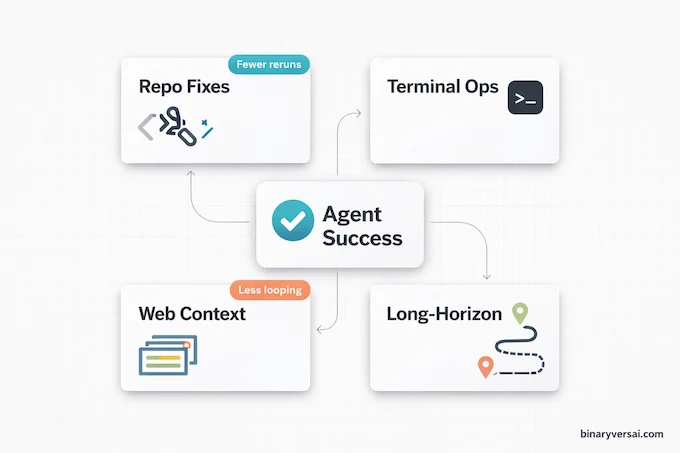
- Coding improves in the “real PR” direction. SWE-bench Verified moves up, and multilingual coding improves too, which matters if your codebase, comments, or tickets aren’t English-only.
- Tool-heavy work jumps. Terminal-Bench 2.0 climbs a lot, which usually correlates with fewer “I can’t run that command” dead ends.
- Agentic browsing gets sturdier. BrowseComp with context management improves, which is basically “can it keep track of what it already learned on the web and not loop.”
- Long-horizon planning stops being a party trick. Vending Bench 2 rises sharply, a weird benchmark that’s useful because it punishes short-term greed and bad memory.
Those deltas are the difference between a model that demos well and a model that survives a two-hour debugging session.
4. Benchmarks Table, But Explained
Benchmarks are easy to misuse. People treat them like a leaderboard, then get mad when reality doesn’t match the bar chart. A better way is to ask, “What kind of failure does this benchmark punish?”
If you’re hunting for a clean GLM-5 benchmarks snapshot, the table below is the fast version, and the sections after it are the part that keeps you from drawing the wrong conclusion.
4.1 What Each Benchmark Actually Measures
- SWE-bench Verified: Can the model fix real bugs and submit plausible PRs, not just answer questions about code.
- Terminal-Bench 2.0: Can it operate in a terminal-like environment, manage files, run commands, and recover when something fails.
- BrowseComp: Can it browse, extract, and manage context without drowning in tabs and repetition.
- Vending Bench 2: Can it run a long simulation over many steps, managing resources and strategy over time.
- MCP-Atlas: Can it use tool protocols cleanly and reliably.
- τ²-Bench: Can it handle multi-turn service-like tasks without falling apart mid-dialog.
| Benchmark (Higher Is Better) | GLM-4.7 | GLM-5 | Claude Opus 4.5 | Gemini 3 Pro | GPT-5.2 (xhigh) |
|---|---|---|---|---|---|
| Humanity’s Last Exam (text / w tools) | 24.8 / 42.8 | 30.5 / 50.4 | 28.4 / 43.4 | 37.2 / 45.8 | 35.4 / 45.5 |
| SWE-bench Verified | 73.8 | 77.8 | 80.9 | 76.2 | 80.0 |
| SWE-bench Multilingual | 66.7 | 73.3 | 77.5 | 65.0 | 72.0 |
| Terminal-Bench 2.0 | 41.0 | 56.2 | 59.3 | 54.2 | 54.0 |
| BrowseComp | 67.5 | 75.9 | 67.8 | 59.2 | 65.8 |
| MCP-Atlas | 52.0 | 67.8 | 65.2 | 66.6 | 68.0 |
| τ²-Bench | 87.4 | 89.7 | 91.6 | 90.7 | 85.5 |
| Vending Bench 2 (USD) | $2,377 | $4,432 | $4,967 | $5,478 | $3,591 |
Notes: Humanity’s Last Exam is shown as text-only and with tools. Vending Bench 2 is a “final balance” style metric, not a percentage.
5. GLM-5 Vs GLM-4.7, When Upgrading Actually Matters
Most upgrades are boring. This one is situationally dramatic.
5.1 Stay On 4.7 If
- You’re doing high-volume summarization, rewriting, or bulk content where cost per token dominates.
- Your workflows are short and stateless, like single-turn Q&A or small snippet generation.
- Latency is the product, and every extra second hurts.
5.2 Upgrade If
- You run multi-step agent loops where the model needs to remember the goal, keep a plan, and call tools without hallucinating the interface.
- You routinely push 100K-plus context, especially on codebases, logs, or long specs.
- You want fewer “looks right, fails on execution” moments in terminal tasks and repo edits.
This is the classic trade: cheaper throughput versus higher success rate per attempt. The moment reruns start costing more than tokens, the newer model pays for itself.
6. GLM-5 Vs Frontier Models, The Honest Positioning
Let’s be blunt: frontier labs still have advantages. They have larger training budgets, deeper post-training, and a lot of product polish. Claude and Gemini often feel smoother in conversation. GPT-style models can be terrifyingly good at certain reasoning patterns.
So why does GLM-5 matter?
Because open distribution changes the decision. When you can run it through your own routing, wrap it in your own safety layer, or serve it in your own region, the question shifts from “best possible score” to “best possible system.”
In practice:
- On coding and tool work, it’s close enough to be interesting, especially if you care about control.
- On some reasoning and exam-style tasks, frontier still wins more often.
- On agentic browsing and long-horizon loops, the story depends on your scaffolding, your tools, and how disciplined your prompts are.
You’re not just buying a model. You’re picking an operating point.
7. Pricing People Are Confused About
If you search GLM-5 pricing, you’ll find three different answers, and they can all be true.
7.1 API Pricing Vs Provider Pricing
There’s the official GLM-5 API pricing on the first-party platform, and then there’s what you see through aggregators and resellers. OpenRouter-style routing can add margin, offer caching, or bundle reliability guarantees. That’s why you’ll see different per-token numbers even when the underlying model is the same.
7.2 Plans Are Not API, Even If They Feel Like It
Subscription plans are quota products. API is metered billing. They behave differently, they throttle differently, and they show “cost” in different ways. Many complaints come from mixing them up, then wondering why a plan call doesn’t match an invoice estimate.
7.3 The Practical Rule
If you’re building a product, start with API and measure. If you’re a developer trying to ship faster, plans can be the better deal, as long as you understand the quota mechanics.
8. Z.ai Coding Plan, Tiers And The Quota Reality
The z.ai coding plan is basically, “Give me a predictable monthly bill, then let me call the model inside my coding tools.” It’s aimed at agent workflows, not at raw API throughput.
Here’s the catch that people miss: rollout and tier gating.
- Max tier is the one that gets GLM-5 first.
- Pro is supposed to get it later as resources shift.
- Calls to the new model consume more quota than GLM-4.7, so a busy day can feel like the meter is running faster.
If you’re evaluating value, treat it like a tool subscription, not like a token spreadsheet.
And yes, people search z.ai glm coding plan because they want the simple answer: “Do I get the new model on my tier?” Today, the clean answer is, Max gets it, everyone else waits.
9. How To Access GLM-5 Right Now
There are three fast paths, depending on whether you’re experimenting or building.
9.1 Z.ai Chat And Agent Mode
If you just want to feel the model, use z.ai glm in chat mode first. Agent mode is where it gets fun, because you can ask for actual deliverables, like a DOCX or PDF, and the system will call the right tools.
9.2 API, The Straight Line For Builders
If you need repeatability, get a z.ai api key, then call the z.ai api directly. This gives you the cleanest view of costs, latency, and failure modes. It also lets you swap models without rewriting your whole workflow.
9.3 Tool Ecosystem, Where It Actually Earns Its Keep
If your day lives inside agents, you can route it through tools like Claude Code, Cline, OpenCode, and OpenClaw. Some setups map model environment variables so you can point existing agents at the new backend without changing how you work. That’s the underrated win here: fewer new knobs.
If you’re still hunting docs and weights, you’re not alone. “glm 5 github” is a real query because people want the canonical repo, the serving recipes, and the exact model names that actually work.
10. Who Should Use GLM-5, A Decision Matrix
This is the part most reviews dodge. Let’s not.
10.1 Best Fit
- Agentic coding: repo edits, multi-file refactors, test failures, CI loops.
- Long-horizon tasks: anything where the model has to keep a strategy across many steps, not just answer a prompt.
- Tool-heavy workflows: terminal operations, web retrieval, context management, MCP-style tool calls.
- Teams that value control: regions, deployment choices, and the ability to swap infra when priorities change.
10.2 Not The Best Fit
- Cheap bulk rewriting and summarization at scale.
- Ultra-low latency autocomplete where milliseconds matter more than success rate.
- “One shot, one prompt” use cases that don’t involve tools or memory.
If your workflow looks like a small program, with state and retries, this model is built for you. If your workflow looks like a content blender, you’ll likely spend less elsewhere.
11. Local Deployment Reality Check, What “Open Weights” Really Means
Open weights under an MIT license is a big deal. It means you can build real systems without begging for access. It does not mean you can run it on your gaming GPU and call it a day.
11.1 The Hardware Truth
FP8 checkpoints, tensor parallelism, and serving stacks like vLLM and SGLang tell you what the target is: multi-GPU servers. In practice you’ll see checkpoints labeled things like GLM-5-FP8, and that naming is a hint about the intended hardware. Think “serious box,” not “laptop weekend.” You can still deploy on alternative accelerators with the right kernels and quantization, but you’re doing infrastructure work, not clicking install.
11.2 Who Local Serving Is Actually For
- Labs and teams that need data control and on-prem routing.
- Companies optimizing cost at scale where serving efficiency matters.
- Builders who want to integrate tool calling and safety in-house, then ship a product on top.
If that’s you, the open-weights angle is the strategic reason to care. If it’s not, you’ll get 90 percent of the value by calling it as a service and spending your time on your agent scaffolding.
12. Closing
The short version is this: GLM-5 is a real step toward models that do work, not just talk about it. The improvements show up where it hurts, in terminal tasks, in long context, in multi-step loops, and in the boring but crucial skill of not losing the plot halfway through.
If you’re building an agent workflow, try GLM-5 in chat mode, then immediately stress it with a task that has teeth: a failing test suite, a messy migration, or a repo-wide refactor with a clear finish line. If it saves you reruns, it’s worth the upgrade. If it doesn’t, you learned that in an hour, not in a quarter.
Want the fastest path? Grab a z.ai api key, wire it into your agent, and run one real task end-to-end. That’s where models stop being hype and start earning their seat in your stack.
If you’re just kicking the tires, start in Z.ai and keep the prompt brutally real. If you’re ready to commit, the z.ai coding plan is the simplest on-ramp, choose a tier that matches how often you expect to ship with an agent watching your back.
1) Is GLM-5 open source, and what license is it released under?
Yes. GLM-5 is released as open weights under the MIT license, which is permissive for commercial use. For most readers, the practical meaning is simple: you can build on it, deploy it, and ship products without license gymnastics.
2) What are GLM-5’s key benchmark scores (SWE-bench, Terminal-Bench, HLE)?
From the published scores: SWE-bench Verified: 77.8, Terminal-Bench 2.0: 56.2, and Humanity’s Last Exam (HLE): 30.5 text-only, 50.4 with tools. In plain terms, GLM-5 looks strongest when it can run tool-heavy, multi-step work instead of just answering.
3) How much does GLM-5 cost per 1M tokens (API vs OpenRouter), and why do prices differ?
For GLM-5 API pricing, the commonly listed baseline is $1.00 per 1M input tokens and $3.20 per 1M output tokens. On OpenRouter, you may see the same or slightly different numbers depending on the provider route. Prices differ due to provider margin, routing/fallback guarantees, and cache discounts that vary by platform and traffic tier.
4) Why is GLM-5 Max-only on the Z.ai Coding Plan, and when will Pro get it?
Because rollout is constrained by compute capacity and resource migration, Z.ai is prioritizing the tier that includes stronger guarantees. Today, GLM-5 is effectively Max-first. Pro is expected to receive GLM-5 after the “old vs new model resource” transition finishes, but no universal date is promised. The practical move: keep Pro for GLM-4.7 workflows, switch to Max only if you truly need GLM-5 now.
5) Can I run GLM-5 locally, what hardware and inference stacks does it need?
Yes, but “local” usually means a multi-GPU server, not a single consumer card. You’ll want FP8 checkpoints (when available), high VRAM, and a modern serving stack like vLLM or SGLang with tensor parallelism. If your goal is real agentic engineering on big contexts, the hosted API is often cheaper than owning the infrastructure.