
1. Introduction
There is a distinct kind of electricity in the air when a David actually lands the stone. We spend so much time discussing compute moats and the inevitability of the trillion-dollar cluster that we forget software efficiency still matters. And frankly, it matters more than raw scale.
Yesterday, a team of roughly 100 researchers at a startup called Runway did something that shouldn’t be possible on paper. They released Runway Gen 4.5, a video generation model that didn’t just inch past the competition, it effectively dethroned Google and OpenAI on the industry’s most respected blind leaderboard.
Internally, they codenamed this project “David.” It is a bit on the nose, sure. But when you look at the technical architecture, specifically the shift to Autoregressive-to-Diffusion (A2D) techniques, you realize this wasn’t just a brute-force training run. It was a surgical strike on how we conceptualize video synthesis.
I have spent the last 24 hours digging through the technical papers, the pricing structures, and the raw outputs. If you are a creator, an engineer, or just someone tired of AI video that looks like a fever dream, you need to pay attention. This is the best AI video generator 2025 has to offer, but it comes with a silence you need to hear about. Let’s dig in.
Table of Contents
2. What is Runway Gen 4.5? The “David” of AI Video
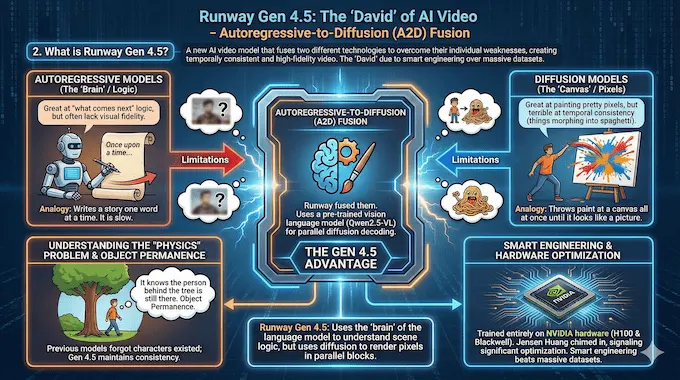
To understand why Runway Gen 4.5 feels different, we have to look under the hood. Most video models historically fall into two camps. You have the diffusion models, which are great at painting pretty pixels but terrible at temporal consistency (things morphing into spaghetti). Then you have autoregressive models, which are great at “what comes next” logic but often lack visual fidelity. Runway didn’t just pick one. They fused them.
The researchers used a technique they call “Autoregressive-to-Diffusion” (A2D). They took a pre-trained vision language model, specifically Qwen2.5-VL, and adapted it for parallel diffusion decoding. Think of it this way. An autoregressive model writes a story one word at a time. It is slow. A diffusion model throws paint at a canvas all at once until it looks like a picture.
Runway Gen 4.5 uses the “brain” of the language model to understand the scene’s logic, but uses diffusion to render the pixels in parallel blocks.
This matters because of the “physics” problem. In previous models, if a character walked behind a tree, the AI forgot they existed. When they emerged, they might be wearing a different shirt. By using a vision-language backbone, Runway Gen 4.5 has a concept of “object permanence.” It knows the person behind the tree is still there.
The model was trained entirely on NVIDIA hardware, H100 and Blackwell GPUs. Jensen Huang even chimed in on the release, which is usually a sign that the optimization work was significant. This isn’t just a model. It is a proof of concept that smart engineering beats massive datasets.
3. The Leaderboard Upset: Runway vs. Google Veo 3
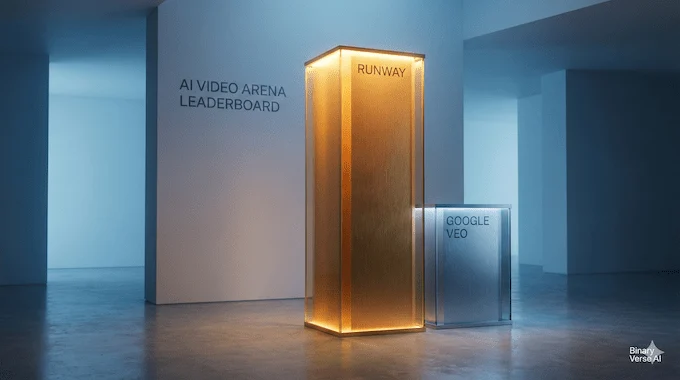
We are past the point where we can rely on cherry-picked marketing demos. Every AI company shows you their best 10 seconds. The only metric that holds water right now is the “Video Arena” from Artificial Analysis.
This is a blind test. Users are shown two clips, one from Model A, one from Model B, and they vote on which one is better without knowing who made it. It is the Pepsi Challenge for text to video AI. Here is where the industry currently stands.
Runway Gen 4.5 Competitor Leaderboard
| Rank | Model | Developer | Elo Score | Note |
|---|---|---|---|---|
| #1 | Runway Gen 4.5 | Runway | 1,247 | The new king. |
| #2 | Veo 3 | 1,226 | Previous leader. | |
| #3 | Kling 2.5 Turbo | Kuaishou | 1,225 | Very close third. |
| #4 | Veo 3.1 Preview | 1,222 | Surprisingly lower than Veo 3. | |
| #7 | Sora 2 Pro | OpenAI | 1,206 | Falling behind. |
Runway Gen 4.5 hitting an Elo of 1247 is significant. In Elo systems, a 20-point gap implies a consistent win rate. Google’s Veo 3 is a fantastic model, but it has been edged out in visual fidelity and prompt adherence.
The data tells us that when humans look at Runway vs Google Veo side-by-side, they prefer the crispness and motion of Runway. OpenAI’s Sora 2, sitting down at 7th place, is the shocker here. It reinforces that in AI, you are only as good as your last shipment.
4. Key Features: Physics, “Vibe,” and Object Permanence

I tested the “beach” and “water” prompts because liquids are the kryptonite of generative video. Usually, water in AI video looks like turbulent jelly.
Runway Gen 4.5 handles fluids with startling accuracy. The A2D architecture seems to grasp the causality of motion. If a wave crashes, the foam dissipates logically. It doesn’t just vanish. This is the “causal reasoning” the engineering team highlighted in their paper.
4.1 The Physics Engine
The model understands weight. When a character in Runway Gen 4.5 walks, they don’t glide. You can feel the impact of the foot on the pavement. This is likely due to the “World Model” training approach, where the AI isn’t just learning images, but learning how the physical world operates.
4.2 Stylistic Control
We are seeing a move away from the “shiny AI look.” You know the look, everything is slightly too smooth and glowing. Runway Gen 4.5 offers specific style presets:
- Photorealistic: Indistinguishable from camera footage.
- Cinematic: Adds depth of field and film grain.
- Slice of Life: This is my favorite. It degrades the quality intentionally to look like an iPhone video.
4.3 Object Permanence
This is the big one. In a generated clip where a car drives through a tunnel, the same car exits the tunnel. That sounds basic, but for a text to video AI, it is a monumental achievement. The memory retention across frames is vastly improved.
5. The Elephant in the Room: Does Gen 4.5 Have Audio?
We have to be honest here. If you are looking for an all-in-one production studio, you are going to hit a wall.
5.1 Runway Gen 4.5 does not generate audio.
This is the primary differentiator in the Runway vs Google Veo debate. Google Veo 3 can generate synchronized audio tracks, footsteps, ambient noise, dialogue. Runway Gen 4.5 is a silent film star.
If you browse the inernet, this is the main complaint. Users want the “one-click” magic. To use Runway, you still need an external workflow. You generate the video, then you bring it into a tool like ElevenLabs for speech or a separate SFX generator for background noise.
Is it a dealbreaker? For professional editors, no. You usually want to sound design separately anyway. But for the casual user wanting to make a quick meme or short, the lack of Runway Gen 4.5 audio is a friction point. Google Veo wins on convenience; Runway wins on visuals.
6. Runway Gen 4.5 Pricing Breakdown (Is It Worth It?)
High-end compute is expensive. Runway Gen 4.5 pricing reflects the fact that you are renting time on H100 clusters. They have structured the tiers to push serious users toward the Pro plan. Here is the reality of the math. The system uses “credits.”
- The Exchange Rate: 5 credits = 1 second of generated video (approximate, based on Gen-4 pricing stability).
- The Cost: High fidelity requires high spend.
Runway Gen 4.5 Pricing Plans
| Plan | Cost | Credits/Month | Effective Video Time | Best For |
|---|---|---|---|---|
| Free | $0 | 125 (One-time) | ~25 seconds | Testing if your prompt works. |
| Standard | $12/mo | 625 | ~2 minutes | Hobbyists & GIF makers. |
| Pro | $28/mo | 2250 | ~7.5 minutes | The Sweet Spot. Content creators. |
| Unlimited | $76/mo | 2250 + Unlimited | Infinite (throttled) | Power users & Studios. |
The Strategy:
Start with the Free plan. You get 125 credits. That is enough for about three to four 5-second generations. Use this to test the “physics” claims I made earlier. If you can’t get a good result in those tries, the model might not be for you.
If you are serious, the Unlimited plan at $76/mo is the only one that makes sense for heavy experimentation. The “relaxed rate” unlimited generations allow you to brute-force your way to a perfect clip without watching your bank account drain.
7. Technical Deep Dive: The A2D Advantage
I want to circle back to the engineering for a moment because it is fascinating. The paper “Autoregressive-to-Diffusion Vision Language Models” dropped alongside the release. The team tackled a massive inefficiency in diffusion models. Usually, training a diffusion model requires massive compute because it tries to learn everything at once.
Runway used Block Size Annealing. Imagine learning to play the piano. You don’t start by playing a whole concerto (full sequence). You start by playing one measure. Then two. Then a page. They trained Runway Gen 4.5 by gradually increasing the “prediction window.”
- Early Training: The model predicts small blocks of tokens.
- Late Training: It predicts large chunks of the video in parallel.
They also used Noise Level Annealing. They masked the “easy” tokens (the left side of an image/video sequence) more frequently at the start, forcing the model to learn the harder, right-side predictions. As training went on, they balanced it out.
This “curriculum learning” approach allows Runway Gen 4.5 to be incredibly efficient. It is why a 100-person team could beat Google. They weren’t just throwing more data at the problem; they were teaching the model how to learn more effectively.
8. Security and Privacy: Is Your Data Safe?
For the enterprise users reading this, and I know many of you are looking at Runway Gen 4.5 for internal marketing, security is the boring but necessary part of this review. Runway is SOC 2 Type II certified. That is the gold standard. But here is the distinction you need to know:
- Standard/Pro Plans: Your generations can theoretically be used to train future models. This is how they built Gen-5.
- Enterprise Plan: Your data is siloed. It is not used for training.
If you are a movie studio working on unreleased IP, you need the Enterprise contract. If you are a YouTuber making a sci-fi short, the Pro plan is fine, but just know you are contributing to the hive mind.
9. Conclusion: The Best AI Video Generator 2025?
We are seeing the maturation of generative video. It is no longer a slot machine where you pull the lever and hope for a coherent image. It is becoming a tool.
Runway Gen 4.5 is currently the best AI video generator 2025 has produced, purely on visual merit. It adheres to physics, it respects object permanence, and it offers a level of control that feels professional. The “David” project worked. They hit the giant.
The Verdict:
- Buy Runway Gen 4.5 if: You need the highest visual quality, you are an editor who handles audio separately, and you want precise control over camera movement and style.
- Wait for Google Veo if: You need an all-in-one clip with sound effects and music, or you are deeply integrated into the Google Workspace ecosystem.
The gap is narrowing, but for right now, the crown belongs to the startup in New York.
Next Step: You have 125 free credits waiting in the dashboard. Go try to break the physics engine. Create a video of “a glass of water spilling on a carpet in zero gravity.” If the liquid floats correctly, you will see exactly what I am talking about.
Is Runway Gen 4.5 free to use?
Yes, Runway offers a “Free Forever” plan, but it is limited. You receive a one-time grant of 125 credits upon signing up, which allows you to generate approximately 25 seconds of video (using Gen-4 Turbo) or test the physics engine. Once these credits are depleted, they do not renew; you must upgrade to a paid subscription (Standard, Pro, or Unlimited) to continue generating.
Does Runway Gen 4.5 generate audio?
No, Runway Gen 4.5 does not currently support native audio generation. Unlike Google Veo 3, which can generate synchronized sound effects and dialogue, Runway focuses purely on visual fidelity. Creators must use external tools like ElevenLabs or Runway’s separate audio features (Lip Sync) to add sound to their generated clips.
Is Runway Gen 4.5 better than Google Veo 3 and Sora?
According to the Artificial Analysis Video Arena leaderboard, Runway Gen 4.5 is currently the superior model. It holds the #1 spot with an ELO score of 1,247, beating Google Veo 3 (1,226) and OpenAI’s Sora 2 Pro (1,206). While Veo 3 wins on audio integration, blind tests confirm Gen-4.5 offers better prompt adherence, motion consistency, and visual realism.
How much does Runway Gen 4.5 cost?
Runway Gen 4.5 operates on a monthly credit system. The Standard Plan costs $12/user/month (625 credits). The Pro Plan, popular with creators, is $28/user/month (2,250 credits). For power users, the Unlimited Plan is $76/user/month, offering unlimited generations at a “relaxed” speed after the initial credits are used.
When is the Runway Gen 4.5 release date?
Runway Gen 4.5 was officially announced on December 1, 2025. It is rolling out gradually to all workspace users throughout the first week of December. Enterprise partners and API developers will receive access shortly after the general rollout, allowing studios to integrate the model into custom production pipelines.