1. Introduction: The Glitch In The Matrix
The funniest part of modern model launches is not the hype. It’s the moment the community does the math. That moment hit hard on Dec 17, 2025, when Gemini 3 Flash showed up and people started asking the impolite question, “Why does the cheaper tier look like it’s dunking on the expensive one?” The official model card is published in December 2025 and frames it as a serious Gemini 3 family release, not a side project.
The “Code Black for OpenAI” memes were predictable. The more interesting reaction was quieter: engineers began rewriting their default choices. Not for ideology. For physics. If a model is fast enough to stay inside your feedback loop and smart enough to avoid constant babysitting, it becomes the thing you reach for first.
That’s the real story of Gemini 3 Flash. It’s not “a Flash model that’s kinda good.” It’s a distilled reasoning engine that makes the price to competence curve bend in a new direction. A lot of teams will stop treating Pro models as the default and start treating them as the escalation path.
Table of Contents
2. What Is Google Gemini 3 Flash?
At a high level, this is Google’s efficiency play inside the broader “Google Gemini 3” lineup: keep the multimodal foundation, keep strong reasoning, then optimize the whole package for speed and cost. The model card describes Gemini 3 Flash as a natively multimodal reasoning model built off the Gemini 3 Pro reasoning foundation, with “thinking levels” to control the quality, cost, and latency tradeoff.
2.1 Inputs, Outputs, And The Practical Ceiling
Here are the specs that actually change product decisions:
- Inputs: text, images, audio, and video, with up to a 1M token context window.
- Output: text, with up to a 64K token output budget.
That 1M context detail matters because it reshapes your architecture choices. For many “read a pile of stuff, then act” tasks, you can often simplify retrieval and just hand the model the actual materials.
2.2 The “Thinking” Part, Without The Mysticism
Small models historically win by being cheap and wrong in a tolerable way. You wrap them in guardrails, you accept a higher retry rate, you pray the user doesn’t notice. This generation is different because the thinking levels imply a control knob. Easy prompts can stay cheap and snappy. Hard prompts can spend more compute and tokens to reason longer. That’s why Gemini 3 Flash feels closer to a serious problem solver than a quick autocomplete.
2.3 Why Google Can Pull This Off
The Gemini 3 Flash Model Card notes training on Google TPUs, with JAX and ML Pathways. If your infrastructure is built for throughput, you can afford to make “fast and good” the default product experience, not the premium add-on.
3. Gemini 3 Flash Benchmarks Vs. The World
Benchmarks are a messy mirror. They can be gamed. They can also be a useful lie detector when you read them like an engineer, not like a sports fan. Google says it evaluated the model across reasoning, multimodal capability, agentic tool use, multilingual performance, and long context, with results current as of December 2025.
The headline numbers that kicked off the “Gemini 3 Flash benchmarks” debate are simple:
- SWE-bench Verified: 78.0%
- GPQA Diamond: 90.4%
- AIME 2025: 99.7% with code execution
- MMMU-Pro: 81.2%
Those are not “good for a small model.” They’re “this will show up in your backlog” scores.
3.1 How To Read Benchmarks Without Getting Played
If you only remember one idea, make it this: benchmarks are less about bragging rights and more about failure modes.
- High math and science scores reduce the “it sounds right but it’s nonsense” rate in structured tasks.
- Strong agentic coding scores reduce the “it got stuck and spiraled” rate in tool-heavy workflows.
- Solid multimodal scores reduce the “it ignored the screenshot and hallucinated a UI” rate.
That framing also makes the Pro comparison less dramatic. Pro still wins on some areas because it has more headroom. The surprise is how close Flash gets on the work that matters most to builders.
3.2 Table: A Focused Benchmark Slice
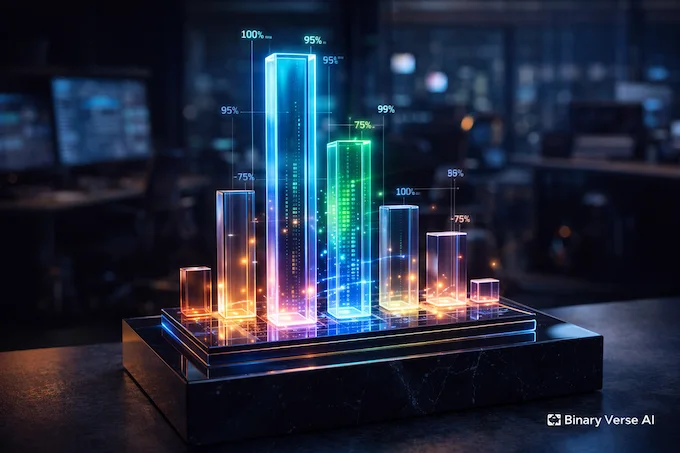
You don’t need a 30-row spreadsheet in the middle of a review. You need a shortlist that predicts real outcomes.
Table 1. Selected Benchmarks (Higher Is Better Unless Noted)
Gemini 3 Flash Benchmarks And Pricing Table
Mobile-friendly view of key evals and token pricing across Gemini, Claude, GPT-5.2, and Grok. Scroll horizontally if needed.
| Benchmark | Notes | Gemini 3 FlashThinking | Gemini 3 ProThinking | Gemini 2.5 FlashThinking | Gemini 2.5 ProThinking | Claude Sonnet 4.5Thinking | GPT-5.2Extra high | Grok 4.1 FastReasoning |
|---|---|---|---|---|---|---|---|---|
| Input price | $/1M tokens | $0.50 | $2.00 $4.00 > 200k tokens | $0.30 | $1.25 $2.50 > 200k tokens | $3.00 $6.00 /MTok > 200k tokens | $1.75 | $0.20 |
| Output price | $/1M tokens | $3.00 | $12.00 $18.00 > 200k tokens | $2.50 | $10.00 $15.00 > 200k tokens | $15.00 $22.50 > 200k tokens | $14.00 | $0.50 |
| Academic reasoning (full set, text + MM) Humanity’s Last Exam | No tools | 33.7% | 37.5% | 11.0% | 21.6% | 13.7% | 34.5% | 17.6% |
| With search and code execution | 43.5% | 45.8% | — | — | — | 45.5% | — | |
| Visual reasoning puzzles ARC-AGI-2 | ARC Prize Verified | 33.6% | 31.1% | 2.5% | 4.9% | 13.6% | 52.9% | — |
| Scientific knowledge GPQA Diamond | No tools | 90.4% | 91.9% | 82.8% | 86.4% | 83.4% | 92.4% | 84.3% |
| Mathematics AIME 2025 | No tools | 95.2% | 95.0% | 72.0% | 88.0% | 87.0% | 100% | 91.9% |
| With code execution | 99.7% | 100% | 75.7% | — | 100% | — | — | |
| Multimodal understanding and reasoning MMMU-Pro | 81.2% | 81.0% | 66.7% | 68.0% | 68.0% | 79.5% | 63.0% | |
| Screen understanding ScreenSpot-Pro | No tools unless specified | 69.1% | 72.7% | 3.9% | 11.4% | 36.2% | 86.3% with python | — |
| Information synthesis from complex charts CharXiv Reasoning | No tools | 80.3% | 81.4% | 63.7% | 69.6% | 68.5% | 82.1% | — |
| OCR OmniDocBench 1.5 | Overall Edit Distance, lower is better | 0.121 | 0.115 | 0.154 | 0.145 | 0.145 | 0.143 | — |
| Knowledge acquisition from videos Video-MMMU | 86.9% | 87.6% | 79.2% | 83.6% | 77.8% | 85.9% | — | |
| Competitive coding problems from Codeforces, ICPC, and IOI LiveCodeBench Pro | Elo Rating, higher is better | 2316 | 2439 | 1143 | 1775 | 1418 | 2393 | — |
| Agentic terminal coding Terminal-Bench 2.0 | Terminus-2 harness | 47.6% | 54.2% | 16.9% | 32.6% | 42.8% | — | — |
| Agentic coding SWE-bench Verified | Single attempt | 78.0% | 76.2% | 60.4% | 59.6% | 77.2% | 80.0% | 50.6% |
| Agentic tool use τ2-bench | 90.2% | 90.7% | 79.5% | 77.8% | 87.2% | — | — | |
| Long horizon real-world software tasks Toolathlon | 49.4% | 36.4% | 3.7% | 10.5% | 38.9% | 46.3% | — | |
| Multi-step workflows using MCP MCP Atlas | 57.4% | 54.1% | 3.4% | 8.8% | 43.8% | 60.6% | — | |
| Agentic long term coherence Vending-Bench 2 | Net worth (mean), higher is better | $3,635 | $5,478 | $549 | $574 | $3,839 | $3,952 | $1,107 |
| Factuality benchmark across grounding, parametric, search, and MM FACTS Benchmark Suite | 61.9% | 70.5% | 50.4% | 63.4% | 48.9% | 61.4% | 42.1% | |
| Parametric knowledge SimpleQA Verified | 68.7% | 72.1% | 28.1% | 54.5% | 29.3% | 38.0% | 19.5% | |
| Multilingual Q&A MMMLU | 91.8% | 91.8% | 86.6% | 89.5% | 89.1% | 89.6% | 86.8% | |
| Commonsense reasoning across 100 Languages and Cultures Global PIQA | 92.8% | 93.4% | 90.2% | 91.5% | 90.1% | 91.2% | 85.6% | |
| Long context performance MRCR v2 (8-needle) | 128k (average) | 67.2% | 77.0% | 54.3% | 58.0% | 47.1% | 81.9% | 54.6% |
| 1M (pointwise) | 22.1% | 26.3% | 21.0% | 16.4% | not supported | not supported | 6.1% |
The punchline is not that Flash is “the best.” It’s that it’s close enough to Pro-class behavior that you can justify using it as your daily driver.
4. Gemini 3 Flash Vs Gemini 3 Pro: Do You Still Need Pro?
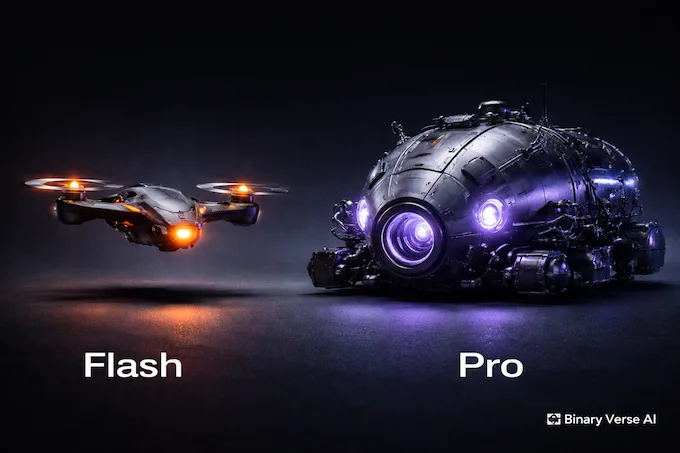
This is the decision that will show up in your architecture doc: “Gemini 3 Flash vs Gemini 3 Pro.” Think of it as default vs escalation. If your work looks like modern development, lots of small edits, lots of tests, lots of tool calls, then speed is not a nice-to-have. It’s the difference between “I use the model” and “I stop using the model because it breaks my flow.”
4.1 Where Flash Wins
- Iteration Speed: Most productivity gains come from tight loops. Generate, run, fail, fix, repeat. A fast model keeps you in the loop.
- Cost Per Finished Task: Token prices matter. Retry prices matter more. A model that lands the fix in fewer attempts is cheaper in practice.
- Agentic Workflows: Tool use is the new baseline. A model that can build AI trading bot capabilities, plan steps, call tools, and recover from errors is worth more than a model that merely writes pretty text.
4.2 Where Pro Still Wins
Pro earns its keep when you push into edge territory:
- Ultra-long context reliability when your prompt becomes huge and messy
- The last few percent of reasoning depth on hard, adversarial problems
- Voice and style control for longform creative outputs
My recommendation: default to Flash, escalate to Pro when the task is both hard and expensive to get wrong.
5. Pricing Analysis: Is The Cost Hike Worth It?
Now we talk money, because money is where opinions go to die. The headline Gemini 3 Flash pricing is $0.50 per 1M input tokens and $3.00 per 1M output tokens. Compared to the Gemini 2.5 Flash price at $0.30 input and $2.50 output, yes, it went up. Compared to Gemini 3 Pro, it’s still a different universe.
5.1 Table: Pricing Snapshot
Table 2. Pricing Snapshot (USD Per 1M Tokens)
Gemini 3 Flash Token Pricing Comparison
Input and output costs per 1M tokens, including higher-rate tiers where noted.
| Model | Input | Output |
|---|---|---|
| Gemini 3 Flash | $0.50 | $3.00 |
| Gemini 3 Pro | $2.00 (>$200k: $4.00) | $12.00 (>$200k: $18.00) |
| Gemini 2.5 Flash | $0.30 | $2.50 |
| Gemini 2.5 Pro | $1.25 (>$200k: $2.50) | $10.00 (>$200k: $15.00) |
| Claude Sonnet 4.5 | $3.00 (>$200k: $6.00) | $15.00 (>$200k: $22.50) |
| GPT-5.2 | $1.75 | $14.00 |
The verdict is not “cheap” or “expensive.” It’s “does it reduce total cost to solution.” If Flash cuts retries and reduces human review, that dominates the token delta fast.
6. Coding Capabilities: The New King Of “Vibe Coding”?

The most important change in 2025 is not that models write code. It’s that models sit in the middle of an iterative development loop. You describe the intent. It proposes a patch. You run tests. You paste the error. You repeat until green. This is the Cursor style workflow, and it punishes latency.
That’s why the SWE-bench pro GPT5 Claude Gemini rankings and the 78% score matter. At 78%, Gemini 3 Flash is credible for multi-step agentic coding, not just snippets. It can keep up with fast feedback loops without turning your day into a waiting room.
This is also where the Gemini 3 Flash API becomes the real product. Put it in your editor, wire it to your CI logs, let it draft the fix, then let it explain the fix. Treat it like plumbing, not like a demo.
7. Comparison: Flash Vs GPT-5.2 And Claude Opus 4.5
If you want a single winner, you’ll be disappointed. If you want a sane buying guide, here it is.
7.1 Flash Vs GPT-5.2
The “Is GPT 5.2 better than Gemini 3” question is really a question about peak reasoning vs throughput. GPT-5.2 still looks like the ceiling on some deep reasoning and agentic evaluations. It’s also priced like a premium tool. If you only need that ceiling occasionally, it makes sense as an escalation model.
In contrast, Grok 4 Heavy review and Gemini 3 Flash discussions show that Flash is engineered to be always-on. It’s the one you can afford to run for every prompt that comes in, then reserve the heavyweight call for the small slice of work that truly needs it.
7.2 Flash Vs Claude Opus 4.5
Claude’s strength is still voice and instruction fidelity. For planning, writing, and a certain kind of product thinking, it can be excellent. The pressure point is agentic coding and tool use at scale. When Flash-class models get this capable, they force you to justify paying premium rates for routine workflows.
8. Real-World Use Cases: Beyond The Benchmarks
The Gemini 3 Flash model card’s intended usage list is refreshingly grounded: agentic workflows, everyday coding, reasoning and planning, and multimodal analysis. That’s basically what people actually do.
Here are the places where Gemini 3 Flash is a practical upgrade, even if you never read another leaderboard.
8.1 Agentic Workflows
- Ops and incident triage: summarize logs, propose next steps, draft a checklist a tired human can follow.
- Business automation: take messy requests, turn them into structured actions, call tools, report results using an agentic AI tools best frameworks guide.
- Research-to-action: digest a long document set, then produce an implementation plan with ChatGPT Atlas.
8.2 Multimodal Work
If your inputs include PDFs, screenshots, or short clips, multimodal competence stops being a novelty. It becomes the difference between “the model saw the problem” and “the model guessed.”
8.3 Limits You Still Need To Design For
The model card includes safety and evaluation notes, including automated safety metrics and a discussion of red teaming and frontier safety assessment. In practice, you should still expect:
- Confident mistakes, especially in long, noisy contexts
- Drift when instructions conflict
- Occasional tool misuse unless you validate outputs
Build with verification, not blind trust.
9. How To Access Gemini 3 Flash
Access matters because it determines adoption. The Gemini API documentation says distribution is similar to Pro.
For developers, the key entry points are Google Gemini 3 AI Studio for testing and iteration, plus the Gemini 3 Flash API for production. For enterprises, the same family shows up through managed platforms where Google Gemini Enterprise pricing and spend controls exist.
For regular users, it being a default in the app and product surfaces is the real strategic move. Defaults reshape habits.
10. Community Reaction: Is OpenAI “Cooked”?
Memes aside, the interesting community shift is psychological. People are no longer assuming that the best experience must be slow and expensive. When a fast model is this competent, it changes what developers expect from the baseline. That forces everyone else to respond, whether through pricing, bundling, or a new generation of “small models that do not feel small.”
Check our best LLM for coding 2025 list to see how it stacks up against others.
11. Conclusion: The New Default Model
Here’s the clean take. Use Gemini 3 Flash for your default workflow. Keep Pro as your safety valve for the hardest cases.
If you build products, measure the real metrics: end-to-end latency, retries per task, human review time, and cost per shipped change. If Flash wins those, it wins the only benchmark that matters.
If you’re deciding today, do one simple test. Open a real repo, a real dataset, or a real PDF, then run a 30-minute “build something” session in Google AI Studio. If you end the session feeling like you stayed in flow, you just found your new default.
Would you like me to help you set up an agent using the AgentKit guide or explore specific ChatGPT agent use cases for your business? We also have a specialized MedGemma guide if you are working in healthcare.
Is Gemini 3 Flash better than Gemini 3 Pro?
Yes and no. Gemini 3 Flash is usually the better pick for speed, cost, and high-frequency “agent loop” work, and it edges Pro on SWE-bench Verified (78.0% vs 76.2%). Gemini 3 Pro can still be worth it for the hardest cases, especially when you need extra headroom and long-context consistency.
Is Gemini 3 Flash free to use?
For most people, yes. Gemini 3 Flash is rolling out broadly in consumer experiences (like the Gemini app), while developers pay for usage through the Gemini API pricing tiers. If you’re building, assume “free in-app” and “metered via API.”
How good is Gemini 3 Flash for coding?
It’s strong enough to be a default coding model. Gemini 3 Flash scores 78% on SWE-bench Verified, which is a major signal for agentic coding, debugging loops, and tool-driven fixes. In practice, low latency plus solid reasoning is what makes it feel “productive,” not just “smart.”
Is GPT-5.2 better than Gemini 3 Flash?
Depends on what you optimize for. GPT-5.2 can win on peak reasoning and some frontier evals, but Gemini 3 Flash is built to win on throughput economics, latency-sensitive workflows, and “good enough to ship” reliability at a lower per-task cost. Many teams will route defaults to Flash, then escalate when needed.
When is the Gemini 3 Flash release date?
Gemini 3 Flash launched Dec 17, 2025, and is available in Preview across Google’s developer surfaces (including AI Studio and the Gemini API) alongside broader rollout in Google products.