The patch backlog isn’t a to-do list, it’s a trench. Every week new vulnerabilities spill in faster than human teams can triage, reproduce, and fix. If you maintain popular libraries, you already know the drill: alerts at 3 a.m., a partial repro on a flaky CI run, and a risk window that stretches from hours to weeks. This is the setting for the system, Google CodeMender if you prefer the full label, an AI agent for security that doesn’t stop at red flags. It proposes, tests, and lands fixes. The aim is simple, ship safer code faster and spend your engineering time on product, not whack-a-mole.
This article is a field guide written by an engineer who has been on both sides of the pager. We’ll unpack what the system is, how it works under the hood, why the Gemini Deep Think stack matters, and how it fits a broader push in AI in cybersecurity. Along the way we’ll look at concrete examples, a compact table, and a playbook you can adopt today. Stick around to the end. You’ll leave with a plan for using AI for code security without handing your codebase to magic.
Table of Contents
1. The Why, The Unwinnable Race Of Manual Patching
Modern security tooling is great at finding trouble, less great at finishing the job. Fuzzers blast inputs until something crashes. Static analysis flags risky patterns. Linters and SAST dashboards create tidy lists. Then humans take over. The hard part isn’t spotting a heap overflow. The hard part is threading a correct, minimal fix through a complex code path, proving it with tests, and getting it upstreamed before attackers weaponize it. Teams end up drowning in findings because discovery scales, while repair remains artisanal.
This gap is the reason the tool exists. Instead of throwing more alerts at tired people, it pushes the workflow forward. It starts at a symptom, traces to a root cause, drafts a patch, validates that patch against unit and property tests, and offers a pull request that a maintainer can review with confidence. In short, it moves the bottleneck from human cognition to automated validation.
2. CodeMender Explained, A Proactive And Reactive Defense
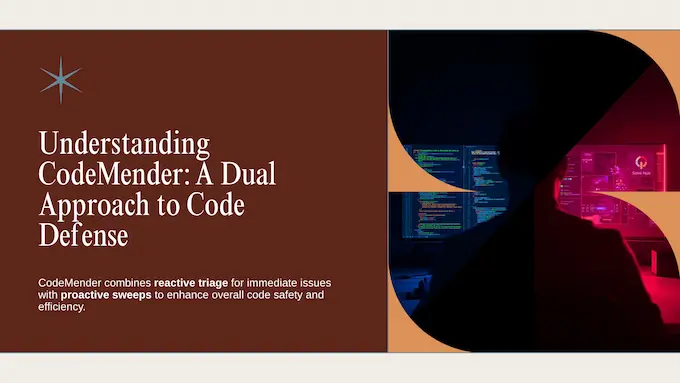
Think of the system as a two-mode teammate. In reactive mode, it analyzes a fresh report, reproduces the issue, and proposes a patch that closes the vulnerability with minimal disruption. In proactive mode, it sweeps a codebase for entire bug classes and replaces brittle patterns with safer ones. This combination matters because software rarely fails in isolation. The first fix buys time. The proactive pass removes the root pattern so the same mistake doesn’t come back under a new filename.
The early track record isn’t fluff. In six months the team has upstreamed 72 security fixes to major open source projects, spanning codebases in the multimillion-line range. That volume tells you something important. This isn’t a toy demo that only works on tiny repos. It’s built to navigate real-world complexity and to collaborate with maintainers instead of bulldozing them. That level of evidence is where CodeMender earns trust from maintainers.
2.1 Reactive Defense, Shrink The Risk Window
When a vulnerability drops, the clock starts. CodeMender triages the input, instruments the failing path, and searches for the smallest correct change. It favors surgical edits, not rewrites. That lowers review friction and reduces the chance of collateral damage in neighboring modules.
2.2 Proactive Defense, Delete Whole Bug Classes
In proactive sweeps, CodeMender hunts for insecure idioms and swaps them for safer constructs. Think unbounded buffers replaced with bounds-checked types, or custom allocators wrapped by hardened APIs. The goal isn’t perfection. The goal is to raise the floor across thousands of call sites so a single missed check can’t echo through the system.
3. Under The Hood, The Gemini Deep Think Engine

Under the banner of Gemini Deep Think, the system pairs large-scale reasoning with a serious tool belt. It isn’t a chatty assistant that guesses from text alone. It’s an agent that reads code, runs it, debugs it, and argues with itself when evidence contradicts its first idea. The tool stack includes static analysis to reason about control and data flow, dynamic analysis to observe real executions, fuzzing to widen coverage, and SMT-backed checks to prove properties when tests can’t.
For CodeMender, credibility is everything. A patch that compiles isn’t automatically safe. By coupling reasoning with grounded signals, the agent resists the temptation to hallucinate fixes. It only surfaces a candidate when automated validators give it a green light across correctness, regressions, and style.
4. More Than One Brain, A Multi-Agent System In Practice

Security work is a team sport. CodeMender reflects that through multi-agent systems that split responsibilities. A scout agent localizes the defect. A builder agent drafts the patch. A critic agent acts like an automated peer reviewer. It compares old and new behavior, checks side effects, and flags any regressions. If something looks off, the critic sends the builder back with precise notes. The result feels like a tight feedback loop between reviewers who never get tired.
The critic role is crucial. Many bad fixes “solve” a crash by trimming inputs or papering over undefined behavior. The critic prevents that by requiring an explanation anchored to the real root cause and by exercising the patch against both unit and property tests. When the critic is satisfied, humans are far more willing to accept the change.
5. CodeMender In Action, From Root Cause To Self-Correction
Stories beat slogans, so let’s walk two concrete cases.
Example 1, Root Cause Analysis. A report shows a heap overflow. The naive fix would add a bounds check near the crash site. CodeMender follows the trace further. The overflow is the symptom. The cause is a broken stack discipline in an XML parser that mismanages nested elements. The agent proposes a patch that repairs the stack logic and adds a property test that would have caught the problem earlier. The result isn’t only a stable build. It’s a parser that respects its own invariants.
Example 2, Proactive Rewriting. A popular image library needs guards against buffer mis-use across a wide surface. CodeMender annotates hot paths with compiler-enforced bounds safety, then refactors local utilities to accept safer types. With the new annotations, entire classes of memory corruption bugs simply fail to compile. That’s the kind of leverage maintainers dream about, because it trades late-night firefighting for a one-time guardrail.
6. A Compact Playbook, How To Work With CodeMender
You don’t need to wait for a hosted product to borrow the ideas. Here’s a minimal playbook that fits most teams.
- Start With Evidence. Wire your CI to capture crash inputs, sanitizer logs, and failing tests as first-class artifacts. Feed those to an agent instead of pastebin text.
- Optimize For Small Changes. Encourage patches that modify the fewest lines needed to fix the root cause. Small diffs review faster and revert cleanly if needed.
- Add Property Tests. When a bug reflects a broken invariant, encode that invariant in a test so the mistake can’t return under a new guise.
- Use Safer Defaults. Adopt bounds-checked containers, lifetime helpers, and audited wrappers. The best fix is the one you can no longer accidentally remove.
- Keep Humans In The Loop. Let agents draft and validate. Keep maintainers as final approvers. This preserves accountability and raises trust.
6.1 Tooling Table, From Findings To Fixes
| Step | Manual Workflow | With CodeMender |
|---|---|---|
| Localize Bug | Skim logs, reproduce in dev, add prints | Trace with instrumented runs and targeted analysis |
| Draft Patch | Rely on individual expertise | Builder agent proposes minimal, testable change |
| Validate | Run unit tests by hand, hope CI passes | Critic agent runs regression checks and property tests |
| Generalize | File a ticket to clean up later | Proactive sweep replaces insecure patterns project-wide |
| Upstream | Open PR and wait for reviews | Open PR with evidence bundle for faster acceptance |
7. Availability, Where Things Stand Today
Right now, CodeMender sits inside a research pipeline with real humans in the final seat. Patches drafted by the agent go through automated checks, then land in a human review queue. The team has been sending accepted fixes to important open source projects to build credibility and to stress test the workflow in the wild. That’s the correct posture for security work, move fast, verify faster, and listen to maintainers.
Public release will come in stages. Expect production-ready components to ship before a push-button “fix my repo” experience. That’s healthy. Good security culture grows from proven tools, transparent logs, and clear escape hatches, not from one-click magic.
8. Strategy, How This Fits The Larger Security Picture
The agent isn’t an isolated gadget. It pairs with a broader strategy that includes updated guidance on securing AI agents and a dedicated program that rewards high-impact vulnerability reports in AI contexts. The message is consistent. Defense should be proactive, measurable, and shared. When safer defaults become common practice, everybody wins, including small projects that can’t afford a full-time security team.
From a practitioner’s view, the important shift is mindset. We’ve spent years scaling discovery with better scanners. The next decade belongs to automated vulnerability patching that scales repair with the same rigor. CodeMender is an early proof that this is possible on real software, not just in clean lab exercises.
9. Engineering Notes, Why This Approach Works
Three ideas carry most of the weight..
- Reason Over Ritual. The agent earns trust by tying each change to evidence. Logs, traces, and tests aren’t decorations. They’re the argument.
- Small Diffs, Large Effects. The system prefers the smallest fix that closes the hole. That keeps history readable and keeps scars shallow when a revert is necessary.
- Critique As A First-Class Step. Automated review isn’t a rubber stamp. It’s an adversary with a checklist. That pressure produces higher-quality patches and teaches the builder to aim for root causes instead of symptoms.
10. Field Impact, What Maintainers Will Notice First
If you run an open source project, the first thing you’ll feel is time returning to your day. Incoming fixes arrive with a narrative, where the bug lives, why the change is correct, how it was validated, and what new tests were added. That makes review faster and safer. Over a quarter, your issue tracker changes shape. There are fewer urgent fire drills and more steady work replacing old idioms with safer defaults.
If you run a product team, you’ll notice incident reviews getting shorter. Instead of debating who should have noticed the risky pattern, the discussion shifts to adopting the safer API everywhere and letting the agent write most of those diffs. Risk windows shrink. Rotations burn out less. The culture gets calmer.
11. Responsible Use, Guardrails You Should Keep
AI is powerful, and power needs guardrails. Put these three in place.
- Log Everything. Store prompts, patches, tests, and validator outputs. You need a paper trail when a change behaves badly in production.
- Gate On Tests. No patch ships without passing unit, integration, and property tests that reflect the security claim. If you lack tests, write them before you merge.
- Respect Maintainers. Never bypass code owners. AI should reduce toil, not erase stewardship.
12. Getting Started, A Practical On-Ramp
You can pilot the philosophy today with tools you already have.
- Enable sanitizers in debug builds, then fail fast in CI when anything triggers. Feed the artifacts to an analysis agent.
- Define a short template for security PRs. Require a root cause summary, a minimal diff, and at least one new property test.
- Schedule quarterly proactive sweeps on a module that scares you. Replace foot-guns with safer wrappers and let an agent shoulder the boring edits.
These habits make you ready for a future where agents like CodeMender plug in cleanly and deliver value on day one.
13. The Takeaway, Tip The Scales Toward Defenders
Attackers automate. Defenders must too. That’s the blunt truth at the center of this story. With systems like CodeMender, the industry can compress the time from bug report to safe release, and it can erase whole categories of mistakes by raising the default safety of our building blocks. The point isn’t to replace engineers. The point is to give them leverage and time.
If this resonates, do one thing before you close this tab. Pick a brittle module, write the property tests you wish you had last year, and start a small proactive sweep. When the hosted product arrives, you’ll be ready to slot CodeMender into a workflow that respects evidence and ships secure code faster. Security is a race. Let’s start winning more of the laps.
Q1. What is Google’s CodeMender and how does it work?
CodeMender is an AI agent for code security that detects vulnerabilities, generates patches, validates them with automated checks, and submits fixes for human review. It works reactively on new bugs and proactively by rewriting insecure patterns to remove entire classes of flaws.
Q2. Is CodeMender a single AI model or a multi-agent system?
CodeMender runs as a multi-agent system. One agent finds root causes, another drafts patches, and a critique agent reviews changes to prevent regressions and ensure code quality before human sign-off.
Q3. How does CodeMender use “Gemini Deep Think” to fix vulnerabilities?
CodeMender leverages Gemini Deep Think for advanced reasoning, then pairs it with static and dynamic analysis, fuzzing, differential testing, and SMT-style checks. This combination helps the agent pinpoint root causes and propose minimal, correct fixes.
Q4. Is CodeMender available to the public for free?
Not yet. CodeMender is currently used within Google’s research pipeline with all patches reviewed by humans. The team is upstreaming fixes to open-source projects and plans a broader release after measured testing.
Q5. How is CodeMender different from other AI code security tools like GitHub Copilot?
Copilot is a general coding assistant. CodeMender is purpose-built for security, operates as a multi-agent system, validates its own patches, and has already contributed dozens of vetted fixes to major open-source projects.