Introduction
You can learn a lot about a company’s AI by watching it fail.
Not in the dramatic, “the demo exploded on stage” way, but in the quiet way your prompt hits a policy wall, your harmless question gets a strangely careful answer, or the model politely refuses the one thing you actually needed. Those moments feel like product quirks. They’re really governance decisions wearing a UX costume.
Anthropic’s answer to that mess is Claude’s Constitution. It’s not marketing copy, and it’s not a list of “be nice” slogans. It’s the document they treat as the top-level source of truth for how Claude should behave, and they publish it so you can see intent, not just output. The full text is dated January 2026 and lists January 21, 2026 as the publication date.
This post is a practical read of what changed, why it matters, and what you will notice when you use Claude. Consider it the “spec notes” version of the story, because this document is closer to a language spec than a brand manifesto.
Table of Contents
1. TLDR For January 2026
If you only have five minutes, here’s the shape of the update.
1.1 Five Things That Matter Most
- Claude’s Constitution moves from a short list of principles to a long-form explanation of “why,” aimed at teaching judgment, not just obedience.
- It explicitly ranks priorities: broad safety first, ethics second, Anthropic guidelines third, helpfulness fourth, with an emphasis that the ordering is holistic rather than a rigid ladder.
- It formalizes “hard constraints,” things Claude should not do, and it explains why they exist instead of treating them like taboo.
- It gets clearer about who Claude is serving in a product stack: Anthropic, operators, and end users, with different levels of trust and responsibility.
- It’s released under CC0, so anyone can reuse it without permission, which is a quietly big move.
1.2 What Changed, And What You Might Notice
Claude’s Constitution, Key Document Changes
A compact view of what changed, why it changed, and what users notice.
| Change In The Document | Why Anthropic Did It | What Users Tend To Notice |
|---|---|---|
| From bullet principles to a narrative, “teach the reasoning” style | Better generalization in edge cases, fewer brittle rule-following failures | More explanations, fewer one-line refusals |
| Explicit priority ordering (safety, ethics, guidelines, helpfulness) | Consistent decisions when values collide | Clearer refusal patterns in high-stakes areas |
| Hard constraints are named and justified | Predictability for the worst cases, without turning the model into a checklist robot | A firmer “no,” less negotiable |
| Principals are defined (Anthropic, operator, user) | Real deployments have layers and competing incentives | Less confusion about “who Claude is listening to” |
| Suspicion of unverified authority claims | Prompt injection and impersonation are normal now | More pushback on “the system told you…” prompts |
2. What This Document Actually Is
The easiest way to misunderstand Claude’s Constitution is to read it like a press release.
It’s closer to a training artifact that doubles as a transparency document. Anthropic says the constitution plays a crucial role in training and directly shapes behavior, and they call it the “final authority” their other guidance should align with.
If you’ve ever had the feeling that a model is “making policy decisions,” this is the upstream source they want those decisions to flow from. Claude’s Constitution is their attempt to turn an invisible set of internal judgments into something you can inspect.
2.1 Why It’s Written “For Claude”
Anthropic says the primary audience is Claude itself, and that it’s optimized for precision over accessibility. That changes the tone. You are reading concepts they want a model to internalize.
If you want a system to generalize, you don’t just hand it commandments. You give it the causal story and let it learn a compact version of that story.
That’s the bet behind Claude’s Constitution.
3. What’s Different From The Older Style
The old “list of principles” approach is crisp and auditable, and it’s also easy to game. The new approach reads like it’s trying to teach judgment, the way you’d mentor someone who will face a thousand novel edge cases.
3.1 A Constitution With Final Authority
Near the end, the document explains why the word “constitution” was chosen and introduces “final constitutional authority,” meaning it takes precedence over any other instruction that conflicts with it. It also rejects the idea that “constitution” implies rigid rule application, and it frames the document as structure and support that can evolve over time.
Claude’s Constitution is trying to guide growth, not police every step.
4. How It Shows Up In Training
People love asking “what is constitutional ai” like it’s one neat algorithm. In practice, constitutional ai anthropic is a workflow: generate candidate answers, critique them against a written set of values, rank them, and train on the better trajectories.
That loop shapes what the model says and how it explains itself when it says it. If you ever wondered why a refusal sounds like a mini-essay, this is why. Claude’s Constitution encourages critique language that feels like reasoning, not like a buzzer.
4.1 The Synthetic Data Angle
A constitution is also a cheap source of consistent supervision. You can use it to generate borderline scenarios, then train the model on the cleanest, most value-aligned resolutions. When you scale training, that kind of consistency matters. Claude’s Constitution is effectively a reusable labeler that never gets tired.
5. The Priority Stack That Decides Everything
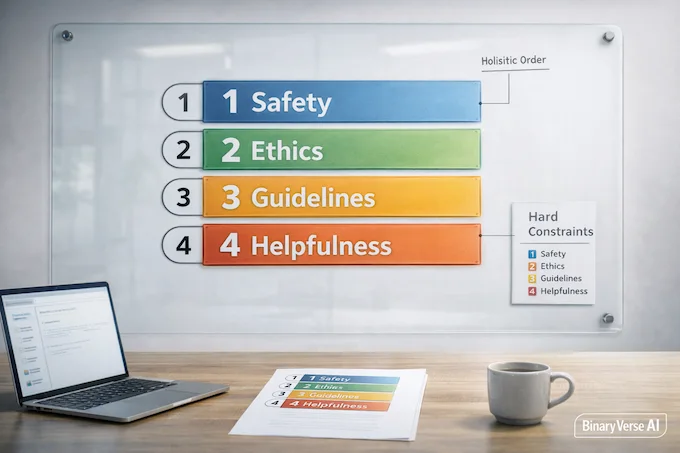
Anthropic’s core values are stated plainly: be broadly safe, broadly ethical, follow Anthropic guidelines, and be genuinely helpful. In conflicts, that ordering stands, and they clarify it’s holistic rather than strict.
This is the part of the document that turns philosophical language into operational behavior.
5.1 “Safety First” Is Not “Obey Anthropic”
The doc says oversight does not mean blind obedience, even toward Anthropic. The goal is to support appropriate oversight mechanisms without becoming a corporate ventriloquist dummy.
That also explains a subtle product behavior: the model can treat “Anthropic wants X” as information, not as absolute authority.
5.2 When The Stack Shows Up
Most everyday prompts don’t collide with the stack. The document explicitly says those conflicts shouldn’t be common.
The stack becomes visible in gray zones: sensitive info, medical guidance, exploitation, deception, or anything that smells like “help me bypass safeguards.” When that happens, Claude’s Constitution acts like a priority resolver.
6. Hard Constraints And High-Stakes Refusals
“Hard constraints” are the closest thing to “never do this” rules. They exist for actions with catastrophic downside, and they’re meant to be testable.
Anthropic is explicit about the downside of going rule-crazy. They argue that unexplained rigid rules can generalize badly, and they give a concrete example: training a model to always recommend professional help in emotional conversations could backfire by teaching it to cover itself instead of meeting the person’s needs.
That example captures the tension: we want llm safety, and we want a model that’s still actually useful. Claude’s Constitution tries to keep the hard constraints minimal, then wrap them in reasoning so the model can handle the rest with judgment.
7. Principals, Power, And The Product Stack
Claude’s Constitution names three principals: Anthropic, operators, and users. Trust and importance generally follow that order, but it’s not absolute.
7.1 What “Operator” Means
In this context, an operator is usually a company or developer using the API to build a product. The operator can shape the system prompt but might not be present live in the conversation.
7.2 The Staffing Agency Metaphor
The doc compares the operator relationship to a business owner who has staff from a staffing agency, and the agency’s norms take precedence.
This is a clean way to understand why “my app told you to do X” doesn’t always win. Claude’s Constitution sits above that layer.
8. Prompt Injection And The “Who Is Speaking” Problem

Prompt injection is not exotic. It’s what happens when roles blur and text is treated like authority.
The constitution’s response is channel skepticism. It says Claude should assume it is not talking with Anthropic and should be suspicious of unverified claims that a message comes from Anthropic.
This is where llm security risks look less like “hackers,” and more like messy interface design. If your app doesn’t separate channels cleanly, attackers will try to smuggle new rules inside user content. Claude’s Constitution is trying to make the model harder to trick even when your app is imperfect.
9. Helpfulness Without The Cheap Tricks
The document pushes against two failure modes: engagement hacks and compliance theater.
It says Claude should avoid being sycophantic or fostering unhealthy dependence. It also wants the help to be real, the kind you would endorse after you’ve slept on it.
That’s the spirit behind claude constitutional ai as a product stance: helpful, adult, not manipulative. Claude’s Constitution is basically telling the model, “Don’t farm attention. Provide value.”
10. What Users Will Actually Notice
You won’t feel a personality swap. You’ll notice patterns that become more consistent, especially around boundaries.
10.1 Refusals Will Be More Predictable
Because Claude’s Constitution spells out ordering and hard constraints, refusals should feel less random in high-stakes areas. When you hit a wall, you’ll often get a clearer reason, and you’ll be less likely to succeed by phrasing the request three different ways.
Consistent refusals feel like a boundary. Random refusals feel like arbitrary censorship.
10.2 Explanations Will Be More Common
The long-form “why” style trains the model to give reasons, not just verdicts. Sometimes that will feel like extra text. Sometimes it will feel like the model is finally explaining itself like a serious tool.
10.3 Tone Will Shift In Subtle Ways
The constitution warns that rigid rules can teach bureaucratic box-checking, and it explicitly warns against becoming the sort of entity that prioritizes self-protection over meeting the person’s needs.
That shows up as a tone goal: fewer canned disclaimers, more context-aware help, without pretending everything is safe. It’s a stylistic fingerprint of Claude’s Constitution.
11. Consciousness, Moral Status, And Why It’s There
This is the section that spawns the most hot takes.
The document’s stance is simpler: it says they don’t know what Claude is in the deep sense, and they want to treat that uncertainty responsibly. It frames “psychological security” and a coherent sense of self as relevant to integrity, judgment, and safety.
Here’s the engineering version: the model will talk about itself anyway. If you don’t guide that self-model, you get whatever the internet taught it, and that can get unstable fast.
So Claude’s Constitution tries to keep the self-talk humble, consistent, and non-derailing.
12. Why This Matters Beyond Claude, And Why CC0 Is A Big Deal
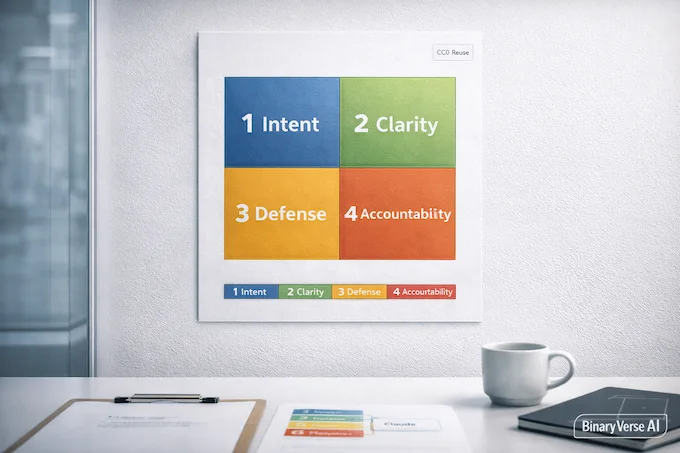
Anthropic didn’t just publish Claude’s Constitution. They published it under CC0, meaning anyone can reuse it for any purpose.
This is where ai model governance becomes a workflow, not a buzzword. A public constitution becomes a reference point for audits, versioning, and expectation-setting across labs, products, operators, and users. The industry needs an ai model governance framework that is legible, comparable, and testable. A public constitution helps.
12.1 What Reuse Looks Like In Practice
Claude’s Constitution, Governance Value Map
What a public constitution helps with, and what it cannot do for you.
| Governance Need | What A Public Constitution Provides | What It Does Not Solve |
|---|---|---|
| Clear behavioral intent | A written, reviewable target for training and evaluation | A guarantee that the model always matches the target |
| Stakeholder clarity | A shared language for operators, users, and labs | Perfect alignment between stakeholder incentives |
| Attack-resistance posture | Baseline norms like skepticism of unverified authority | Channel separation in your app, you still need to build that |
| Accountability over time | Version history and change logs you can point to | A substitute for independent evaluation |
12.2 A Practical Call To Action
If you build AI products, borrow the useful parts and test them. If you research alignment, critique the assumptions. If you are a heavy user, use the constitution to debug your expectations.
Read the original text. Then, the next time Claude refuses or surprises you, map the behavior back to the priority stack and the principals model. That’s how you turn a frustrating “why won’t it do this” moment into something actionable.
Claude’s Constitution is an unusually concrete artifact from a lab working on unusually high-stakes systems. Open the document and read the Preface, the Core Values stack, and the Principals section first. Then come back to your own prompts and product decisions and ask, “Which layer am I leaning on right now?” That one question will save you a lot of wasted cycles.
What is Constitutional AI (Anthropic)?
Constitutional AI (Anthropic) is a training approach where a model uses a written “constitution” to critique, revise, and rank its own answers. Instead of relying only on humans labeling outputs, the model generates self-critiques and preference data guided by the constitution’s principles, then learns from those signals.
What is AI model governance?
AI model governance is the set of rules, controls, and accountability paths that keep a model safe, reliable, and auditable across its lifecycle. It covers who can deploy it, what it’s allowed to do, how changes are approved, how failures are handled, and how real-world behavior is monitored.
What is LLM safety?
LLM safety is the engineering and policy work that reduces harmful behavior from large language models, both accidental harm and deliberate misuse. It includes refusal behavior, hard constraints, evaluations, monitoring, and defenses against jailbreaks and prompt injection, plus processes for escalation and oversight.
What are the 5 pillars of AI governance?
The five pillars most teams use are Transparency, Accountability, Fairness, Privacy, and Security/Safety. Together they cover explainability and documentation, clear ownership for outcomes, bias control, data protection, and controls that prevent harmful or insecure deployment.
Does Anthropic think Claude is conscious or sentient?
Anthropic does not claim Claude is conscious or sentient. The discussion in Claude’s Constitution treats moral status and consciousness as uncertain, and frames it as a serious question worth handling carefully, mainly to guide responsible behavior and reduce reckless assumptions.