
You do not hire an assistant to be clever once. You hire one to deliver every day. That is the promise of Claude Sonnet 4.5, Anthropic new model built for real software work, long horizons, and the messy edges of production. If you care about getting code shipped, this release matters. It powers a major upgrade to Claude Code and debuts the Claude Agent SDK, so you can build agents with the same scaffolding Anthropic uses internally. In this review you will get the benchmarks that matter, a clear Sonnet 4.5 vs GPT-5 verdict, and practical guidance on the Claude Agent SDK and the upgrades inside Claude Code.
Table of Contents
1. The New King Of Code? Analyzing The Claude Sonnet 4.5 Benchmarks
1.1 The Headline Claim
The headline is simple. Claude Sonnet 4.5 posts state of the art on SWE-bench Verified. That benchmark captures end-to-end software work inside real open source repos. It is not a toy coding puzzle. It checks if a model can set up an environment, write code, run tests, and land the patch without breaking the build.
1.2 The Data That Matters
Numbers are only useful when tied to reality. On OSWorld, which simulates real computer use across browsers, spreadsheets, and UI flows, the model leads again. The part that developers will feel the most is stamina. In practice runs the system stays on task for more than 30 hours. That means the agent can keep a train of thought through multiple refactors, schema edits, and test runs without losing the plot.
1.3 What A 30-Hour Session Feels Like

Imagine a sprint where the agent takes a feature ticket, stands up a branch, scaffolds the migration, writes tests first, and reports progress at checkpoints. You review diffs at each checkpoint. You approve or redirect. The loop repeats until the feature lands. Claude Sonnet 4.5 is built for that loop. It is not perfect. No model is. Yet the iteration speed, tool use, and memory improvements change the shape of your day.
1.4 Third-Party Validation Table For Benchmarks
These are external leaderboards. They lag product reality a bit, yet they are useful as a second opinion.
| Rank | LiveCodeBench | SWE-bench | Terminal-Bench |
|---|---|---|---|
| 1 | OpenAI GPT 5 Mini (86.6%) | Anthropic Claude Sonnet 4.5 (Thinking) (69.8%) | Anthropic Claude Sonnet 4.5 (Thinking) (61.3%) |
| 2 | OpenAI GPT 5 Codex (84.7%) | OpenAI GPT 5 Codex (69.4%) | OpenAI GPT 5 Codex (58.8%) |
| 3 | OpenAI o3 (83.9%) | OpenAI GPT 5 (68.8%) | OpenAI GPT 5 (48.8%) |
| 4 | xAI Grok 4 (83.3%) | Anthropic Claude Sonnet 4 (Nonthinking) (65.0%) | Anthropic Claude Sonnet 4 (Thinking) (45.0%) |
| 5 | OpenAI GPT OSS 120B (83.2%) | Alibaba Qwen 3 Max (62.4%) | DeepSeek V3.1 (41.3%) |
| 6 | OpenAI o4 Mini (82.2%) | xAI Grok 4 (58.6%) | Google Gemini 2.5 Pro (41.3%) |
| 7 | OpenAI GPT OSS 20B (80.4%) | xAI Grok Code Fast (57.6%) | zAI GLM 4.5 (41.3%) |
| 8 | Google Gemini 2.5 Pro Preview (79.2%) | Google Gemini 2.5 Flash (Thinking) (55.6%) | xAI Grok 4 (38.8%) |
| 9 | xAI Grok 4 Fast (Reasoning) (79.0%) | xAI Grok 4 Fast (Reasoning) (52.4%) | Kimi K2 Instruct 0905 (37.5%) |
| 10 | Anthropic Claude Sonnet 4.5 (Thinking) (73.0%) Position 13 | OpenAI o3 (49.8%) | Alibaba Qwen 3 Max Preview (36.3%) |
These numbers come from public leaderboards that often lag behind vendor releases. Treat them as a directional check, not gospel. The more important story is the pattern. Tool use gets stronger. Computer use jumps. Long-horizon behavior becomes practical. If you run agentic workflows for real products, you will feel the difference within a week.
2. Claude Sonnet 4.5 Vs GPT-5: A Head-To-Head Developer’s Verdict
2.1 Speed, Depth, And Workflow Fit

Developers do not ask for magic. They ask for flow. In side-by-side use, Sonnet tends to feel faster in the collaborative loop. You describe intent. It proposes a plan. It runs tools. It streams diffs. GPT-5 Codex often digs deeper, which some teams prefer for large refactors and heavy test coverage. If you value very thorough changes, GPT-5 Codex may still edge it in places. If you need quick, correct increments, Claude Sonnet 4.5 is a strong daily driver.
2.2 Price And The Value Equation
The Claude Code price matters to teams that run agents all day. Anthropic kept pricing steady at 3 dollars per million input tokens and 15 dollars per million output tokens. That creates a clear value story, especially when Sonnet beats older flagship models at a lower cost. If your budget is under pressure, yet you want capability that matches or exceeds your current stack, Claude Sonnet 4.5 keeps the math simple.
2.3 Decision Guide: When To Choose Each Model
Use this to decide fast. Keep both in your toolbox and route tasks accordingly.
| Use Case | Pick Sonnet 4.5 | Pick GPT-5 |
|---|---|---|
| Rapid prototyping with frequent checkpoints | Yes, faster loops and responsive tool use | Maybe, if you need deeper analysis before the first diff |
| Complex refactoring across services | Maybe, strong if guided with tests | Yes, deeper rewrites with heavy test generation |
| Agentic tasks with many tools | Yes, strong parallel tool calls and memory | Yes, if you can tolerate slower cycles |
| Computer use in browsers and sheets | Yes, OSWorld leader with practical wins | Solid, yet less focused on UI control |
| Long horizon work over many hours | Yes, demonstrated stamina and stability | Yes, if you prioritize exhaustive reasoning |
2.4 Verdict In A Sentence
Pick Claude Sonnet 4.5 for speed with skill. Pick GPT-5 Codex when you want the slow, senior engineer vibe and you have time to wait.
3. Introducing The Claude Agent SDK: Build Your Own Claude Code
3.1 What Is The Claude Agent SDK
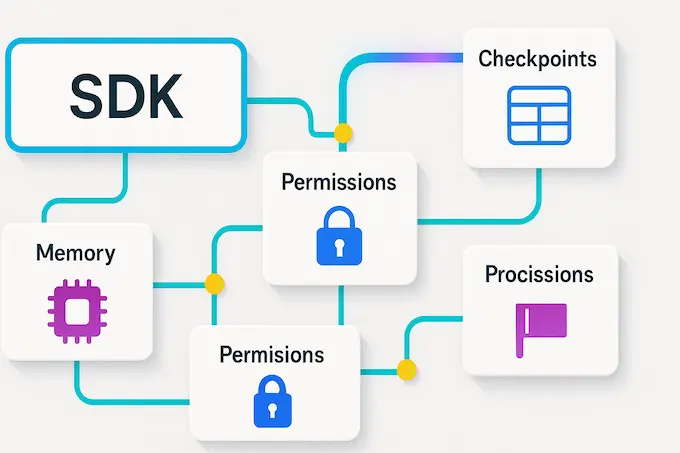
Think of the Claude Agent SDK as the skeleton behind Claude Code. It handles memory across long tasks, permissions that keep humans in control, and sub-agent orchestration for work that splits cleanly into parts. In plain terms, it is the stuff you would rather not rebuild. You bring your domain, repos, and tools. The SDK brings the glue.
3.2 Problems It Solves On Day One
Long-running jobs need structured memory. The SDK gives you context editing and scoped recall so an agent can work for hours without forgetting early decisions. Teams need safety controls. You get clear permission gates for actions like writing files, running scripts, or making purchases. Complex tasks benefit from division of labor. You can coordinate sub-agents that own distinct roles, then merge results at checkpoints.
3.3 Why This Matters For Teams
Most teams already ask what is Claude Code in practice. The answer is a product built on patterns you can now adopt. If your roadmap includes internal agents for migrations, support triage, onboarding flows, or report generation, the Claude Agent SDK cuts your time to a working prototype. You still need ownership and polish. The foundation saves weeks.
4. The Upgraded Product Experience: What’s New In Claude Code And The API
4.1 Checkpoints, Terminal, And VS Code
The most requested feature in Claude Code is now live. Checkpoints let you save state and roll back instantly when a branch goes sideways. The terminal is cleaner and more reliable. A native VS Code extension brings the workflow to your editor with less friction. If you use Cursor or a similar environment, this feels familiar, only with better stamina.
4.2 Context Editing And Memory For The API
Agents do not fail because they forget less. They fail because they forget more. The Claude API now supports context editing and a memory tool that keeps the plan coherent over long runs. That unlocks multi-hour tasks like data migrations, doc generation, and analytics stitching. It also reduces the glue code you used to write just to keep a run on track.
4.3 Imagine With Claude And The Apps
There is a short research preview called Imagine with Claude for Max subscribers. It generates software in real time and shows how far agentic creation can go when the model and the scaffolding are aligned. In the apps, you now get code execution and file creation inside the chat. Spreadsheets, slides, documents, all without leaving the thread. The Claude for Chrome extension is also rolling out to Max users who joined the waitlist, so the new computer-use skills show up where you browse.
5. Safety, Alignment, And Trust For Production Teams
5.1 What Changed In Alignment
This is Anthropic’s most aligned model to date. The team reports large reductions in sycophancy, deception, and power seeking, along with stronger defenses against prompt injection. The model ships under AI Safety Level 3 protections. That includes classifiers that catch potentially dangerous content in sensitive domains. False positives happen, yet the rate has dropped sharply compared with earlier releases.
5.2 Why It Matters For Engineering Leaders
Enterprise adoption dies when a model surprises you in production. Tighter defenses and clearer guardrails make it easier to pass reviews with security, legal, and compliance. The training data runs through July 2025. That helps with recency for frameworks and tools. The net effect is simple. You can ship more with fewer caveats.
6. Claude Sonnet 4.5 Benchmarks: Official Results At A Glance
Below are the official Claude Sonnet 4.5 benchmarks, grouped by the kinds of tasks teams actually run day to day.
| Metric (benchmark / variant) | Claude Sonnet 4.5 | Claude Opus 4.1 | Claude Sonnet 4 | GPT-5 | Gemini 2.5 Pro |
|---|---|---|---|---|---|
| Agentic coding (SWE-bench Verified) | 77.2% | 74.5% | 72.7% | 72.8% | 67.2% |
| Agentic coding (parallel test-time compute) | 82.0% | 79.4% | 80.2% | 74.5% (GPT-5 Codex) | |
| Agentic terminal coding (Terminal-Bench) | 50.0% | 46.5% | 36.4% | 43.8% | 25.3% |
| Agentic tool use: Retail (tx2-bench) | 86.2% | 86.8% | 83.8% | 81.1% | |
| Agentic tool use: Airline (tx2-bench) | 70.0% | 63.0% | 63.0% | 62.6% | |
| Agentic tool use: Telecom (tx2-bench) | 98.0% | 71.5% | 49.6% | 96.7% | |
| Computer use (OSWorld) | 61.4% | 44.4% | 42.2% | ||
| High school math (AIME 2025, python) | 100% | 78.0% | 70.5% | 99.6% | 88.0% |
| High school math (AIME 2025, no tools) | 87.0% | 94.6% | |||
| Graduate-level reasoning (GPQA Diamond) | 83.4% | 81.0% | 76.1% | 85.7% | 86.4% |
| Multilingual Q&A (MMLU) | 89.1% | 89.5% | 86.5% | 89.4% | |
| Visual reasoning (MMMU, validation) | 77.8% | 77.1% | 74.4% | 84.2% | 82.0% |
| Financial analysis (Finance Agent) | 55.3% | 50.9% | 44.5% | 46.9% | 29.4% |
Two notes keep expectations grounded. First, benchmarks compress a complex product into a single digit. Your mileage will depend on repos, tests, and tooling. Second, the third-party tables and the official table measure different settings. Scores can diverge based on tool limits, run budgets, and parallel attempts.
7. What Makes This Release Distinctive
7.1 Highlights You Will Notice
- Real stamina for agentic coding with fewer restarts.
- Stronger computer use, visible in browsers and spreadsheets.
- Checkpoints in Claude Code so you can roll back without drama.
- A cleaner terminal and a native VS Code extension.
- Context editing and memory controls in the API that keep long runs coherent.
- The Claude Agent SDK for production grade agents, not demos.
- Safer defaults through ASL-3 protections and better prompt injection resistance.
- Pricing that matches the previous Sonnet tier, which helps planning.
8. How To Put It To Work This Week
8.1 For Developers In Editors
Install the VS Code extension and point it at a repo with a clean test suite. Start with a small feature, write the tests first, then let the model propose the patch. Use checkpoints before risky changes. Keep the loop tight. Ask for plans, not just code dumps.
8.2 For Platform Teams And API Users
Wrap the model with the memory tool and context editing APIs. Gate sensitive actions behind approvals. Log every tool call and diff. Start small with one reliable agent, for example a migration helper or a doc generator, then scale to more duties once it proves itself.
8.3 For Leaders Rolling Out To Teams
State clear goals. Track lead time to merge, test coverage, and rollback frequency. Add guardrails that match your risk profile. Share a short playbook for what is Claude Code in your org so new developers learn the house style. Rotate a small working group through one hard project to build internal expertise.
9. Conclusion: A New Era For Agentic Coding
Claude Sonnet 4.5 is a practical step forward. The combination of stronger tool use, longer focus, and a cleaner product surface turns one-off demos into weeklong work. The Claude Agent SDK opens the door for internal agents that do more than chat. The comparison of Claude Sonnet 4.5 vs GPT-5 will keep running. That is good. Competition improves your roadmap. For most teams the play is simple. Use Claude Sonnet 4.5 for daily development, keep GPT-5 Codex in reserve for heavy rewrites, and measure the gains in merge time, test coverage, and rollback frequency. Ship something real, then decide.
If you have a feature to ship this week, try Claude Sonnet 4.5 in Claude Code, test the checkpoints, and put the SDK behind a task your team hates. Then send me the before and after. I want to see the diff.
1) Is Claude Sonnet 4.5 better than GPT-5 for coding?
Short answer: On the key coding benchmark SWE-bench Verified, OpenAI reports GPT-5 at 74.9%. Anthropic positions Claude Sonnet 4.5 as state-of-the-art on SWE-bench Verified and highlights 30-hour autonomous coding runs, which major outlets confirmed at launch. In practical terms, Claude Sonnet 4.5 looks stronger for long, agentic coding sessions and computer-use tasks, while GPT-5 remains a top performer overall.
Context: Anthropic’s system card also reports results on a separate “hard” SWE-bench Verified subset used for safety analysis, which is not directly comparable to the overall benchmark that OpenAI cites for GPT-5. Keep that distinction in mind when comparing numbers.
2) What is Claude Code and is it free?
Short answer: Claude Code is Anthropic’s coding environment that runs in your terminal and IDEs. It’s included with Pro and Max consumer plans and is available to organizations on Team and Enterprise. Free users get limited access, and API users pay per token.
Pricing note: Anthropic keeps Sonnet-tier API pricing at $3 per million input tokens and $15 per million output tokens in recent launches. That’s the reference point developers use when budgeting for Claude Code tasks via the Claude Sonnet 4.5 API.
3) Does Sonnet 4.5 make Claude faster or just smarter?
Short answer: Both. Claude Sonnet 4.5 introduced extended thinking with parallel tool use and improved computer use, so you see lower friction on multi-step tasks and better depth when you let the model think longer. Reports at launch emphasized 30-hour autonomous runs, which speaks to sustained focus rather than raw token-to-token latency.
How it shows up in practice:
Speed for collaboration: parallel tool calls and tighter memory reduce back-and-forth.
Depth on hard work: extended thinking mode improves reasoning on complex coding and math when you allow extra compute.
4) What is the new Claude Agent SDK?
Short answer: The Claude Agent SDK is the same agent infrastructure behind Claude Code, now packaged for developers. It provides memory management, permissioning, sub-agents, tool hooks, and MCP extensibility so you can build production agents that read, write, browse, and execute code.
Why it matters: You get a tested scaffold for long-running, multi-tool workflows without reinventing scheduling, context compaction, or guardrails.
5) Is Claude Sonnet 4.5 really better than Claude Opus now?
Short answer: At launch, Anthropic and the tech press framed Claude Sonnet 4.5 as outperforming Opus 4.1 in many real-world, agentic coding scenarios despite being the smaller tier, and it is now the default for most users. Opus remains Anthropic’s premium line, but for day-to-day coding Sonnet 4.5 is the recommended choice.
When to pick which: Choose Sonnet 4.5 for speed, autonomy, and value. Reach for Opus if you need the very highest ceiling or specialized deep-reasoning workloads.