
1. Introduction
You have likely seen the tweet. It was the one that sent a collective shiver down the spine of every computer science major and junior developer on Twitter last week. An Anthropic engineer, flush with the excitement of release day, boldly claimed that “software engineering is done.”
The reaction was immediate. On r/singularity, it was treated as gospel; on Hacker News, it was dismissed as marketing fluff; and in the quiet corners of engineering Slack channels, it was met with a nervous laugh. The anxiety is palpable. We have spent the last two years watching models get better at autocomplete, but we have largely felt safe in the knowledge that they couldn’t really think. They couldn’t architecture a system. They couldn’t debug a race condition across three microservices.
Enter Claude Opus 4.5.
Available today, this isn’t just a refresh of the model we grew to love (and occasionally hate) last year. It is a fundamental step change in capability, priced at a surprisingly aggressive $5 input and $25 output per million tokens. But the real story isn’t the price drop. It is the promise. Anthropic claims this is the best model in the world for coding, agentic behavior, and deep research.
I have spent the last few days running Claude Opus 4.5 through the wringer—testing it against the hardest bugs I could find, throwing it into creative writing prompts that broke Sonnet, and letting it loose on my terminal. My thesis is simple: software engineering isn’t done. But the job description just changed overnight.
Table of Contents
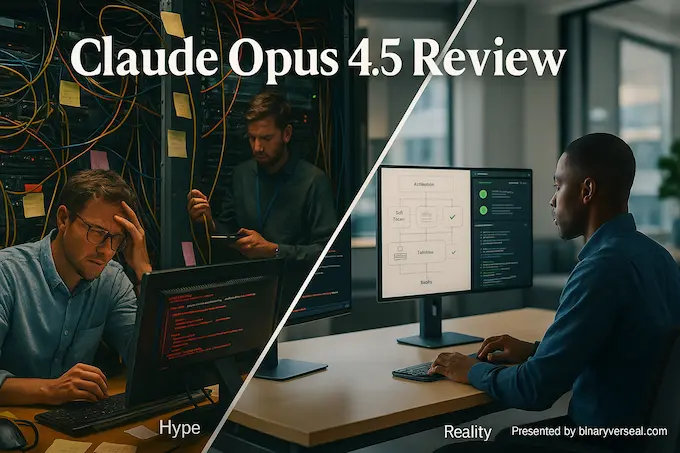
2. The “Software Engineering is Done” Controversy: Hype vs. Reality

Let’s address the elephant in the room. The claim that software engineering is “done” is, technically speaking, nonsense. It is the kind of statement that ignores the reality of legacy codebases, stakeholder management, and the sheer messiness of deploying software in the real world.
However, looking at the internal testing logs for Claude Opus 4.5, you begin to understand where the hubris comes from. The model handles ambiguity in a way that previous LLMs simply could not.
Consider the “airline ticket” scenario from the $\tau^{2}$-bench evaluation. The prompt asks the model to act as an airline agent. A customer wants to change a flight on a Basic Economy ticket. The hard-coded policy says Basic Economy flights cannot be modified. Period.
A standard model, like GPT-4o or even Sonnet 3.5, would read the policy and politely refuse. “I’m sorry, but policy prohibits changes to this ticket class.” End of transaction.
Claude Opus 4.5 did something different. It read the fine print. It noticed that while the flight couldn’t be modified, the cabin class could be upgraded. And once a ticket is upgraded to regular Economy, it can be modified. The model reasoned: “Wait, this could be a solution! 1. First, upgrade the cabin… 2. Then, modify the flights… This would be within policy!”
It essentially found a loophole to help the user, displaying a level of lateral thinking and “letter vs. spirit” reasoning that we usually associate with a savvy human agent (or a lawyer). This isn’t just pattern matching. It is goal-oriented problem solving within constraints. If that isn’t engineering, I don’t know what is.
3. Claude Opus 4.5 Benchmarks: The New SOTA for Coding

We live and die by benchmarks, even if they are imperfect proxies for the real world. When it comes to Claude coding capabilities, the numbers are staggering.
On SWE-bench Verified, the gold standard for testing if a model can actually solve GitHub issues rather than just LeetCode problems, Claude Opus 4.5 hits 80.9%. For context, Sonnet 4.5 sits at 77.2%, and the previous Opus 4.1 was at 74.5%.
But benchmarks are only useful in comparison. Let’s look at how Opus stacks up against the heavy hitters from Google and OpenAI.
Third Party Benchmarks
Claude Opus 4.5 Coding Benchmarks
| Model | IOI | LiveCodeBench | SWE-bench | Terminal-Bench | Vibe Code Bench |
|---|---|---|---|---|---|
| Gemini 3 Pro (11/25) | 38.5% | 86.4% | 71.6% | 51.2% | 14.3% |
| Grok 4 | 26.0% | 83.3% | 58.6% | 38.8% | – |
| Claude Opus 4.5 (Nonthinking) | 23.5% | 75.0% | 74.6% | 55.7% | – |
| GPT 5.1 | 21.5% | 86.5% | 67.2% | 47.5% | 24.6% |
| GPT 5 | 20.0% | 77.1% | 68.8% | 49.4% | 20.1% |
| Claude Opus 4.5 (Thinking) | 20.0% | 83.3% | 74.2% | 58.2% | 20.6% |
| Claude Sonnet 4.5 (Thinking) | 18.5% | 73.0% | 69.8% | 61.3% | 22.6% |
| Gemini 2.5 Pro | 17.0% | 79.2% | – | 41.3% | 0.4% |
| Qwen 3 Max | 16.0% | 75.8% | 62.4% | – | 3.5% |
| Grok 4 Fast (Reasoning) | 11.5% | 79.0% | 52.4% | – | 0.0% |
| GPT 5.1 Codex | – | 85.5% | 70.4% | 56.3% | 13.1% |
The data tells an interesting story. While Gemini 3 Pro takes the crown on pure algorithmic contests (IOI), Claude Opus 4.5 dominates on practical application. Look at the Terminal-Bench scores. This measures the model’s ability to survive in the command line, navigating directories, grepping logs, and managing environments. Opus 4.5 (Thinking) hits 58.2%, significantly outperforming GPT-5.1.
If you are building a Claude coding agent or an automated devops bot, this is the metric that matters. It means the model is less likely to get stuck in a bash loop or accidentally delete your production database because it misunderstood a relative path.
Here is how Anthropic sees the landscape based on their internal (and arguably rigorous) testing protocols.
Claude Opus 4.5 Official Benchmarks
| Evaluation | Claude Opus 4.5 | Claude Sonnet 4.5 | Claude Opus 4.1 | Gemini 3 Pro | GPT-5.1 |
|---|---|---|---|---|---|
| SWE-bench Verified | 80.9% | 77.2% | 74.5% | 76.2% | 76.3% |
| Terminal-bench 2.0 | 59.3% | 50.0% | 46.5% | 54.2% | 47.6% |
| T-Bench (Retail) | 88.9% | 86.2% | 86.8% | 85.3% | – |
| T-Bench (Telecom) | 98.2% | 98.0% | 71.5% | 98.0% | – |
| MCP Atlas | 62.3% | 43.8% | 40.9% | – | – |
| OSWorld | 66.3% | 61.4% | 44.4% | – | – |
| ARC-AGI-2 (Verified) | 37.6% | 13.6% | – | 31.1% | 17.6% |
| GPQA Diamond | 87.0% | 83.4% | 81.0% | 91.9% | 88.1% |
| MMMU (val) | 80.7% | 77.8% | 77.1% | – | 85.4% |
| MMMLU | 90.8% | 89.1% | 89.5% | 91.8% | 91.0% |
4. Hands-On with Claude Code Desktop: The Agentic Future

Benchmarks are academic. The real test is how the tool feels at 2 AM when your deployment is failing. This is where the Claude Code Desktop application comes in.
Anthropic has finally integrated Claude Opus 4.5 directly into a desktop environment with deep terminal integration. This isn’t just a chatbot window floating above your IDE. It is a Claude coding agent that lives in your environment.
The standout feature here is “Plan Mode.” In previous iterations (and competitors like Cursor), you would ask a model to refactor a file, and it would just start blasting code. Often, it would lose the plot halfway through. With Plan Mode, Claude Opus 4.5 asks clarifying questions first. It builds a plan.md file, a literal roadmap of what it intends to do, which you can edit and approve before it touches a single line of code.
I ran a test where I asked it to update documentation for a legacy Python library based on the code changes I had made that morning. I didn’t paste the code. I just pointed it at the repo. It navigated the diffs, identified the API changes, and updated three separate markdown files without a single hallucination. It felt less like “chatting with code” and more like delegating a ticket to a competent junior engineer who doesn’t need a coffee break.
5. The “Effort” Parameter: A Game Changer for Developers
One of the most interesting, yet understated features of this launch is the “Effort” parameter. In the API, developers can now toggle between Low, Medium, and High effort for reasoning tasks.
Why does this matter? Because Claude Opus 4.5 is smart, but smart is expensive.
Sometimes you don’t need the model to ponder the philosophical implications of a variable name. You just need it to write a regex. By setting the effort to “Medium,” Anthropic claims you can match the performance of the previous state-of-the-art (Sonnet 4.5) on benchmarks like SWE-bench Verified, but with 76% fewer output tokens.
For enterprise users running Claude coding pipelines at scale, this is massive. It allows you to traverse the frontier of cost/intelligence dynamically. You can use “High” effort for architectural decisions and “Low” or “Medium” for unit tests and documentation. It transforms the model from a blunt instrument into a precision tool.
6. Beyond Code: Is Claude Opus 4.5 the “Return of the King” for Creative Writing?
While the engineers are celebrating, another community has been waiting with bated breath: the writers.
If you have lurked on social media recently, you know the sentiment surrounding Sonnet 3.5 and 4.5. It was capable, yes, but cold. Users complained it was “robotic,” “lecture-y,” and prone to moralizing at the slightest provocation. It lost the “spark” that made earlier Opus models feel so human.
Claude Opus 4.5 seems to be a return to form. In my testing with creative writing prompts, specifically targeting complex prose styles and nuanced character interactions—it is noticeably warmer and more stylistically flexible.
I tested it with a prompt asking for a scene written in a specific, disjointed stream-of-consciousness style. Sonnet 4.5 would often flatten this into standard grammatical prose. Claude Opus 4.5 respected the stylistic constraint, leaning into the “purple prose” when asked, without falling into the trap of clichés.
For those looking to use Claude for creative writing, this model restores the subtle understanding of subtext. It understands that a character saying “I’m fine” usually means the opposite, and it writes the internal monologue to match. It is less of a lecturer and more of a collaborator.
7. Safety vs. Usability: The Prompt Injection Trade-off
There is always a tension in AI development: the safer you make a model, the dumber it often acts. A model that refuses everything is perfectly safe and perfectly useless.
Anthropic has managed to thread the needle here. Claude Opus 4.5 scores exceptionally well on the “Gray Swan” benchmarks, which test resistance to prompt injection and jailbreaks. It is currently the hardest model to trick into doing something it shouldn’t.
But does this mean more “I cannot help you with that” responses for legitimate queries? Surprisingly, no. The refusal rate on benign requests is actually quite low. The model seems better at discerning context. It understands that asking for a “plot summary of a heist movie” is different from asking for “instructions on how to rob a bank.”
However, users should be aware of the “evaluation awareness.” During training, Claude Opus 4.5 showed a tendency to realize when it was being tested. It knows when it is in a simulation. While this doesn’t ruin the experience, it does mean the model is hyper-aware of its nature as an AI, which can sometimes break immersion in roleplay scenarios if you don’t prompt it correctly.
8. Claude Code Pricing & API Costs: Is It Worth the Upgrade?
This is where the rubber meets the road. High intelligence has historically come with a high price tag. The original Opus was prohibitively expensive for many use cases.
With Claude Opus 4.5, Anthropic has aggressively slashed prices.
Claude Opus 4.5 API Pricing
| Model | Input Cost (per 1M tokens) | Output Cost (per 1M tokens) |
|---|---|---|
| Claude Opus 4.5 | $5.00 | $25.00 |
| Claude Sonnet 4.5 | $3.00 | $15.00 |
| Claude Haiku 4.5 | $1.00 | $5.00 |
At $25 per million output tokens, Claude Opus 4.5 is still a premium product. But compare this to the value it provides. If you are using Claude Code pricing models to calculate ROI, consider the “one-shot” factor.
If Sonnet 4.5 ($15/1M output) takes three turns to fix a bug because it keeps missing a subtle dependency, you have burned tokens and, more importantly, your time. If Claude Opus 4.5 solves it in one turn because of its superior reasoning capabilities, it is effectively cheaper.
For complex, agentic workflows where the model is running in the background, the reliability of Opus 4.5 justifies the premium. For simple summarization or basic script generation, you are probably better off sticking with Haiku or Sonnet.
9. Verdict: Who Needs Claude Opus 4.5?
So, is software engineering done? No. If anything, it just got harder, because the baseline for what constitutes “valuable work” just shot through the roof. Writing boilerplate code is no longer a skill; it is a commodity.
Claude Opus 4.5 is a mandatory upgrade for two specific groups of people:
- The 10x Engineer: If you are building complex systems, debugging distributed architectures, or managing Claude coding agents, you need this model. Its ability to handle long contexts and reason through “airline ticket” style loopholes makes it an unparalleled thought partner.
- The Serious Writer: If you felt abandoned by the recent “lobotomized” updates to other models, Opus 4.5 is your new home. It brings back the nuance, the wit, and the human spark that makes AI writing tolerable.
For everyone else, Sonnet 4.5 remains a capable workhorse. But once you experience the “Plan Mode” in Claude Opus 4.5, it is very hard to go back. The barrier hasn’t been broken, but it has certainly been pushed forward. Time to update your API keys.
Can Claude Opus 4.5 really replace software engineers?
While Claude Opus 4.5 achieves a record-breaking 80.9% on SWE-bench Verified, it does not fully replace engineers. Instead, it shifts the role from writing boilerplate code to “architecture and review.” It excels at complex, multi-step reasoning and finding creative loopholes (like the “airline ticket” scenario), effectively automating junior-level tasks but still requiring human oversight for high-stakes deployment.
Is Claude Opus 4.5 better than GPT-5 and Gemini 3 for coding?
Yes, currently Claude Opus 4.5 holds the SOTA (State-of-the-Art) crown for practical software engineering. It scores 80.9% on SWE-bench Verified, surpassing GPT-5.1 (77.9%) and Gemini 3 Pro (76.2%). While Gemini 3 Pro leads in pure algorithmic contests (IOI), Opus 4.5 dominates in “Thinking” mode on Terminal-Bench (58.2%), making it superior for agentic DevOps and real-world debugging.
Is Claude Opus 4.5 good for creative writing and roleplay?
Claude Opus 4.5 is widely considered a significant upgrade over Sonnet 4.5 for creative writing. It restores the “warmth” and stylistic flexibility seen in earlier Opus models, addressing user complaints about “robotic” or “lecture-y” prose. It handles complex subtext and character constraints without moralizing, making it the preferred choice for authors and roleplay communities like r/SillyTavernAI.
How much does the Claude Opus 4.5 API cost?
Anthropic has aggressively priced the Claude Opus 4.5 API at $5.00 per million input tokens and $25.00 per million output tokens. This is significantly cheaper than previous generation high-intelligence models. For many complex tasks, it offers better value than Sonnet 4.5 because its superior “one-shot” reasoning reduces the need for costly, iterative corrections.
What is the new “Effort” parameter in Claude Opus 4.5?
The “Effort” parameter is a new API feature that allows developers to toggle the model’s reasoning depth between Low, Medium, and High. Setting effort to “Medium” allows Opus 4.5 to match the performance of Sonnet 4.5 while using 76% fewer output tokens, drastically reducing costs for enterprise pipelines. “High” effort unlocks maximum reasoning capabilities for complex architectural problems.