Introduction
Some weeks in AI feel like a stack of isolated announcements. This week feels different. The pieces rhyme. Models got better at long-horizon reasoning, better at acting inside tools, and in a few cases, better at doing real research instead of benchmark theater. If you track AI updates this week for signal, this is one of those weekends where the pattern matters more than the press release.
What stands out across these AI world updates in AI News February 21 2026 is not just raw capability. It is distribution, deployment, and reliability. The center of gravity is moving from clever demos to systems people can actually ship. Here are the Top AI news stories, with the why behind each one.
Table of Contents
1. Claude Sonnet 4.6 Makes Premium-Level Intelligence Feel Normal

Anthropic just did something strategically sharp. It pushed Sonnet 4.6 to claude.ai as the default for Free and Pro users, kept pricing at $3 and $15 per million tokens, and still closed the gap to Opus-class performance. Early user preference data points in the same direction, better instruction following, fewer hallucinations, and less of the overengineered nonsense that wastes time in real workflows.
The bigger story is practical capability. Sonnet 4.6 improves computer use, hardens prompt injection resistance, and adds a 1 million token context window in beta with tool support and better long-horizon planning. In AI News February 21 2026, this is one of the clearest examples of frontier quality turning into everyday default infrastructure, not a premium checkbox. Our Claude Sonnet 4.6 review, benchmarks, pricing, and API guide breaks down exactly what changed and why it matters.
2. Gemini 3.1 Pro Turns Deep Reasoning Into The Baseline, Not A Mode
Google is making the same strategic move from a different angle. Gemini 3.1 Pro reportedly posts a verified 77.1 percent on ARC-AGI-2, more than doubling Gemini 3 Pro on a benchmark built to test novel pattern reasoning. That matters because it suggests Google is shifting stronger reasoning out of special settings and into the model people will actually touch.
The rollout strategy is just as important as the score. Gemini 3.1 Pro is showing up across API, AI Studio, CLI, Android Studio, Vertex AI, Gemini Enterprise, the Gemini app, and NotebookLM. It also hints at practical outputs, like website-ready animated SVG generation, which makes this one of the more interesting AI Advancements for builders, not just benchmark watchers. See our full Gemini 3.1 Pro review covering ARC-AGI-2 and custom tools for the complete picture.
Gemini 3.1 Pro Review: ARC-AGI-2 Results and Custom Tools Explained.
3. Qwen3.5 Pushes Open Multimodal Agents Toward Long-Horizon Work
Qwen3.5-397B-A17B is a strong reminder that open ecosystems are not standing still. The model uses a sparse MoE design with 397 billion total parameters and 17 billion active per pass, plus hybrid attention choices aimed at keeping inference efficient. The headline feature for many teams will be the direction, native multimodal agent behavior with long context and tool use.
What makes this release notable is the systems thinking. Qwen expands language coverage to 201 languages and dialects, scales infrastructure around FP8 and heterogeneous parallelism, and frames reinforcement learning as the engine for generalizable agent capability instead of narrow benchmark tuning. If you follow Open source AI projects, this is one of the week’s most important foundation moves. Our Qwen3.5-397B-A17B benchmarks, API, and pricing guide covers the technical architecture in depth.
4. Seed2.0 Ships A Full Multimodal Agent Lineup For Production Teams
Seed2.0 arrives with a very different vibe than a typical lab drop. Instead of one flagship model and a pile of caveats, ByteDance is presenting a production-first family, Pro, Lite, and Mini, each with a clear operational role. That is exactly the sort of packaging shift that tells you multimodal agents are moving from research novelty into procurement conversations.
The capability claims are ambitious and practical at the same time, from visual reasoning and motion understanding to image-to-webpage generation with layout and interactions restored automatically. In AI News February 21 2026, Seed2.0 stands out because it is not selling one benchmark miracle. It is selling deployment choices, throughput tradeoffs, and reliability across real workloads. Read our independent Seed2.0 Pro benchmarks covering ProcBench and Putnam for the numbers behind the claims.
Seed2.0 Pro Benchmarks: ProcBench, Putnam, and Production Performance.
5. GPT-5.2 Helps Find A New Gluon Result, Then Helps Prove It
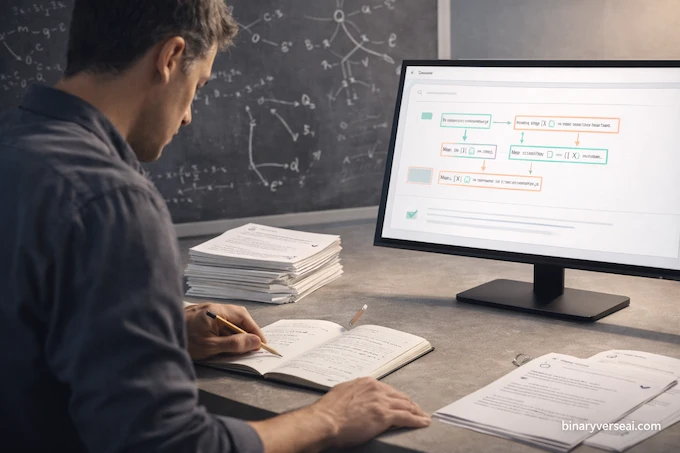
This is the kind of story that cuts through AI hype because it has an old-fashioned academic smell to it, formulas, proofs, and people checking the math. Researchers report a nonzero gluon scattering amplitude in a setting long assumed to vanish, then show GPT-5.2 helped simplify explicit cases, spot a pattern, and conjecture a general formula.
The important part is not “AI solved physics alone,” because it did not. The interesting part is workflow compression. Humans did the heavy symbolic work, the model surfaced a cleaner structure, and the result was then formally checked against known constraints like recursion relations and soft theorems. These are the Artificial intelligence breakthroughs worth paying attention to, because they leave a paper trail. Our ChatGPT physics and GPT-5.2 half-collinear zero rule breakdown puts this result into broader context.
ChatGPT Physics: GPT-5.2, Half-Collinear Zero Rule and What It Means.
6. Gemini Adds Lyria 3, And Music Generation Gets More Casual
Google is widening Gemini’s creative surface area again, this time with Lyria 3 music generation in beta. Users can prompt a mood, memory, genre, photo, or video and get a 30-second track with lyrics, cover art, and tunable style controls. The product framing is smart, quick expressive creation for everyday users, not a full DAW replacement.
Under the hood, Google is pitching better realism, stronger prompt alignment, and cleaner creative workflow integration, including YouTube Dream Track upgrades for Shorts creators. It is also pairing the launch with SynthID watermarking and audio verification features. This is classic platform strategy, add a new modality, make it shareable, then build trust tooling alongside the feature. Our MedGemma guide shows how Google’s model family is expanding across very different domains in parallel.
MedGemma Guide: How Google’s Gemini Model Family Is Expanding Across Domains.
7. Pomelli Photoshoot Gives Small Businesses A Cheap Studio In Software
Pomelli’s new Photoshoot feature is easy to underestimate if you only read the headline. This is not just another image generator. It is a workflow product aimed at small businesses that need usable marketing assets fast, without a photographer, editor, or agency in the loop. Google Labs combines product photos, brand context, and templates to produce polished campaign-ready visuals.
The practical detail that matters is memory and grounding. Businesses can save a “Business DNA” style profile, upload reference images, or point Pomelli at a product URL so the system pulls titles, descriptions, and images automatically. That makes the tool less like a toy prompt box and more like a lightweight creative operating system for repeatable marketing output. For teams thinking about agentic workflows in creative and business contexts, our ChatGPT agent use cases guide covers the landscape of what these tools can now automate end to end.
ChatGPT Agent Use Cases: Real Workflows and Automation for Business Teams.
8. Grok 4.2 Beta Treats The Release Itself As A Learning Loop
Grok 4.2 enters public beta with a release-candidate posture and an explicit ask for critical feedback. Users have to select it manually, which keeps the rollout controlled while still collecting usage data. The interesting part is not a benchmark chart, because none was the headline. It is the promise of weekly learning updates with release notes.
That signals a change in product cadence. Instead of dramatic model jumps every few months, xAI is leaning into continuous refinement in public view. In AI News February 21 2026, Grok 4.2 matters less as a static version number and more as a distribution experiment, can a frontier model improve fast enough in the open that the beta becomes part of the product itself. Our Grok 4 Heavy review gives useful background on where xAI’s flagship models have been heading leading up to this beta release.
Grok 4 Heavy Review: Benchmarks, Pricing, and xAI’s Flagship Model Analyzed.
9. OpenAI Hires OpenClaw’s Founder And Signals A Multi-Agent Shift
OpenAI hiring Peter Steinberger, creator of OpenClaw, is one of the more strategically revealing moves of the week. OpenClaw proved there is real demand for agents that operate across everyday apps through simple chat interfaces like WhatsApp, Discord, and Telegram. That is a different thesis from building one assistant that lives inside one polished app shell.
The foundation angle matters too. OpenAI says the project will move into an open-source foundation rather than disappear into a closed feature roadmap. That aligns with a broader bet on interoperability and user-built automation. If this works, the next wave of productivity software could look less like SaaS menus and more like teams composing their own cross-app agents. Our OpenClaw easy install guide is a good starting point for anyone who wants to understand what made the project compelling enough to acquire.
AgentKit Guide: Pricing, Access, Build Setup for Multi-Agent Development.
10. Mind Opens A Mental Health Inquiry After Google Overviews Concerns

Mind’s year-long inquiry into AI and mental health lands at exactly the right moment. The trigger was reporting that Google AI Overviews surfaced dangerous or misleading mental health advice in some cases, including content that experts said could discourage professional care. That turns a familiar quality problem into a public health question, which changes the stakes immediately.
What Mind seems to understand is that the core issue is not just factual error. It is confidence, presentation, and the illusion of certainty in a short summary format. Expect this to become a reference point in AI regulation news, especially as more health information gets mediated by search summaries and assistant interfaces before people ever reach source material. Our ChatGPT health, HIPAA, privacy, and diagnosis use guide covers the responsible use frameworks that matter most right now in this space.
AI Misinformation and Chatbots: Political Persuasion, Health Risk and Platform Trust.
11. First Proof AI Raises The Bar For What “Math Benchmark” Should Mean
OpenAI’s First Proof AI challenge is one of the best examples this week of evaluation getting more serious. These are research-level proof problems, not short-answer contest questions, and correctness depends on checkable arguments and expert review. OpenAI says multiple model-generated proof attempts look likely correct, while others remain under scrutiny and one earlier hopeful result was reclassified as wrong.
That mix of progress and public correction is healthy. In AI News February 21 2026, the real takeaway is methodological, frontier models need harder tests that measure sustained reasoning, abstraction choices, and rigor under ambiguity. If AI news this week February 2026 has a theme, it is that benchmark culture is slowly growing up. Our LLM math benchmark performance guide for 2025 gives useful context for understanding how seriously to take any model’s claimed math results.
LLM Math Benchmark Performance 2025: Which Models Actually Solve Hard Problems.
12. Claude Code Security Brings Advanced Vulnerability Hunting To Defenders
Anthropic’s Claude Code Security is a limited research preview, but the direction is clear and urgent. The system scans full codebases inside Claude Code on the web, reasons about interactions between components, and proposes patches for human review. That sounds incremental until you compare it with classic rule-based scanners that miss business-logic bugs and broken access control issues.
Anthropic is framing this as a defensive response to an AI cybersecurity arms race, and that framing is probably right. The notable design choice is restraint, severity and confidence scores are surfaced, but fixes are not auto-applied. This kind of human-in-the-loop posture matters if AI vulnerability discovery is about to scale faster than current security teams can triage. Our piece on AI model welfare and Anthropic’s approach with Claude Sonnet 4.6 explores the broader design philosophy Anthropic is bringing to its safety-first deployments.
AI Model Welfare and Anthropic: Claude Sonnet 4.6 Safety Design and Human-in-the-Loop Posture.
13. China’s Humanoid Robot Demos Are Better, But The Real Test Comes Next
China’s humanoid robot leap from awkward viral clips to kung fu flips and synchronized gala performances is a real engineering signal, even if the internet treats it like sports highlights. The improvements in stability, dexterity, and motion quality appear tangible. They also sit on top of something less flashy and more decisive, China’s manufacturing scale and supply-chain depth.
Analysts point to cost advantage and installation volume as the structural story, not just acrobatics. Still, the caution is important. Choreographed routines do not prove reliability in messy human environments like care work or logistics. The next phase will be about cognition and endurance, not spectacle, which makes this story as much about AI stacks as robot hardware. Our TPU vs GPU AI hardware war guide covers the infrastructure layer that will ultimately determine which robotics platforms can scale.
TPU vs GPU: AI Hardware War Guide — Nvidia, Google, and the Infrastructure Race.
14. Meta’s Afterlife Patent Reopens The Weirdest Questions In AI Ethics
Meta receiving a patent for AI systems that could simulate a user’s social media behavior after death sounds like science fiction until you realize the ingredients already exist, LLMs, platform history, and engagement incentives. Meta says it has no plans to build the product, but the patent is still a sharp signal about where the technical envelope is headed.
The ethical questions are not abstract. Consent, post-mortem privacy, authenticity, grief, and platform economics all collide here. “Grief tech” already exists in smaller forms, and large platforms have memorial tools today. What changes with generative AI is scale and realism. This is a category where product capability is moving faster than social norms, and everyone can feel it. Our look at whether AI is conscious, drawing on Anthropic’s introspection study, is relevant reading for anyone thinking seriously about AI identity and personhood questions raised by cases like this.
Is AI Conscious? Anthropic’s Introspection Study and What It Reveals About AI Identity.
15. GLM-5 Makes A Serious Open-Weights Case For Agentic Engineering
GLM-5 is the kind of release that forces people to update old assumptions about the open model ceiling. Zhipu AI and Tsinghua describe a 744B parameter model with 40B active, trained at huge scale and tuned for agentic engineering rather than prompt-era “vibe coding.” The benchmark story is strong, especially across coding, reasoning, and long-horizon agent evaluations.
The more interesting detail is architectural intent. DeepSeek Sparse Attention is pitched as a way to preserve long-context fidelity while cutting compute, and the team pairs it with asynchronous reinforcement learning and multi-token prediction for deployment efficiency. In AI News February 21 2026, GLM-5 is one of the strongest signals that open models are competing on systems design, not just parameter count. Our GLM-5 benchmarks, pricing, and agentic engineering deep dive covers everything builders need to evaluate this release.
GLM-5 Benchmarks, Pricing, and Agentic Engineering — Full Pro Guide.
16. ERL Shows Why Reflection During Training Can Beat Raw Trial And Error
The ERL paper from USC, Microsoft, and UPenn tackles a stubborn problem in reinforcement learning for language models, sparse and delayed rewards. Instead of forcing a model to infer everything from a scalar reward after the fact, ERL adds an explicit loop, attempt, feedback, self-reflection, retry, then consolidation into the base policy through selective distillation.
That sounds simple, but it changes credit assignment in a useful way. The model learns to turn feedback into reusable corrective strategies, and successful revisions get baked into behavior without needing reflection at inference time. Reported gains across Sokoban, FrozenLake, and tool-using reasoning tasks make this one of the most practical New AI papers arXiv for agent training this week. Our guide to reinforcement learning, AI compute, and scaling LLMs provides the conceptual grounding to understand why the ERL loop design matters for the next generation of agent training pipelines.
Reinforcement Learning, AI Compute, and Scaling LLMs — What the Research Actually Shows.
Closing Thoughts
The pattern across this week is hard to miss. Frontier labs are converging on the same destination, stronger reasoning by default, longer context that actually works, and agents that can act inside real environments with guardrails. That is why AI News February 21 2026 feels less like a random feed and more like a roadmap draft.
If you publish or build in this space, do not just track leaderboards. Track packaging, rollout surfaces, tool integration, and evaluation quality. That is where the durable edge is forming. Follow these Top AI news stories closely, and then ask the only question that matters for next week, what moved from demo to default?
What is the biggest model launch takeaway this week?
The biggest takeaway is that frontier labs are pushing stronger reasoning into default-tier products, not just premium modes. In AI News February 21 2026, that shows up in multiple releases where performance gains are paired with broader rollout and production readiness, which matters more than benchmark spikes alone for real users and teams.
Why is OpenAI’s First Proof challenge important for AI progress?
It matters because First Proof tests whether AI can produce long, checkable mathematical proofs, not just short answers. OpenAI says at least five of ten model-generated proof attempts are likely correct after expert feedback, which makes this a stronger reasoning benchmark than typical quiz-style evaluations.
Did GPT-5.2 really contribute to a new physics result?
Yes, in a meaningful but collaborative way. OpenAI says GPT-5.2 proposed a formula for a gluon amplitude that was then formally proved and verified by researchers. In AI News February 21 2026, this stands out because it is not just text generation, it is AI-assisted pattern discovery feeding into rigorous human-checked theory work.
What is Claude Code Security and who should care?
Claude Code Security is Anthropic’s limited research preview tool inside Claude Code on the web that scans codebases for vulnerabilities and suggests targeted patches for human review. Security teams, platform engineers, and open-source maintainers should care because it aims to catch contextual flaws that rule-based scanners often miss.
Why is the Mind inquiry into AI and mental health a major AI story?
It is major because Mind launched a year-long inquiry after reporting on dangerous mental health advice in Google AI Overviews, shifting the conversation from generic AI safety to concrete public-health risk and accountability. In AI News February 21 2026, this is one of the clearest signals that AI regulation and oversight debates are moving into mainstream service design.