
An infinite-dimensional algebra can have just one kind of irreducible representation and still fail to be an algebra of compact operators. OpenAI’s September 24, 2026 manuscript constructs precisely that object using standard set theory, without Jensen’s diamond principle. For readers searching for the Naimark problem ZFC result, that is the central answer.
There is an important priority qualification. The manuscript explicitly credits Ryotaro Tanaka’s earlier ZFC construction. OpenAI supplies an alternative argument, built around carefully controlled extensions and a way to capture every pure state. The contribution is a new route through a foundational obstacle, not the first announcement that the obstacle can be crossed.
Table of Contents
1. Naimark Problem ZFC: What Did the 1951 Question Actually Ask?
A complex -algebra is a norm-complete algebra with an adjoint operation, abstracting the arithmetic of bounded operators. A representation realizes its elements as operators on a Hilbert space. It is irreducible when it is nonzero and has no proper, nonzero closed invariant subspace.
Write for the compact operators on . These operators send bounded sets into sets with compact closure. Every nonzero irreducible representation of is equivalent to its defining action. Naimark’s problem asks whether the converse holds: does having only one irreducible representation, up to unitary equivalence, force this particular algebraic form?
“Equivalent” allows a unitary change of Hilbert-space coordinates. It does not mean that there is literally one representation map or one state.
1.1. Naimark Problem ZFC: Key Facts
| Question | Does one irreducible representation class characterize compact operators? |
|---|---|
| Manuscript | OpenAI, September 24, 2026 |
| Algebra | Unital, infinite-dimensional, simple, complex -algebra |
| Trace | A faithful tracial state |
| Representations | One unitary equivalence class of nonzero irreducible representations |
| Foundations | ZFC, with no additional set-theoretic assumption |
| Construction length | ; not asserted to be the algebra’s density |
| Priority | An alternative to Tanaka’s earlier ZFC construction |
2. What the OpenAI Proof Establishes: Theorem 1.1
In Theorem 1.1 of the supplied manuscript, the algebra is unital, infinite-dimensional, simple, and complex. It has a faithful tracial state, and every nonzero irreducible representation belongs to the same unitary equivalence class.
Unital means it contains an identity. Simple means it has no nonzero proper closed two-sided ideal. A tracial state is a normalized positive functional satisfying . Faithfulness means whenever is nonzero. These are substantive structural guarantees, not optional embellishments.
Tanaka’s September 22 preprint already gives the existence conclusion. Recognizing different proofs of the same result matters here, just as in our Courtade–Kumar proof comparison.
OpenAI’s release announcement attributes the collection to an internal frontier model. Its Lean scope document reports this counterexample without an additional set-theoretic assumption. That is a report of formalization scope. This article has not rebuilt the Lean project or established independent peer review. Our Fermat formalization explainer explains why encoded statements and verification need separate attention.
3. The Previous Barrier: Why Jensen’s Diamond Principle Was Needed
The Akemann–Weaver construction, published in 2004, used Jensen’s diamond principle. Informally, diamond supplies predictions that let a transfinite construction anticipate states requiring attention. Without such control, eliminating today’s unwanted representation classes need not eliminate those appearing at the completed limit.
ZFC means Zermelo–Fraenkel set theory with the axiom of choice. It already supports infinite sets, well-ordering, and transfinite recursion. “Without extra axioms” does not mean without axioms or without choice.
The older independence theorem concerns a counterexample generated by elements. Unrestricted existence imposes no such generator bound. A construction answering the unrestricted question therefore does not overturn the bounded theorem.
Diamond was needed by that earlier method, not proved necessary for every possible method. The present proof replaces prediction with a structural theorem about states. Also, earlier diamond constructions could already accommodate traces. A faithful trace should not be presented as the first appearance of tracial structure in this history.
4. Pure States and GNS Representations: The Language of the Proof
A state assigns normalized positive scalar values to algebra elements. A pure state cannot be written as a nontrivial convex mixture of other states. For matrices, a unit vector gives a familiar example through its expectation values.
The Gelfand–Naimark–Segal construction, abbreviated GNS, turns a state into a representation with a cyclic vector. Pure states correspond to irreducible GNS representations. Thus the authors can work with states while targeting representation classes.
Two distinct pure states can produce equivalent representations. For a full matrix algebra, different unit vectors illustrate this distinction: their vector states differ, while their irreducible GNS representations are equivalent.
The proof’s invariant is unique extension: every pure state on an earlier algebra has exactly one state extension to a later algebra. Uniqueness is among all states, not merely pure ones. The unique extension is automatically pure, because any mixture would restrict to a mixture of the original pure state.
The support projection lives in the enveloping von Neumann algebra . It isolates where the state is concentrated. For a pure state this projection is minimal, giving the analytic proof a precise target for compression estimates.
5. Peaking Projections and Pure-State Excision: How the Proof Isolates States
A decreasing projection sequence peaks to when is the only state assigning value one to every projection. Each constraint narrows the possibilities. Together they identify the state exactly, even when the algebra is enormous.
Projection excision, Lemma 2.5, says that compression near this support increasingly turns an element into its scalar state value:
Here is any algebra element, is the identity, and the double bars denote operator norm. The subtraction measures the part left after removing the state’s scalar prediction.
For inequivalent pure states, cross-excision makes mixed compressions tend to zero as well. This separation is stronger than saying two states disagree on one observable. It controls arbitrary intervening algebra elements.
General pure-state excision initially uses nets, which generalize sequences to more flexible directed index sets. The proof does not assume every pure state of an arbitrary nonseparable algebra already has a peaking sequence. Producing suitable sequences later is part of the construction.
Peaking also survives restriction to a subalgebra containing the sequence. Any competing state extends to the larger algebra, where the peaking constraints force equality. This observation supplies unique extensions for selected states before the stronger global theorem is available.
6. Matching Traces and Conditional Expectations: Preparing the Construction
The bridge requires two peaking sequences whose traces match term by term and strictly decrease to zero. Equal trace values make the identification between their generated commutative subalgebras preserve the trace.
For a concrete picture, imagine nested projections with trace values one, one-half, one-quarter, and so on. Their successive differences behave like disjoint measurable pieces. This is exactly the trace pattern supplied by the CAR starting algebra, although the proof works with operator-algebra projections rather than classical events.
Why can the sequences approach zero in trace while retaining state value one? Lemma 2.7 shows that a pure-state support has trace zero when the algebra has no finite-dimensional irreducible representations. This concerns the trace’s normal extension to the bidual. Faithfulness on the original algebra is not faithfulness on every bidual projection.
A conditional expectation projects the larger algebra onto a subalgebra while preserving positivity and respecting multiplication by elements of that subalgebra. Here it must also preserve the trace. Lemma 2.9 constructs it using the successive differences between peaking projections as finite atoms, with the pure state supplying the limiting coordinate.
Faithfulness prevents this projection from silently losing positive information. Together with unique pure-state extensions, a faithful expectation preserves simplicity. If a proper ideal existed upstairs, quotient states and unique extension would force the expectation to annihilate its positive elements. Faithfulness would then force those elements to vanish.
7. Reduced HNN Extensions: The Algebraic Engine of the OpenAI Proof
An HNN extension adds an element implementing an identification by conjugation. The related group-theoretic idea appears in our Boone–Higman analysis. Here the added element is a stable unitary , and the identified objects are commutative -subalgebras generated by two peaking sequences.
For projections and , its defining action is:
The star denotes adjoint. The unitary moves the entire first sequence onto the second, giving their associated states a route to equivalence.
The word “reduced” adds essential analytic structure. Products involving base elements and stable unitaries have specified expectation-zero rules after allowable cancellations are removed. These reduced-word rules control which interactions survive.
Following Ueda’s method, the authors construct the extension as a corner of a reduced amalgamated free product of two matrix algebras. Amalgamation identifies a shared subalgebra. Taking a corner compresses to one diagonal projection, recovering the intended algebra and stable unitary.
The construction supplies a faithful trace and an expectation back onto the base. Its prescribed trace moments also identify the resulting norm, enabling later reordering arguments. Merely writing a conjugation relation would not provide these guarantees.
8. The Selective Bridge: Merging Two Classes Without Collapsing the Others
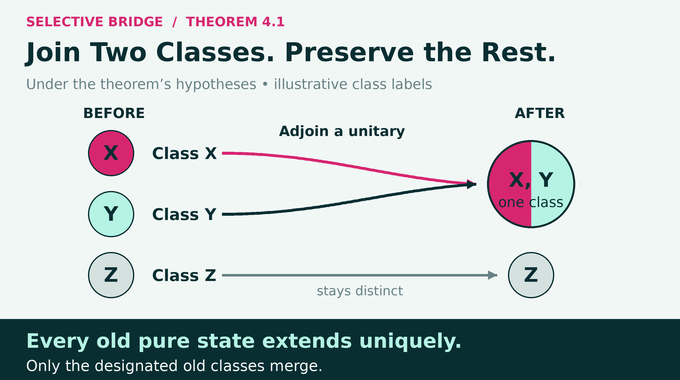
Theorem 4.1 applies to a faithfully tracial unital algebra without finite-dimensional irreducible representations. Its two selected states must be inequivalent and have peaking sequences with the matching trace conditions. Under these hypotheses, every old pure state extends uniquely, and exactly the designated pair of old classes merges.
8.1. What the Selective Bridge Must Preserve
| Selected classes | The two designated inequivalent old classes become equivalent. |
|---|---|
| Other old classes | No other pair of old inequivalent classes merges. |
| Pure-state extensions | Every old pure state has exactly one extension among all states. |
| Trace and expectation | A faithful trace extends the base trace; a faithful trace-preserving expectation returns to the base. |
| Simplicity | A simple base gives a simple extension under the theorem’s hypotheses. |
The norm estimates make this selectivity possible. Compressing nonempty reduced words between suitable excision elements forces the relevant terms to zero. For one state, this forces competing extensions to agree. Between inequivalent states outside the designated pair, it prevents a new equivalence.
The stable unitary then establishes the intended join. If classes labelled red and blue are selected, their extensions become equivalent. An old green class remains distinct. This is an illustration of the theorem’s equivalence pattern, not a claim that only three classes exist.
Crucially, the theorem addresses all old pure states. Controlling only a previously enumerated collection would leave a gap when the construction is rearranged or completed. New pure states are handled by the later determination and scheduling arguments.
9. Closed Subiterations and Countable Determination: Replacing Set-Theoretic Prediction
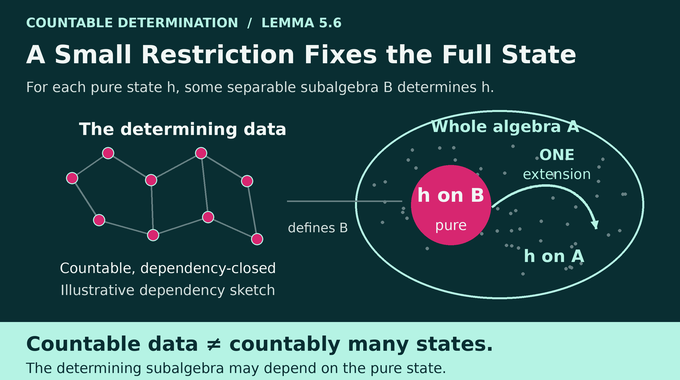
Each added unitary depends on only countably many earlier generators. A set of steps is dependency-closed when it includes those prerequisites for every retained step. Starting with a countable set, repeatedly adding prerequisites still produces a countable set.
Theorem 5.5 says that every pure state on the algebra generated by such a closed subiteration extends uniquely to the whole iteration. This is stronger than uniqueness along the original chronological chain.
To prove it, omitted adjunctions are moved after retained ones. The reduced HNN construction permits this interchange when the required data lie in a common base. The bridge’s exclusion of unintended joins keeps each postponed pair inequivalent until its own adjunction occurs. Otherwise, postponement could invalidate the bridge’s hypotheses.
Lemma 5.6 then uses excision witnesses to build a countable dependency-closed subalgebra on which any given full pure state restricts purely. Theorem 5.5 makes its extension unique. Every pure state therefore has a separable determining subalgebra.
“Countable determination” does not say there are countably many states. It says each state has countably supported determining data. This yields at most continuum many pure states at every intermediate stage below the final construction length. That bound makes exhaustive scheduling possible without diamond.
10. The Final ZFC Construction: CAR Algebra and the Transfinite Schedule
The initial algebra is the canonical anticommutation relation, or CAR, algebra. It is the completed increasing union of full matrix algebras with matrix size . Its standard presentation is:
Here means two-by-two complex matrices, and indexes the tensor factors over the positive integers.
It is separable, simple, infinite-dimensional, and faithfully tracial. Projections selecting the first basis vector in the first tensor factors peak to a reference pure state and have trace . Any containing unital algebra has no finite-dimensional irreducible representation, maintaining a bridge hypothesis throughout.
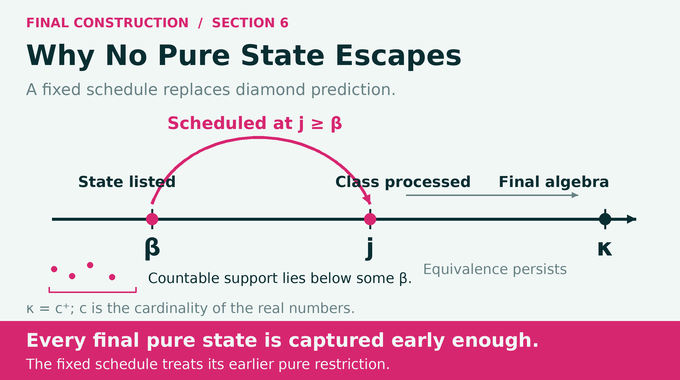
Set and run the construction for stages, the successor cardinal of the continuum. Before building any algebra, fix an injective schedule assigning each stage-and-list-position pair a later or equal processing stage.
At each intermediate stage, list its pure states. A scheduled state is lifted uniquely to the current algebra. If already equivalent to the reference state, nothing changes. Otherwise, choose its separable determining subalgebra. The Kishimoto–Ozawa–Sakai homogeneity theorem supplies an automorphism producing a peaking sequence for that state.
Matching traces require care: the automorphism need not preserve the entire specified trace. Instead, its images of finite matrix stages have unique normalized matrix traces, forcing the selected projections to retain their trace values.
At limits, take norm closures of unions. Every final pure state has countable determining support, bounded below the final ordinal, so it appears early enough for the schedule to process it. The manuscript justifies all choices using set-sized codes and ordinary ZFC recursion. Construction length is not asserted to equal the algebra’s density. Nor does the proof produce a finite data structure listing the final algebra. The schedule is a set-theoretic construction whose completeness follows from bounded countable supports, not from executing a program until no states remain.
11. Why the Counterexample Is Not the Compact Operators
Every final pure state now yields the same irreducible representation class. Conversely, every nonzero irreducible representation of a unital algebra comes from a vector pure state: each nonzero vector is cyclic. This closes the passage from state control back to Naimark’s original question.
The algebra remains unital and contains the infinite-dimensional CAR algebra. Infinite-dimensional compact operators have no identity, while finite-dimensional compact-operator algebras cannot contain this infinite-dimensional algebra. Neither possibility fits.
The positive case involving an irreducible representation on a separable Hilbert space remains intact. A faithful separable representation need not be irreducible, a distinction especially relevant to Tanaka’s construction.
For researchers, the useful machinery is selective amalgamation plus countable determination. For developers, this is an existence proof, not a finite implementation or a measured computational improvement. Even its trace is a structural invariant, not a performance metric. Our Kaplansky direct-finiteness explainer gives another example of why algebraic trace assumptions matter.
The Naimark problem ZFC story therefore rewards reading the mechanism: control extensions locally, prove that local data determine every state, then schedule the global construction. Follow Binary Verse AI’s mathematical proof coverage for explanations that separate the theorem, its dependencies, and the evidence supporting it.
Did OpenAI prove Naimark’s problem has a counterexample in ZFC?
OpenAI’s September 24, 2026 manuscript presents a ZFC construction of a unital, infinite-dimensional, simple complex -algebra with a faithful tracial state and one unitary equivalence class of nonzero irreducible representations. It explicitly credits Tanaka’s earlier ZFC construction and supplies an alternative proof.
Why did earlier counterexamples require Jensen’s diamond principle?
Akemann and Weaver’s construction used diamond to anticipate states during a transfinite recursion. OpenAI’s alternative uses selective bridges, unique pure-state extensions, and countable determination to organize the unrestricted construction in ZFC. This does not mean diamond was logically necessary for every possible construction.
How can an algebra have only one irreducible representation without being the compact operators?
The property concerns one equivalence class of nonzero irreducible representations, rather than one literal representation map. The constructed algebra is unital and infinite-dimensional. By contrast, is unital only when is finite-dimensional, so it cannot be isomorphic to this algebra.
How does a reduced HNN extension preserve unique pure-state extensions?
Under Theorem 4.1’s hypotheses, the construction adds a stable unitary connecting two peaking projection sequences with matching traces. Excision and reduced-word norm estimates force every old pure state to extend uniquely and prevent unintended equivalences. Exactly the designated two old inequivalent classes merge.
How does the OpenAI proof account for every pure state?
Countable determination gives each final pure state a separable dependency-closed subalgebra on which its restriction is pure and determines its unique full extension. Its countable determining support is bounded below the final construction ordinal. A fixed transfinite schedule therefore reaches that state at an earlier stage and joins its class to the reference class.
Does this contradict the separable case of Naimark’s problem?
No. If the unique nonzero irreducible representation acts on a separable Hilbert space, the positive compact-operator conclusion still holds. A faithful representation on a separable Hilbert space need not be irreducible. Confusing those properties would misread both the positive theorem and Tanaka’s construction.
Does Lean verification establish that no axioms beyond ZFC are needed?
OpenAI’s scope document reports a formalized counterexample with no additional set-theoretic assumption. The manuscript separately explains its explicit ZFC recursion and set-sized choices. A scope statement alone is not an independent audit of the formal theorem or its dependencies, and this article has not rebuilt the Lean project. Lean checking should not be described as a literal verification inside ZFC without examining the foundational translation.