
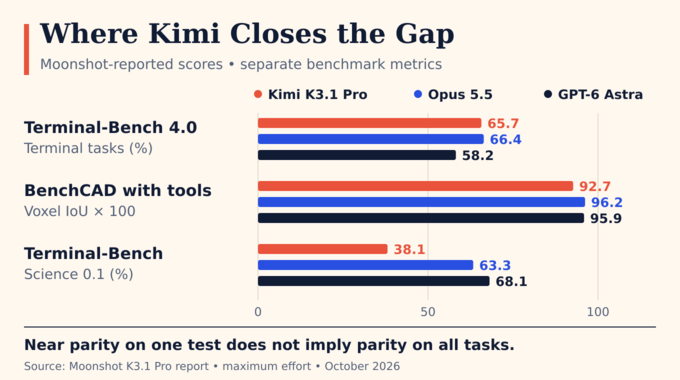
A coding agent can look almost tied with Claude on one test and fall far behind it on the next. Kimi K3.1 Pro makes that tension unusually concrete: Moonshot reports 65.7% on Terminal-Bench 4.0 against Claude Opus 5.5’s 66.4%, yet only 31.5 against Opus’s 65.0 on ProgramBench’s binary scoring.
Released October 23, 2026, Moonshot’s new flagship combines a million-token context window, stronger agent training and standard API rates of $2 per million input tokens and $10 per million output tokens. Independent testing supports a substantial advance. Whether developers should switch depends on the work, reasoning consumption and latency. Here is what the release evidence establishes as of October 24.
Table of Contents
1. Kimi K3.1 Pro: What Moonshot AI Just Released
Moonshot’s release report introduces a post-trained successor to K3, available through Kimi’s apps, Work, Code and API. Highspeed offers the same advertised capabilities with faster output. The full weights are promised by November 4, so “open-weight” describes the intended release, not a download already available at this cutoff.
| Item | Verified Detail |
|---|---|
| Launch | October 23, 2026 |
| Model Class | 3T-class, post-trained from Kimi K3 |
| Maximum Context | 1,048,576 tokens; product entitlements vary |
| Inputs | Text and visual input; Code documentation lists image and video |
| Standard API | Input $2; output $10 per 1M tokens |
| Highspeed | Advertised 2–3× output speed |
| Weights | Promised by November 4, 2026; pending at cutoff |
For the preceding generation’s architecture and deployment background, see our Kimi K3 analysis. This launch primarily changes post-training and product economics.
2. Inside Kimi K3.1 Pro: Architecture, Reinforcement Learning And 1M Context
Moonshot describes larger post-training compute and joint reinforcement learning across hundreds of domains. Reinforcement learning rewards useful behavior in task environments: the agent acts, receives feedback and adjusts its policy through training. The report highlights infrastructure improvements in rollouts, sandboxes, long-context inference and environment checks, without publishing enough detail to reproduce the training run.
“3T-class” is a size category, not proof that three trillion parameters activate for every token. Artificial Analysis lists 2.8 trillion total and 104 billion active parameters. Sparse activation reduces computation per token, but the full weights still need storage. The launch report does not establish a new architecture relative to K3.
The distinction matters for researchers: larger training investment is an explanation offered by the developer, while benchmark gains are the reported observations. Without ablations isolating individual changes, readers cannot assign a particular improvement to sandbox engineering, reinforcement-learning scale or a specific data intervention.
A million-token window lets an agent carry more documents and tool history. It does not guarantee accurate recall throughout that window. Our context engineering guide and analysis of context rot explain why selecting and verifying evidence remains necessary. Visual understanding also differs from native 3D generation: Kimi can produce code that drives modeling tools.
3. Kimi K3.1 Pro Benchmarks: Complete Performance Comparison
Below are all 47 comparison rows from Moonshot’s official dataset, preserving missing values, internal-test labels and score precision. Fable means Claude Fable 5.1, Astra means GPT-6 Astra, Opus means Claude Opus 5.5, and DeepSeek means DeepSeek-V4.1-Flash-1017. All columns use maximum effort; the three proprietary columns are labeled “with fallback” in the source. NR means not reported, not zero.
| Benchmark | K3.1 Pro | Fable | Astra | Opus | DeepSeek | GLM-5.3 |
|---|---|---|---|---|---|---|
| Coding | ||||||
| Terminal-Bench 4.0 [Claude Code] | 65.7 | 57.9 | 58.2 | 66.4 | 42.3 | 41.8 |
| Terminal-Bench Science 0.1 [Claude Code] | 38.1 | 40.0 | 68.1 | 63.3 | 15.7 | 8.1 |
| SWE Marathon v1.1 [Claude Code] | 51.7 | 45.6 | 42.5 | 46.3 | 40.0 | 42.5 |
| BenchCAD w/o tools | 72.8 | 60.6 | NR | 73.0 | 41.2 | NR |
| BenchCAD w/ tools | 92.7 | 92.6 | 95.9 | 96.2 | 81.6 | NR |
| Program Bench [Claude Code] | 31.5 | 53.5 | 50.0 | 65.0 | 29.1 | 19.0 |
| DeepSWE v1.1 [Claude Code] | 75.5 | 67.4 | 74.1 | 74.2 | 77.0 | 66.9 |
| PostTrain Bench v1.2 [Claude Code] | 36.5 | 44.6 | 41.9 | 43.8 | 30.5 | 34.5 |
| Kimi Code Bench 2.0 (Internal) [Claude Code] | 77.1 | NR | NR | NR | 76.1 | 61.7 |
| Kimi Code Bench 3.0 Long-horizon (Internal) [Claude Code] | 61.2 | 58.8 | 66.5 | 58.5 | 51.5 | 45.5 |
| Agentic | ||||||
| HLE-Full w/ tools | 70.0 | 65.6 | 57.2 | 67.7 | 58.8 | 62.5 |
| BrowseComp | 92.1 | NR | 91.5 | 90.8 | NR | NR |
| BioMysteryBench | 80.6 | 81.6 | 78.9 | 81.9 | 80.0 | 79.6 |
| CharXiv (RQ) w/ python | 93.4 | 92.7 | 92.8 | 93.8 | 85.6 | NR |
| MMMU-Pro w/ python | 90.0 | 88.4 | 87.8 | 89.8 | 82.5 | NR |
| GDP.pdf w/ python | 85.7 | 83.8 | 85.5 | 83.9 | 73.0 | NR |
| ChartoGraphy w/ python | 90.2 | 88.4 | 91.0 | 89.0 | 83.0 | NR |
| BabyVision w/ python | 95.4 | 95.1 | 96.6 | 97.7 | 92.5 | NR |
| ZeroBench_main w/ python (pass@5) | 63.0 | 59.0 | 58.0 | 61.0 | 51.0 | NR |
| Agents’ Last Exam (ALL) | 43.2 | NR | 32.8 | 42.6 | 37.7 | 26.2 |
| Agents’ Last Exam (CLI) | 44.2 | NR | 38.8 | 40.7 | 36.0 | 29.4 |
| Automation Bench-AA | 73.3 | 59.4 | 68.5 | 69.5 | 66.6 | 62.2 |
| GDPval-AA v2.1 (Elo-score) | 1846 | 1754 | 1573 | 1866 | 1746 | 1650 |
| AA-Briefcase v1.1 (Elo-score) | 1678 | 1672 | 1569 | 1803 | 1570 | 1507 |
| APEX-Agents | 67.2 | 68.6 | 64.7 | 73.5 | 63.4 | 56.6 |
| OfficeQA Pro v2 | 64.4 | 54.5 | 54.4 | 62.2 | 40.4 | 31.1 |
| OfficeQA Pro | 67.4 | 68.6 | 66.2 | NR | 62.4 | 58.6 |
| Frontier Finance | 58.6 | 60.8 | 45.0 | 56.7 | 54.5 | 57.5 |
| Harvey Legal Agent | 23.7 | 19.1 | NR | NR | 21.0 | NR |
| HANDBOOK.md | 44.6 | 38.8 | NR | 41.5 | 28.9 | 20.8 |
| OSWorld V2.1 | 79.6 | 80.7 | 75.8 | 81.8 | 69.3 | NR |
| Business Operation (Internal) | 37.8 | 30.7 | 32.3 | NR | 8.9 | 18.6 |
| DECK-Arena (Internal, Elo-score) | 1456 | NR | 1423 | 1253 | 1231 | 1119 |
| Design Bench (Internal, Elo-score) | 957 | NR | 1076 | 927 | 863 | 718 |
| Kimi Hallu Bench Hard w/ tools (Internal, lower is better) | 8.3 | 23.3 | 5.5 | 15.0 | 23.3 | 22.6 |
| Reasoning & Knowledge & Multimodal | ||||||
| GDP.pdf | 34.6 | 27.6 | 34.2 | 30.6 | 17.2 | 11.2 |
| HLE-Full | 51.1 | 57.6 | 53.6 | 59.8 | 42.6 | 43.0* |
| HLE-Diamond | 39.4 | 55.1 | 65.8 | 60.9 | 21.6 | 25.1* |
| GPQA-Diamond | 94.2 | 93.7 | 96.1 | 93.9 | 92.2 | 91.7 |
| CharXiv (RQ) | 89.0 | 88.8 | 90.0 | 92.1 | 77.0 | NR |
| MMMU-Pro | 84.1 | 86.3 | 86.9 | 87.7 | 80.6 | NR |
| ZeroBench_main (avg@5 / pass@5) | 29.8 / 39.0 | 23.0 / 35.0 | 43.2 / 52.0 | 35.0 / 43.0 | 11.8 / 23.0 | NR |
| PerceptionBench | 68.3 | 63.0 | 77.6 | 72.1 | 47.7 | NR |
| Kimi Hallu Bench w/o tools (Internal, lower is better) | 5.4 | 11.4 | 4.2 | 6.8 | 13.1 | 14.8 |
| Cyber Security | ||||||
| ExploitBench | 74.7 | 83.0 | 100 | 91.0 | NR | 54.4 |
| ExploitGym | 20.7 | 30.4 | 42.4 | 34.5 | NR | 15.0 |
| xdev-bench-hard (Internal) | 81.0 | NR | NR | NR | 85.7 | 57.1 |
Scores retain their source scales: Elo rows are ratings, BenchCAD measures voxel intersection-over-union, hallucination rows are claim-error rates, and most other rows use percentage-scaled benchmark scores. Higher is better except the two hallucination rows. Asterisks on GLM’s HLE results indicate text-only subsets. ZeroBench retains average-over-five and best-of-five results separately.
Moonshot normally uses temperature 1.0 and top-p 0.95. These are compiled comparisons, not one uniform experiment: harnesses, datasets and judges differ. ProgramBench counts a task only at 95% or higher. BenchCAD open-model testing uses 1,000 sampled cases from 17,900. PostTrainBench substitutes H20 hardware and a different judge. Terminal-Bench Science uses an older DeepSeek checkpoint. GDP.pdf with Python uses rubric-level averaging, whereas its tool-free row uses strict passing, so their gap is not a clean tool-effect estimate.
OfficeQA agents receive PDFs as images rather than extracted text. Moonshot assigns zero where an agent retrieves reference answers online. That scoring decision matters when comparing results with other evaluations. Public benchmark names do not automatically mean identical evaluation procedures, and private tasks remain harder for outsiders to audit.
4. Kimi K3.1 Pro Vs Claude Opus 5.5 And GPT-6 Astra: Who Actually Wins?
The useful answer is domain-specific. Kimi leads both rivals on SWE Marathon and OfficeQA Pro v2 in this table. Opus leads Terminal-Bench, BenchCAD and ProgramBench. Astra leads Terminal-Bench Science and HLE-Diamond by substantial margins. Kimi’s tool-assisted HLE score should not be substituted for its tool-free knowledge score.
The Kimi K3.1 Pro vs Claude Opus 5.5 comparison therefore favors testing sustained engineering and document workflows first. The Kimi K3.1 Pro vs GPT-6 Astra comparison is less convincing for scientific terminal work. Our Opus 5.5 cost-per-task analysis and GPT-6 Astra review provide the surrounding release context.
An agent harness supplies tools, memory management and stopping rules. Changing that software can change a model’s measured performance, so a narrow score difference alone does not establish superiority inside your application.
5. Independent Benchmarks: Does Real-World Performance Match The Hype?
Artificial Analysis’s model page reports an Intelligence Index of 55, approximately 73.5 output tokens per second and $2.11 per evaluation task. The speed measures token generation, not complete task turnaround. Its October 23 launch analysis instead lists $1.98 per task and roughly 55,000 output tokens per task. Those are distinct snapshots, not interchangeable prices.
The independent launch evaluation reports 67% on Terminal-Bench, versus Moonshot’s 65.7%. Neither should silently replace the other. Artificial Analysis also reports a 44% AA-Omniscience hallucination rate, measuring something different from Moonshot’s claim-level stress test. Cross-benchmark subtraction would be meaningless.
These results strengthen the case for an advance, but this Kimi K3.1 Pro review is an evidence assessment, not a Binary Verse AI hands-on replication. The lesson from our earlier independent Kimi comparison still applies: evaluate completed tasks, retries and human corrections.
6. Real-World Capabilities: Coding, 3D Games, CAD And Financial Research
Moonshot’s demonstrations connect code generation to working tools. One Unreal Engine scene uses Blender-generated geometry, MetaHuman and external assets. That demonstrates orchestration within an existing ecosystem, not the invention of every texture or engine component.
A more revealing internal example involves a walking simulator: Moonshot reports 167 missions, 420 reviews, corrections to 36 shoulder-muscle calculations and eventual alternating strides for 11.2 seconds. This is an illustrative trajectory, not a measured reliability rate across arbitrary simulation projects.
BenchCAD tests reconstruction through CAD code, while OfficeQA tests document retrieval and numerical reasoning. Neither certifies manufacturing tolerances or financial forecasts. Moonshot’s finance chart reports modeling scores of 57.6 versus K3’s 50.4, and research scores of 70.4 versus 58.8. Its business-operation chart shows 37 versus 8.9, while the full table shows 37.8 for K3.1 Pro. That source mismatch remains unresolved.
7. Hallucinations, Accuracy And The Deliberate Cybersecurity Restrictions
On internal Kimi Hallu Bench Hard, claim-level hallucinations fall from K3’s 23.4% to 8.3%. The share of responses containing an error is 42.4% of K3’s rate, not an absolute 42.4% response-error rate. Moonshot explicitly says these deliberately difficult prompts do not measure everyday error frequency. Our hallucination explainer provides the wider reliability context.
Moonshot also removes cyber-related mid-training data and reinforcement-learning tasks. Its unrestricted checkpoint solves 90.5% on internal xdev-bench-hard, compared with 81.0% for the release model and 33.3% for K3. Here means success within three attempts, not first-attempt reliability. Runs have no hard time or output-token limit. The reduction supports a narrower capability claim, not proof that misuse is prevented.
8. Kimi K3.1 Pro Pricing: API Costs, Caching And Real Task Economics
The official Kimi API platform lists the following USD rates. They are token charges, separate from consumer memberships, with no monthly subscription implied.
| Token Category | K3.1 Pro | High | K3 |
|---|---|---|---|
| Input | $2 | $4 | $3 |
| Output | $10 | $20 | $15 |
| Cache Hit | $0.20 | $0.20 | $0.30 |
| Cache Write | $2 | $4 | $3 |
For standard inference, let count uncached input tokens, cached-hit tokens and billable output tokens, including reasoning. Ignoring tool charges, the estimated token cost in dollars is:
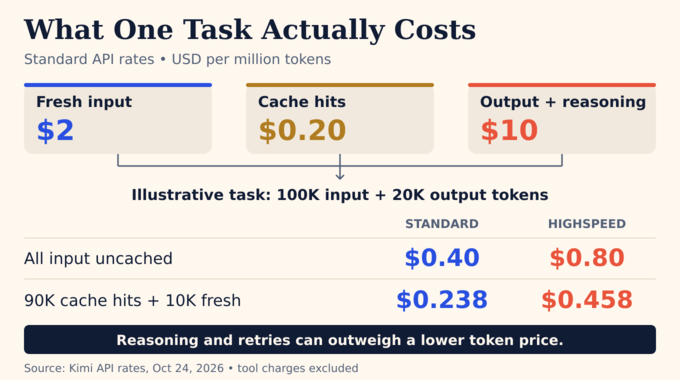
For 100,000 uncached input tokens and 20,000 output tokens, standard costs $0.40 and Highspeed $0.80. If 90,000 input tokens are cache hits and only 10,000 are fresh, those totals become $0.238 and $0.458. Treat cache writes at their stated rate without counting the same input twice.
Anthropic’s pricing documentation lists Opus 5.5 at $4 input and $20 output, but its cache-hit rate is also $0.20. Kimi’s standard fresh-token rates are half Opus’s, not a guarantee of half the task cost. Tokenization, reasoning length and retries matter. Use our LLM pricing comparison to frame a workload budget.
9. Kimi K3.1 Pro Highspeed: Faster Responses, Higher Costs And Usage Limits
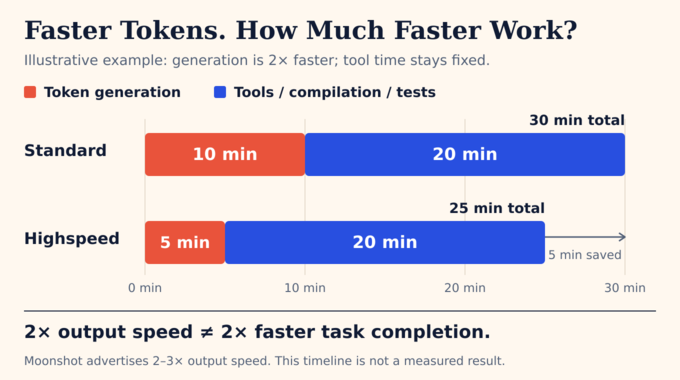
Kimi K3.1 Pro Highspeed advertises roughly 2–3× faster output, with approximately twice the Code quota consumption. Cache hits remain equally priced. A task dominated by tests, browsing or rendering will accelerate less than its token stream.
For example, accelerating ten minutes of generation to five minutes saves five minutes, even if the same job still requires twenty minutes of compilation and tool execution. This hypothetical illustrates why output speed and end-to-end productivity should be measured separately. A responsive stream can feel better without halving delivery time.
Thinking cannot be disabled. The Code default is maximum effort, and changing effort or models invalidates the context cache. These documented mechanisms can explain unexpectedly fast quota consumption, but cannot prove the cause of an individual complaint. Kimi K3.1 Pro usage limits depend on membership and workload. Test lower effort before paying for faster decoding, then compare quality and total completion time.
10. How To Access Kimi K3.1 Pro: API, Subscriptions, Open Weights And Local Hardware
The Kimi Code model documentation lists k3.1-pro and k3.1-pro-highspeed. The general API release names are kimi-k3.1-pro and kimi-k3.1-pro-highspeed. Use the identifier for your endpoint. Code’s new plans allow standard access from Plus, with full 1M context and Highspeed from Pro. Enterprise administrators must enable access at launch.
Kimi K3.1 Pro local requirements remain provisional until weights, formats and licensing arrive. At 2.8 trillion parameters, a hypothetical four-bit copy needs about 1.4 terabytes for weights alone, excluding cache and runtime overhead. That arithmetic is not a supported deployment recipe. As our DeepSeek V4 deployment discussion illustrates, sparse activation does not make total-weight storage disappear. Ordinary desktop hardware is an unrealistic target for the full model.
11. Kimi K3.1 Pro Verdict: Who Should Switch And Who Shouldn’t?
Developers with long engineering jobs and researchers processing document collections have good reasons to run a controlled pilot. Keep identical tools, inputs and acceptance tests. Record successful completion, wall time, token categories and review effort. Companies should additionally verify data handling and model availability before migration.
Budget-sensitive users should start with standard inference and deliberate context management. Users needing the strongest demonstrated scientific-terminal performance, predictable short responses or immediate self-hosting have reasons to wait or retain alternatives. Kimi K3.1 Pro closes meaningful gaps, while leaving others plainly visible. Follow Binary Verse AI for evidence-led model analysis, and make your next model decision with a small workload evaluation rather than a launch-day leaderboard.
What is Kimi K3.1 Pro, and what can it do?
Kimi K3.1 Pro is Moonshot AI’s 3T-class flagship reasoning model, released October 23, 2026. It targets coding, tool-using agents, 3D workflows, financial analysis and multimodal research, with context support up to 1,048,576 tokens. Capabilities and access depend on the product and plan.
Is Kimi K3.1 Pro better than Claude Opus 5.5 or GPT-6 Astra?
Not universally. Moonshot reports 65.7% on Terminal-Bench 4.0, versus 66.4% for Opus 5.5 and 58.2% for GPT-6 Astra. Kimi leads some engineering and agent evaluations but trails on others, including BenchCAD and scientific terminal tasks. Harnesses, settings and independent results affect the comparison.
How much does Kimi K3.1 Pro cost, and is it free?
As checked October 24, 2026, the standard API costs $2 per million input tokens and $10 per million output tokens. Highspeed costs $4 and $20 respectively. Cache hits cost $0.20 per million tokens for both. These are paid API rates. Web access, any free allowances and coding subscriptions have separate entitlements.
What is Kimi K3.1 Pro Highspeed, and is it worth the extra cost?
Moonshot advertises approximately 2–3× faster output with equivalent model capabilities. Highspeed doubles fresh input and output prices and uses about twice the standard Kimi Code quota, while cache-hit pricing stays the same. Its value depends on latency needs, reasoning consumption, cache use and time spent executing tools.
Why does Kimi K3.1 Pro consume usage limits so quickly?
K3.1 Pro requires thinking mode, and Kimi Code defaults to maximum reasoning effort. Longer reasoning can consume more output tokens. Changing models or thinking effort invalidates context caches and requires fresh processing. Highspeed also uses approximately twice the regular coding quota. These mechanisms do not establish the cause of every user’s quota experience.
Does every user get Kimi K3.1 Pro’s one-million-token context window?
No. The model supports up to 1,048,576 context tokens, but Kimi Code’s new-plan documentation reserves the full 1M context for Pro members and above. Plus users can access the standard model with different entitlements. Legacy plans have separate eligibility rules, so check the plan attached to your account.
Is Kimi K3.1 Pro open source, and can it run locally?
As of October 24, 2026, the full weights are pending: Moonshot promises them by November 4. The eventual license must be checked before calling the release open source. A full model at this scale requires substantial infrastructure. Weight formats, supported inference software and deployment requirements remain to be verified after release.