

Prime factors can be counted, but their parity has resisted a deceptively simple prediction for decades. The two-point Chowla conjecture asks whether the even-or-odd factor counts of two integers a fixed distance apart become uncorrelated. OpenAI’s September 24, 2026 manuscript claims a proof for ordinary averages at every cutoff, with a power-of-logarithm saving. It also proves a broader binary corrected Elliott theorem under a precise nonpretentiousness assumption.
The paper appeared in OpenAI’s October mathematics release. Its significance lies in removing exceptional averaging scales, not in producing a practical factoring algorithm. Here is what the argument actually establishes and how its machinery fits together.
Table of Contents
1. What Is the Two-Point Chowla Conjecture?
The Liouville function records prime-factor parity:
Here counts prime factors with multiplicity. Since , its count is three and . For , the count is one, so the product . Conversely, has even parity, giving .
A positive product means matching parity. A negative product means different parity. The conjecture predicts that neither outcome retains a positive proportional advantage as the interval grows. Individual pairs need not behave randomly, and prime factorization certainly follows arithmetic rules. The statement concerns their aggregate correlation.
1.1. Two-Point Chowla Conjecture: Key Facts
| Key Fact | Precise Scope |
|---|---|
| Manuscript | OpenAI, September 24, 2026. Public release: October 6, 2026. |
| Main Claim | Ordinary Liouville correlation cancellation at every real cutoff. |
| Quantitative Bound | , with one absolute ; constants depend on fixed forms. |
| Affine Hypotheses | Fixed integers , , and . |
| Second Theorem | Qualitative binary corrected Elliott cancellation under uniform nonpretentiousness. |
| Verification Evidence | Manuscript and Lean solution targets are published; independent reproduction is a separate question. |
Chowla’s 1965 formulation provides the 61-year historical reference. “Two-point” specifies a binary correlation, not a claim about all higher-order patterns.
2. OpenAI’s Exact Two-Point Chowla Theorem: What Was Proved?
Theorem 1.1 in Ordinary Two-Point Correlations of Multiplicative Functions states that some absolute satisfies
The integers and are fixed, their determinant is nonzero, and may be real. No coprimality assumption is imposed. Setting both slopes to one and the offsets to zero and a fixed positive gives the ordinary two-point Chowla conjecture:
Dividing the bound by explains the guarantee: the parity imbalance tends to zero at a logarithmically controlled rate. The exponent is independent of the forms. The constant is not, and the paper does not promise effective constants. This is the same distinction between an asymptotic theorem and a usable threshold that matters in our irrationality-exponent analysis.
3. Why Did Ordinary Averaging Resist Proof for 61 Years?
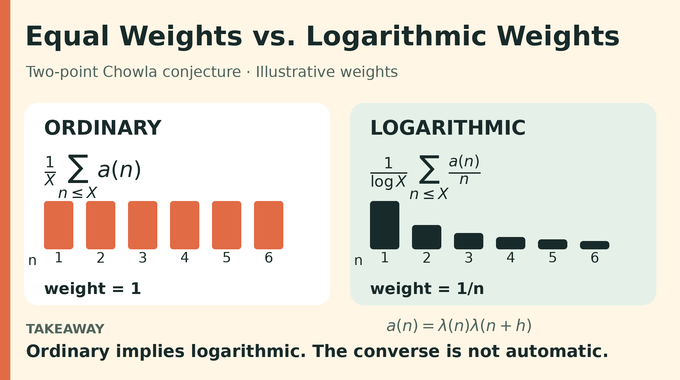
Counting prime factors without tracking parity is often accessible to sieve methods. Distinguishing odd from even counts is their notorious parity barrier. Information about individual divisibility events does not automatically determine the signed correlation of two complete factorizations.
Ordinary and logarithmic averages also demand different information. For a bounded sequence , their normalizations are
Ordinary averaging gives every integer equal weight. Logarithmic averaging gives roughly comparable influence to successive multiplicative ranges. A troublesome terminal range can matter greatly to the first average while contributing little to the second.
Partial summation transfers ordinary cancellation to logarithmic cancellation. The reverse implication does not follow automatically: cancellation accumulated across many scales can conceal exceptional individual scales. A power-of-logarithm saving for a logarithmically weighted sum therefore cannot simply have its weight removed.
For a concrete picture, the interval from one million to two million contains half the integers in the prefix ending at two million. Its reciprocal weight, however, is about the logarithm of two. Against the logarithmic weight of the whole prefix, that is a shrinking share. This illustrates the weighting problem without suggesting that Liouville actually has persistent bias on that interval.
Reciprocal weights also appear in the Erdős–Turán progression problem, but there they define the hypothesis. Here, changing the weight changes the correlation theorem itself.
4. From Tao’s 2015 Breakthrough to the Remaining Every-Scale Barrier
Tao’s logarithmically averaged Chowla and Elliott paper first appeared in 2015 and was published in 2016. It established binary cancellation with logarithmic weights, using multiplicativity, short-interval estimates, and an entropy decrement argument. It did not establish equal-weight cancellation at every cutoff.
4.1. Earlier Results and the Remaining Averaging Gap
| Contributor | What Earlier Work Established |
|---|---|
| Matomäki–Radziwiłł–Tao | Short-interval and exponential-sum tools, plus cancellation averaged over growing windows of shifts. |
| Tao | Logarithmically averaged binary cancellation for fixed nonproportional affine forms. |
| Helfgott–Radziwiłł | Divisibility-graph expansion and quantitative cancellation for the logarithmically weighted consecutive-pair sum. |
| Pilatte | A power-of-logarithm improvement for that weighted sum, retaining logarithmic averaging. |
| Tao–Teräväinen | Ordinary binary cancellation outside exceptional scales; later quantitative progression estimates still permit exceptional scales. |
OpenAI’s proof extends this machinery through new residue comparisons, weighted graph estimates, and a transfer back to ordinary averages. Calling it simply a new parity trick would miss the architecture. The historical deadlock concerned the strongest averaging target, not an absence of progress for six decades.
5. The Key New Argument: Turning Liouville Correlations Into a Divisor Graph
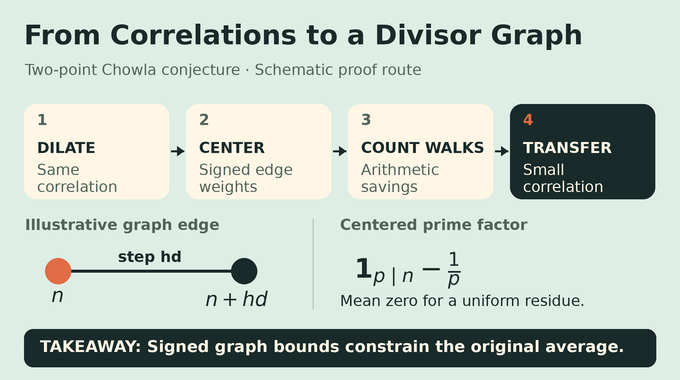
Liouville is completely multiplicative: , even when the factors share primes. Consequently,
The two dilation factors cancel because . This identity lets the proof trade a correlation at separation for divisor-weighted correlations at separations .
Imagine integers as graph vertices. An admissible divisor produces an edge connecting an integer to another displaced by . Edge weights carry divisibility tests, signs, and normalization factors. The graph is an arithmetic device, not a sampled social network.
Testing its operator against a suitably weighted Liouville vector recovers the correlation information. Thus bounding the operator can force cancellation in the original average. The difficult work is designing edges whose total useful mass remains large while their signed action remains small.
As in the Sidorenko graph argument, graph language becomes informative only after the exact weights and counting convention are specified.
6. Prime Supplies, Padding Divisors, and Centered Correlations
The quantitative proof chooses one prime from each of disjoint supplies. Each supply has reciprocal mass comparable to a large fixed parameter . Their product supplies a composite divisor with many possible prime labels.
For each selected prime, the signed factor is
The indicator is one when divides , and zero otherwise. Under a uniform residue modulo , divisibility has probability . Subtracting that probability makes the factor have mean zero. Products of centered factors carry the cancellation that ordinary positive divisor weights lack.
Separate primes form a squarefree padding divisor, so no padding prime repeats within that divisor or overlaps the centered supplies. Padding distributes divisor weight across short multiplicative intervals. It prevents excessive concentration from undermining the graph normalization.
The proof groups products into narrow logarithmic bins, controls unusually large degrees and rare sites, and bounds the discarded edge mass. Deletion must cost little relative to the useful divisor mass.
The governing comparison is favorable: centered supplies contribute mass at least , whereas the operator estimate costs roughly . Making sufficiently large eventually creates exponential decay in .
7. How the Proof Replaces Integer Averages With Independent Prime Residues
Independent residues make centering transparent, but actual integers do not arrive as independent random coordinates. The product of all relevant primes can vastly exceed the averaging interval. Averaging over their full joint period is therefore unavailable.
Lemma 3.1 compares only the residue tests required by the argument. It represents those tests with Boolean circuits of controlled depth and size, then compares their probabilities under integer-origin residues and independent uniform residues. Translated tests share the same coordinate modulo a given prime. Different vertices do not receive fresh, independent residues.
The proof encodes residues as bits using auxiliary random jitter. Small collections of bits are nearly uniform because their associated modulus fits within the available averaging scale. A Fourier correction converts this approximate bounded independence into exact bounded independence while preserving a nonnegative probability distribution.
Braverman’s theorem then says that sufficiently independent bits fool the relevant bounded-depth circuits. Encoding and correction errors are included in the final comparison budget.
The Boolean circuits here recognize arithmetic events. They serve a different purpose from the information-carrying functions in the Courtade–Kumar problem. Their role is to justify a finite-scale probabilistic replacement, not to assume away arithmetic dependence.
8. Prohibited Paths and High-Trace Estimates: Where Cancellation Appears
Powers of a graph matrix expand into weighted walks. Traces and related high moments encode closed configurations of those walks. Large operator action would force sufficiently large moments, so bounding the walk expansion constrains the graph.
Not every configuration behaves alike. Repeated prime labels impose congruence relations among step displacements. Many independent relations provide direct arithmetic savings, provided they can be summed in an order that preserves independence of the remaining coefficients.
Primes appearing only once supply another opportunity. Their centered factors cancel on averaging over the corresponding residue. However, deletion predicates and vertex weights can depend on those residues. The proof integrates signed factors before taking absolute values and tracks the resulting mixed differences. Simply declaring every singleton contribution zero would be wrong.
Prohibited paths identify rare arithmetic configurations whose starting sites can be removed at small cost. Their exclusion restricts how prime labels may disappear, recur, or produce zero-displacement subpaths.
For the remaining walks, a forest records repetition patterns. Crucially, the pattern count is uniform over padding values, allowing those values to be summed afterward in a common residue environment. Otherwise apparently harmless padding could multiply the combinatorial cost.
Together, centering, congruence savings, and forest counting produce the high-moment estimate with the square-root dependence on needed by the final parameter choice.
The nonbacktracking construction keeps consecutive whole prime tuples unequal, preventing immediate tuple repetition from overwhelming the useful moment estimate. It is not a blanket prohibition on revisiting vertices. The proof needs closed configurations, but it distinguishes their repetition patterns carefully. That distinction connects the combinatorics to the spectral estimate rather than merely making the graph look sparse.
9. Spectral Transfer: How OpenAI Gets a Logarithmic Saving at Every Cutoff
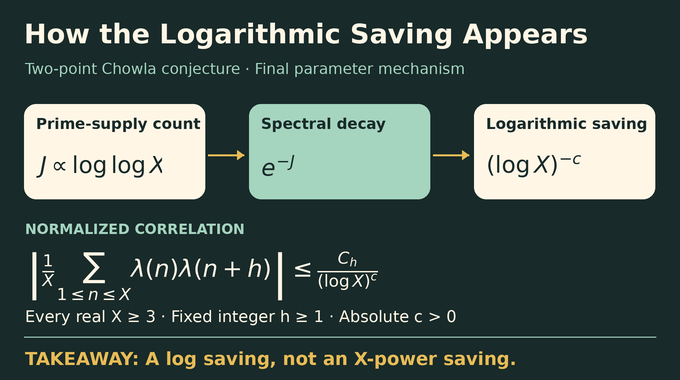
The moment estimate becomes useful only after transfer to the self-adjoint edge operators tested against Liouville. The proof controls exceptional spectral contributions, retains degree projections, and averages overlapping blocks. Boundary edges and floor errors must also fit the error budget.
There are roughly short multiplicative bins, where is a small fixed power of and controls bin width. An edge-normalization factor compensates for the factor in their number. The remaining exponential losses in are absorbed by choosing after the absolute graph constants.
Section 8.4 obtains a bound proportional to . Since grows proportionally to , this becomes a power of . The manuscript specifies , with and absolute auxiliary constants .
This is not a bound of order . Its strength is ordinary cancellation at every real cutoff. Small cutoffs are covered by enlarging the implied constant, rather than discarding an exceptional sequence of scales.
10. The Corrected Elliott Conjecture: OpenAI’s Second Proof
Theorem 1.2 replaces Liouville with complex multiplicative functions of modulus at most one. Multiplicativity is required only for coprime arguments. At least one original factor must be uniformly nonpretentious.
Pretentious distance measures resemblance on primes:
Here is a Dirichlet character, is real, and supplies a logarithmic phase. Uniform nonpretentiousness means that, for every fixed character, the infimum of this distance over tends to infinity. Excluding only resemblance to each fixed twist would miss functions that imitate changing frequencies at successive scales.
Under that hypothesis, every fixed pair of distinct nonnegative shifts satisfies
There is no conjugation in this displayed theorem. Conjugated correlations follow by conjugating a factor, which preserves the condition.
The proof uses a distinct weighted divisor graph with two prime bands. Higher core primes regulate divisor size and vertex normalization. Lower center primes provide additional signed cancellation matched to those weights, rather than literal mean-zero factors under uniform residues.
A persistent bias would exceed the graph bound after centering. The argument fixes the auxiliary graph scale first, takes the long-average limit, then increases that scale. Nonpretentiousness has no prescribed divergence rate, so this contradiction yields qualitative convergence without a universal quantitative rate.
11. Beyond Consecutive Integers: Fixed Shifts, Residue Classes, and Affine Forms
The final deductions permit every fixed residue class, including nonunit and zero classes. Restricting to a progression is therefore part of the theorem, not an informal expectation of uniform behavior.
The modulus remains fixed while the cutoff grows. This qualification matters because estimates for an expanding family of progressions would require additional uniformity that the stated theorem does not supply.
For affine forms, the key condition is
It excludes proportional forms. For example, and are proportional, and their Liouville product is identically one because both and equal minus one. No cancellation theorem could cover that pair.
By contrast, and have nonzero determinant. Multiplying their arguments by the opposite slopes places them on a common progression with a fixed nonzero separation. Complete multiplicativity then reduces the Liouville case to the established progression estimate.
For general multiplicative functions, finite local modifications and expansions handle the primes involved in the coefficients. Changing finitely many prime values alters squared pretentious distance by a bounded amount, preserving divergence. The quantitative Liouville bound and qualitative Elliott conclusion both retain their original distinction after this affine transfer.
12. What OpenAI’s Proof Does Not Establish and What Remains to Verify
This Chowla conjecture proof concerns two factors. It does not establish higher-point correlations, uniform estimates for coefficients growing with the cutoff, or a practical algorithmic speedup. The logarithmic exponent should not be turned into a benchmark. Our exact DFT analysis likewise separates theoretical guarantees from measured performance.
As checked on October 12, 2026, the public manuscript matches the uploaded PDF. The repository supplies Comparator challenges for Theorem 1.1, Theorem 1.2, and the affine Elliott corollary, linked to Lean solution declarations. The stated targets cover the quantitative bound, including real cutoffs, and both qualitative conclusions.
Those published artifacts are distinct from independently reproducing their checks or accepting the manuscript’s mathematical exposition. This article does not report a fresh Lean compilation or completed independent review. For that distinction, see our guide to theorem proving and Lean formalization.
The two-point Chowla conjecture advance is precisely every-cutoff cancellation under fixed arithmetic data. Follow Binary Verse AI for source-led explanations of the proof and substantive verification updates.
Has the two-point Chowla conjecture finally been proved?
OpenAI’s manuscript dated September 24, 2026, publicly released on October 6, claims a proof of the ordinary two-point Chowla conjecture. It gives a power-of-logarithm bound for every fixed positive shift at every real cutoff. The repository includes Lean solution declarations and Comparator targets for the main results. Published proof artifacts should be distinguished from independently reproducing their checks and completing mathematical review.
What is the formula for the two-point Chowla conjecture?
For every fixed positive integer , the conjecture states . Here , with prime factors counted with multiplicity. OpenAI’s quantitative theorem bounds the absolute unnormalized sum by for an absolute .
How does OpenAI’s proof differ from Terence Tao’s 2015 result?
Tao’s paper, first posted in 2015 and published in 2016, proves logarithmically averaged binary cancellation, with summands weighted by . OpenAI’s manuscript claims equal-weight cancellation at every cutoff. It develops divisor graphs, centered prime factors, finite-residue comparisons, high-moment bounds, and spectral transfer, building on earlier short-interval and graph methods.
Does OpenAI’s result prove the full Chowla conjecture?
No. The manuscript addresses two-point correlations, including fixed shifts and fixed nonproportional affine forms. The full Chowla conjecture concerns any fixed number of distinct shifts. Higher-point cases are not established here, and the quantitative theorem asserts no uniformity for affine coefficients that grow with the cutoff.
What is the corrected Elliott conjecture, and why is it included?
The corrected Elliott conjecture extends correlation cancellation to bounded multiplicative functions. OpenAI’s binary theorem requires at least one original factor to be uniformly nonpretentious: for every fixed Dirichlet character, its pretentious distance from twists diverges uniformly over as the prime cutoff grows. Under that condition, ordinary two-point averages tend to zero, including fixed nonproportional affine forms. The conclusion is qualitative, without a universal convergence rate.