

A cube looks ordinary until you ask a question mathematicians have spent decades trying to answer: can any symmetric convex shape beat it at a particular geometric balancing act?
The Mahler conjecture concerns a shape and its polar, a mathematical partner whose size changes in response to the original. Multiply their volumes, and you get a quantity that stretching cannot change. The challenge is to find its smallest possible value in every dimension.
OpenAI’s September 22, 2026 manuscript, announced in its October release, claims that exact minimum for every origin-symmetric convex body. It also identifies every shape that achieves equality: invertible linear images of Hanner polytopes. OpenAI lists supporting Lean formalizations, while independent scrutiny remains essential to assessing the announced result.
The significance extends beyond settling a geometric inequality. The claimed theorem supplies sharp functional bounds, and subsequent work connects it to Kalai’s flag conjecture. Understanding that impact starts with a square, a diamond, and a surprisingly productive refusal to let scaling do the work.
Table of Contents
1. What Is the Mahler Conjecture? A Shape and Its Polar
A convex body is a bounded, closed shape with interior and no inward dents. Draw a segment between any two points inside it, and the entire segment stays inside. Squares, balls and solid cubes qualify.
Origin symmetry means that whenever a point belongs to the body, its opposite through the origin belongs too. This allows the body to serve as the unit ball of a norm, a rule for measuring lengths.
Its polar, written (K^\circ), contains the vectors whose dot product with every point of (K) is at most one. Geometrically, those vectors describe linear measurements that never exceed one on the original shape.
Mahler Conjecture: Key Facts and Claimed Proof Scope
| Key Fact | What It Means |
|---|---|
| Quantity Studied | Volume of a convex body multiplied by the volume of its polar. |
| Symmetric Bound | A volume product of at least 4n/n! in dimension n. |
| Claimed Minimizers | Invertible linear images of Hanner polytopes. |
| Manuscript Scope | Every origin-symmetric convex body, in every dimension. |
| Verification Artifacts | OpenAI lists Lean formalizations for the bound and equality classification. |
Enlarge the body, and its polar shrinks. More generally, an invertible linear transformation multiplies their volumes by reciprocal determinant factors. The product stays fixed, so changing coordinates cannot manufacture a better answer.
2. The Mahler Volume Formula, Explained With a Square and a Diamond
Take the square ([-1,1]^2). Its area is four. Its polar is the diamond with vertices ((1,0)), ((0,1)), ((-1,0)) and ((0,-1)), whose area is two.
Their product is eight, exactly (4^2/2!). A larger square produces a smaller diamond, preserving the same result.
The Mahler volume formula is simply
[ P(K)=|K|,|K^\circ|. ]
Here, vertical bars mean volume in the relevant dimension.
Mahler Conjecture Explained: Shapes, Polars and Volume Products
| Body | Polar Body | Volume Product | Lesson |
|---|---|---|---|
| Square [−1, 1]2 | Diamond | 8 | Attains the planar symmetric minimum. |
| Unit Disk | Unit disk | π2 | Larger product than the square. |
| Cube [−1, 1]3 | Octahedron | 32/3 | Matches the bound 43/3!. |
| Stretched Square | Reciprocally stretched diamond | 8 | Invertible linear stretching preserves the product. |
The disk’s value is roughly 9.87. Rounder shapes can therefore have larger products, even though ordinary size alone tells us nothing useful.
The established Blaschke–Santaló inequality places ellipsoids at the maximum. The difficult question concerns the minimum, where several geometrically distinct families compete. Calling this a measure of “roundness” helps intuition, provided we remember that the actual theorem concerns volumes and polarity.
3. Symmetric vs General Mahler Conjecture: Two Different Problems
There are two versions because removing symmetry changes both the bound and the shapes expected to attain it.
For symmetric bodies centered at the origin, the proposed inequality is
[ |K|,|K^\circ|\geq\frac{4^n}{n!}. ]
For general convex bodies, the choice of center matters. The Santaló point selects the translation that minimizes the polar volume. The conjectured bound becomes
[ |K|,|(K-s(K))^\circ|\geq\frac{(n+1)^{n+1}}{(n!)^2}. ]
Simplices are the expected minimizers in this broader setting. A triangle is a two-dimensional simplex, and a tetrahedron is its three-dimensional counterpart.
For dimensions at least two, the general constant is smaller. Consequently, proving the general inequality does not automatically establish the sharper symmetric one. A bound that holds for more shapes can still be too weak for a restricted class.
OpenAI released separate manuscripts for these problems. The symmetric paper uses symmetry throughout its argument, so the claims should retain their separate scope even when headlines bundle them together.
4. Why the Problem Resisted Proof for Decades
Kurt Mahler’s work on the problem dates to the late 1930s. Important progress followed, but several kinds of progress must be distinguished.
The planar case was known. Hiroshi Iriyeh and Masataka Shibata established the full symmetric three-dimensional result, including equality. Other researchers developed shorter arguments and stability results. Work by Shibing Chen, Yuanyuan Li, Dongmeng Xi and Zhe-Feng Xu addressed three-dimensional problems through shadow-flow methods.
Higher-dimensional special cases also mattered. Jean Saint-Raymond proved the sharp bound for unconditional bodies, which remain unchanged under coordinate sign flips. Shlomo Reisner obtained results for zonoids and helped characterize extremizers. Bourgain and Milman established a general reverse volume-product estimate, later strengthened explicitly by Greg Kuperberg.
Yet a good approximate bound leaves the exact constant unsettled. Likewise, a theorem for highly symmetric subclasses does not cover every origin-symmetric body.
The minimum also has many candidates beyond the cube. Their varied structure makes it difficult to devise a universal deformation that improves every shape while preserving the exact bound. The obstacle was proving that no unexpected shape could slip underneath the familiar examples.
5. What OpenAI’s Mahler Paper Claims to Prove
Theorem 1.1 asserts the sharp inequality for every positive integer dimension and every origin-symmetric convex body. Equality holds precisely for linear Hanner bodies, meaning invertible linear images of Hanner polytopes.
That combines two substantial achievements. The inequality rules out smaller products. The equality classification rules out unrecognized minimizers.
No smooth boundary is required. Neither is strict convexity. Polytopes with flat faces and bodies with curved boundaries fall within the same statement.
This is why the OpenAI Mahler conjecture announcement is more substantial than another computation checking a particular dimension. It claims a universal argument across an unlimited sequence of dimensions and all admissible shapes.
The paper also makes its dependencies visible. Classical complex analysis and established results about finite-dimensional normed spaces play central roles. Its proposed contribution lies in connecting those tools tightly enough to obtain the exact constant and characterize equality.
6. Inside the Proof: A Conformal Lens
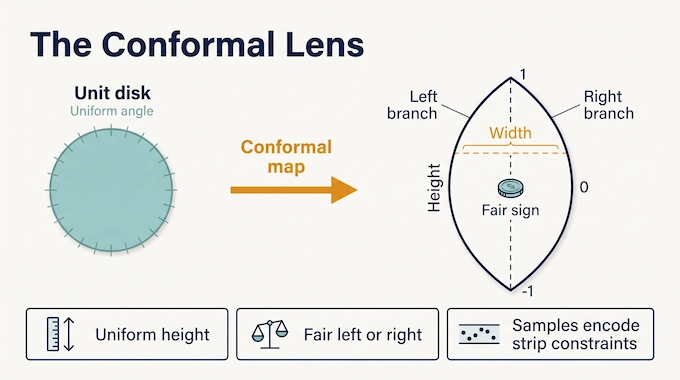
The unexpected object is a lens-shaped region in the complex plane.
A conformal map carries the unit disk into this region. It preserves angles locally, but the property that matters here concerns the boundary: a uniformly chosen angle becomes a uniformly distributed vertical coordinate between minus one and one.
On either boundary branch, height determines the horizontal position through a width function. An independent fair sign chooses the left or right branch. This converts sampling around a circle into sampling a height and a sign with precisely controlled weights.
That is useful because convex polytopes can be described by linear strip constraints. The lens supplies compatible widths for auxiliary constraints, allowing complex boundary samples to encode real geometric information.
The map builds on Renan Gross’s conformal Skorokhod embedding example. The paper proves the properties needed for its own argument, including concavity and endpoint behavior.
The lens is therefore an accounting device. Its boundary distribution aligns analytic probabilities with geometric volume calculations. An arbitrary pretty curve would not provide the same exact correspondence.
7. From Holomorphic Mass to the Sharp Bound
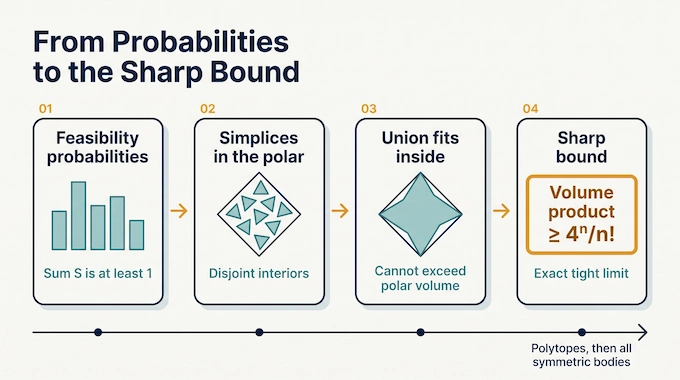
The Mahler conjecture proof first treats symmetric polytopes defined by finitely many strips.
Choose enough independent constraints to determine a point, then sample the associated lens boundary coordinates. The resulting point may satisfy the remaining constraints or fail them. Each independent choice has a feasibility probability.
The analytic step shows that the sum of these probabilities is at least one. It uses a mass estimate for a holomorphic map with an isolated zero, proved through Stokes’ theorem. Taking high powers concentrates the relevant integrals toward boundary samples.
Next comes the geometric translation. The uniform height law turns feasibility probabilities into integrals involving simplices inside the polar body. Their interiors are disjoint outside exceptional configurations of measure zero, so adding their volumes does not silently count the same region twice.
The decisive chain is
[ 1\leq S =\frac{n!}{4^n}\int_K |\Sigma_x|,dx \leq\frac{n!}{4^n}|K|,|K^\circ|. ]
Here, (S) is the probability sum and (\Sigma_x) is a union of feasible simplices contained in the polar. The final inequality follows because that union cannot occupy more volume than the entire polar body.
Rearranging gives the desired lower bound. Approximation by polytopes then extends it to arbitrary symmetric convex bodies.
The distinction matters: numerical sampling suggests probabilities, but the manuscript’s argument proves their required bound analytically. Its control of exceptional cases and limiting bodies is part of the proof, rather than an optional technical appendix.
8. Why Equality Picks Out Hanner Polytopes
Hanner polytopes begin with intervals and grow through two operations: Cartesian products and convex-hull joins in complementary coordinate spaces.
Products of intervals build cubes. Repeated joins build cross-polytopes. Mixing the operations creates further shapes with the same extremal volume product. A cube and an octahedron are familiar members of a larger family.
Showing that these constructions attain the bound follows from volume and polarity formulas. Showing that nothing else does is harder.
The proof tracks how much polar volume the feasible simplex unions leave uncovered. At equality, the integrated deficit vanishes. A carefully controlled passage through approximating bodies turns this into feasibility information for individual points and directions.
The argument then produces a metric median for every triple in the norm defined by the polar body. Such a median lies between every pair according to that norm’s distance. It need not be unique or resemble the center of a Euclidean triangle.
This yields the three-ball intersection property: three closed balls that intersect pairwise share a common point. The balls belong to the relevant normed space and may have different radii.
A classical Hansen–Lima classification identifies these finite-dimensional spaces with recursive constructions using sum and maximum norms. Their unit balls are Hanner polytopes, completing the proposed classification.
9. How Was the Proof Produced, and What Has Been Verified?
OpenAI attributes the manuscripts to an unreleased internal model. Its repository describes an evaluation involving roughly 4,000 problems, with an average result using compute equivalent to about three hours of ChatGPT Pro thinking.
That average is not a measured runtime for this particular paper, nor does it mean a public ChatGPT model can reproduce the result on demand. OpenAI also released an abridged reasoning account for the Mahler family.
Its formalization notes list the symmetric inequality and the Hanner equality characterization. Functional consequences should not be assumed to have identical formal coverage merely because they appear in the manuscript.
Lean checks formal deductions. Assessing a major result also requires checking that the formal definitions, assumptions and final statement match the intended mathematics. Human-readable exposition helps researchers understand the mechanism and reuse it.
For readers asking “Is the Mahler conjecture solved?”, the accurate answer is that OpenAI has announced a solution with supporting formal artifacts. Reporting that claim is different from independently auditing those artifacts or establishing broad community acceptance.
The scientific opportunity includes turning the argument into mathematical understanding. A proof others can explain, check and extend has value beyond its verification status.
10. Functional Mahler and Entropy–Transport Consequences
The geometric result extends to functions through an established implication developed by Matthieu Fradelizi and Mathieu Meyer.
Replace a body with an even convex potential (\varphi), and replace polarity with its Fenchel–Legendre transform (\varphi^*). The manuscript derives
[ \left(\int e^{-\varphi(x)},dx\right) \left(\int e^{-\varphi^*(y)},dy\right)\geq4^n. ]
The first integral must be positive and finite. The potential must satisfy the stated convexity and regularity conditions. This is a sharp statement about a defined class of functions.
An instructive example is (\varphi(x)=\sum_i|x_i|). Its transform is zero on the cube and infinite outside it, and both integrals equal (2^n).
Crucially, the implication uses geometric bounds in arbitrarily high auxiliary dimensions. A proof in one fixed dimension would not supply the same conclusion.
The paper also derives an entropy–transport inequality for symmetric log-concave probability measures under specified continuity and integrability assumptions. It connects their entropy with a transport-related quantity involving moment measures.
These are concrete mathematical consequences. They establish sharp inequalities, while the geometric equality classification alone does not classify every functional equality case or demonstrate a faster learning algorithm.
11. Kalai’s Flag Conjecture and Further Geometry
Martin Winter’s October 7, 2026 paper adds a fresh connection between Mahler volume and the number of flags of a polytope.
A flag is a nested chain of faces, progressing from a vertex through higher-dimensional faces to the whole polytope. For a three-dimensional cube, think vertex, incident edge, incident face, then cube.
Winter proves an upper bound on symmetric Mahler volume in terms of flag number. Combine it with the proposed lower bound, and the flag count must be at least (2^n n!), as predicted by Kalai’s flag conjecture.
He explicitly makes the resulting conclusion conditional on OpenAI’s solution being correct. His note leaves the equality case unresolved. Classifying geometric minimizers does not automatically classify equality in this separate combinatorial comparison.
A companion OpenAI manuscript also claims that symmetric polar products have Gromov width four, linking the problem to symplectic ball embeddings. That is a related geometric result with its own argument and scope.
The immediate implications are therefore sharp bounds, structural classifications and connections between fields. Claims about improved chip design, production optimization or AI performance would require further evidence.
12. What to Watch Next
The value of this claimed breakthrough will become clearer through reproducible verification, readable accounts of the proof and independent work using its consequences.
For technically curious readers, the square–diamond example provides a useful starting point. Follow the lens-to-simplex argument next, then examine the equality classification. Those steps reveal more than a headline declaring another old problem finished.
The Mahler conjecture asks a precise question about how small a shape and its dual can be together. OpenAI’s manuscript proposes an equally precise answer, with consequences already being explored. The next task is to understand how securely that answer stands and what mathematics it makes possible.
Follow Binary Verse AI at binaryverseai.com for clear research explainers that connect the theorem, the proof and the evidence behind AI’s scientific claims.
1. What is the Mahler conjecture?
The Mahler conjecture asks how small the product of a convex body’s volume and its polar body’s volume can be. For origin-symmetric bodies in (n) dimensions, the proposed minimum is (4^n/n!), attained by cubes, cross-polytopes and, more generally, Hanner polytopes.
2. Has OpenAI solved the Mahler conjecture?
OpenAI has announced proofs of both the symmetric and general Mahler conjectures in every dimension. Its symmetric paper also classifies all equality cases, and OpenAI lists accompanying Lean formalizations. These are published proof claims with supporting artifacts; independent scrutiny remains important before describing them as universally accepted results.
3. What is the difference between the symmetric and general Mahler conjectures?
The symmetric conjecture concerns bodies symmetric about the origin and predicts the bound (4^n/n!). The general conjecture covers arbitrary convex bodies, centered at their Santaló point, and predicts ((n+1)^{n+1}/(n!)^2), with simplices attaining equality. They require separate arguments.
4. How does OpenAI’s proposed Mahler conjecture proof work?
The proof constructs a conformal lens that converts boundary probabilities into geometric volumes. A holomorphic mass estimate supplies a lower bound, while simplices inside the polar body produce the sharp volume inequality. A separate argument uses metric medians and ball intersections to identify every equality case as a linear image of a Hanner polytope.
5. Why would proving the Mahler conjecture matter?
It would establish an exact limit on volume products and identify every symmetric shape attaining that limit. The paper derives functional and entropy–transport inequalities. Martin Winter’s subsequent work also shows that the symmetric Mahler bound would imply Kalai’s flag conjecture, conditional on OpenAI’s proof being correct.