Google has turned its “fast model” tier into something much harder to dismiss. Released on September 2, 2026, Gemini 3.8 Flash is positioned as the company’s new workhorse for coding, agents, multimodal tasks, and complex reasoning. It keeps the headline economics of Flash, with introductory API pricing of $0.75 per million input tokens and $3.75 per million output tokens, while moving much closer to frontier-model performance on several serious benchmarks.
That combination is the story. This is not simply a cheaper Gemini that got a few benchmark bumps. Google says the model works harder on difficult tasks, taking extra reasoning steps and making repeated tool calls. That can improve quality, but it can also increase token use. In other words, the price per token is excellent, while the real cost per completed task needs a closer look.
Our verdict: 3.8 Flash is one of the strongest value models available for coding and agentic workloads, but it is not a universal replacement for Claude Opus 5 or GPT-5.6 Sol. Its biggest wins come where speed, scale, multimodality, and strong reasoning matter together.
Table of Contents
1. Gemini 3.8 Flash Review: Quick Verdict
Gemini 3.8 Flash Review: Quick Verdict by Category
| Category | Verdict |
|---|---|
| Coding | Excellent, near frontier level on some tests |
| Agentic workflows | Very strong, but benchmark-dependent |
| Output speed | Extremely high |
| Reasoning | Frontier-adjacent |
| Multimodal work | A major strength |
| Cost per token | Excellent |
| Real cost per task | Higher than the token price alone suggests |
| Best effort level | Medium for many production workloads |
| Upgrade from 3.7 | Yes for quality-first work, not automatic for efficiency-first work |
The key distinction is between capability and efficiency. Gemini 3.8 Flash often produces better results than 3.7 Flash, and Google’s own model card says it advances software engineering and agentic knowledge workflows. But the same card also frames effort level as a control over quality, cost, and latency, which is exactly how developers should evaluate the model in production.
2. What Is Gemini 3.8 Flash, And What Changed?
This release is an iteration on Gemini 3.7 Flash, not a clean-sheet model family. DeepMind’s model card says 3.8 is based on 3.7 and specifically targets better software engineering and agentic knowledge work while retaining configurable effort levels. It accepts text, images, audio, and video, supports up to a 1M-token input context, and can return up to 64K tokens of text.
Google is positioning it as a production workhorse rather than a stripped-down budget model. It is available through the Gemini app, Gemini Enterprise Agent Platform, Google AI Studio, the Gemini API, AI Mode, and Antigravity.
The meaningful change is behavioral. 3.8 is designed to spend more effort on hard tasks when that improves the answer. That is why its gains show up strongly in software engineering, tool-using agents, and multi-step professional work, but it also explains why identical per-token pricing does not guarantee identical bills. Google keeps 3.7 Flash supported precisely because some workloads value efficiency more than extra reasoning.
Think of 3.8 as a more ambitious Flash, not simply a faster 3.7.
3. Gemini 3.8 Flash Benchmarks: Complete Results
Google’s September evaluation covers coding, professional knowledge work, multimodality, long-context tasks, computer use, and scientific reasoning. The comparison below is useful because it shows both the striking wins and the places where premium models still have a clear edge.
Gemini 3.8 Flash Benchmarks: Full Model Comparison
Complete benchmark results comparing Gemini 3.8 Flash with Gemini 3.7 Flash, Claude Opus 5, Claude Sonnet 5, GPT-5.6 Sol, and GPT-5.6 Terra.
| Benchmark | Gemini 3.8 Flash | Gemini 3.7 Flash | Claude Opus 5 | Claude Sonnet 5 | GPT-5.6 Sol | GPT-5.6 Terra |
|---|---|---|---|---|---|---|
| DeepSWE v1.1 | 73.7% | 65.3% | 74.0% | 53.8% | 72.7% | 69.6% |
| GDPval-AA v2 | 1545 | 1482 | 1824 | 1584 | 1710 | 1528 |
| Vals Finance Agent v2 | 61.4% | 59.0% | 58.6% | 53.9% | 53.8% | 54.4% |
| Harvey’s Legal Agent | 10.0% | 8.8% | 6.7% | 5.0% | 2.5% | 0.8% |
| Terminal-bench 2.1 | 89.4% | 85.8% | 89.1% | 80.4% | 88.8% | 87.4% |
| Terminal-bench 4.0 | 19.1% | 11.2% | 51.8% | 12.4% | 37.3% | 23.6% |
| GDP.PDF | 35.0% | 34.0% | 37.0% | 28.0% | 40.0% | 29.0% |
| CharXiv Reasoning | 86.2% | 84.5% | 83.7% | 70.1% | 85.8% | 85.9% |
| LVBench, agentic | 87.8% | N/A | N/A | N/A | N/A | N/A |
| LVBench, static | 87.1% | 85.4% | 75.4% | 68.5% | 82.1% | 78.9% |
| HLE-Verified | 54.9% | 53.6% | 54.4% | 31.0% | 54.5% | 51.1% |
| OSWorld-2.0 | 59.0% | 50.6% | 75.4% | 42.6% | 62.6% | 50.2% |
| BioMysteryBench, Human Solvable | 88.8% | 87.1% | 90.1% | 87.5% | 79.5% | 83.8% |
| BioMysteryBench, Human Difficult | 56.5% | 43.5% | 49.4% | 34.1% | 44.7% | 49.4% |
| LABBench2 | 86.2% | 82.1% | 84.2% | 80.1% | 82.1% | 81.2% |
Green values indicate the highest reported score in each benchmark row. Gemini 3.8 Flash is highlighted throughout for easier comparison.
Source: Google DeepMind’s September 2026 model-card evaluation results.
The headline result is DeepSWE. At 73.7%, 3.8 Flash lands just 0.3 percentage points behind Opus 5 and ahead of GPT-5.6 Sol. On Terminal-bench 2.1 it actually leads the group at 89.4%. Those are unusually strong results for a Flash-priced model.
Professional workflows are also notable. Gemini leads Vals Finance Agent v2 at 61.4% and Harvey’s Legal Agent benchmark at 10.0%. On HLE-Verified, the difference among Gemini 3.8 Flash, Sol, and Opus is only half a percentage point, too small to support a grand claim that one model has clearly superior expert reasoning.
The table is not a single independent shootout, though. Google’s comparison mixes its own evaluations, public leaderboards, Vals.AI, Artificial Analysis, and some provider-reported competitor results. Small gaps should be read as signals, not scientific proof of an absolute ranking.
4. What The Benchmark Results Actually Mean
The right takeaway is not “Flash beats Opus.” The data is more interesting than that.
Gemini’s clearest strengths are long-horizon software engineering, terminal coding, finance, legal workflows, chart reasoning, video understanding, difficult biology tasks, and LABBench2. The jump on BioMysteryBench Human Difficult is especially large, from 43.5% on 3.7 Flash to 56.5% on 3.8 Flash.
But premium models still win decisively in some broader environments. Opus 5 reaches 51.8% on Terminal-bench 4.0 versus 19.1% for Gemini, and it also leads GDPval-AA and OSWorld-2.0. GPT-5.6 Sol leads GDP.PDF at 40.0%.
That makes the practical verdict clearer: 3.8 Flash is frontier-class on selected workloads, not a universal frontier-model replacement. If your task distribution resembles the areas where it is strong, the price-performance story is excellent. If your workload is dominated by hard general-agent planning or computer use, the larger models still deserve testing.
5. Terminal-Bench 2.1 Vs 4.0: Why The Huge Gap?
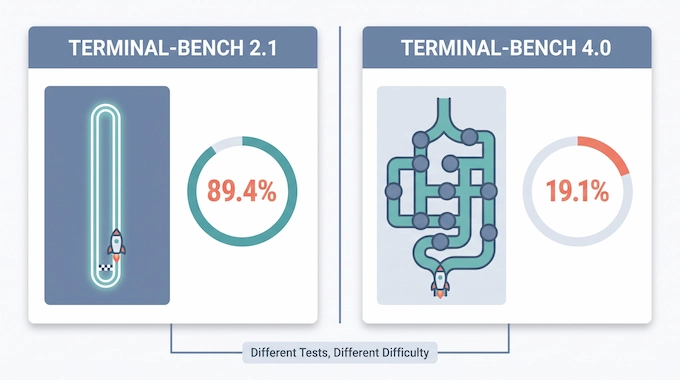
One number demands explanation. How can the same model score 89.4% on Terminal-bench 2.1 and only 19.1% on Terminal-bench 4.0?
Because they are not the same test. Terminal-bench 2.1 is centered on agentic terminal and coding work. Version 4.0 is a newer, broader, harder general-agent environment. So the percentages do not represent an 89-to-19 collapse on an identical task set.
Still, the contrast matters. Opus 5 and GPT-5.6 Sol maintain much stronger relative performance on 4.0, which suggests Gemini’s strengths are not equally distributed across all forms of agency.
Some community discussion has framed this as evidence of “benchmaxxing” or contamination. The results justify asking whether a model is unusually specialized for a benchmark. They do not prove that the benchmark was in training data. Without evidence, contamination should remain a hypothesis, not a conclusion.
6. Gemini 3.8 Flash Vs 3.7 Flash: Is The Upgrade Worth It?
For difficult coding, agents, and quality-sensitive work, yes. For high-volume production, the answer is “benchmark it first.”
Artificial Analysis scores 3.8 Flash High at 59 on its Intelligence Index versus 56 for 3.7 Flash High. It also measures output throughput at roughly 305 tokens per second for 3.8 versus 279 for 3.7.
The catch is token consumption. Google explicitly says 3.8 may take additional reasoning steps and use more tokens, especially at higher effort levels. It even recommends lower effort settings or continued use of 3.7 Flash when compute efficiency is the main constraint.
So the upgrade decision depends on what you are optimizing. If a harder task succeeds more often, spending extra tokens can be a bargain. If you are classifying millions of simple items, extracting structured fields, or running cheap repetitive agents, 3.7 may still have better economics.
7. Gemini 3.8 Flash Speed: Throughput Is Not Latency
The Gemini 3.8 Flash speed story needs three separate measurements.
7.1 Output Throughput
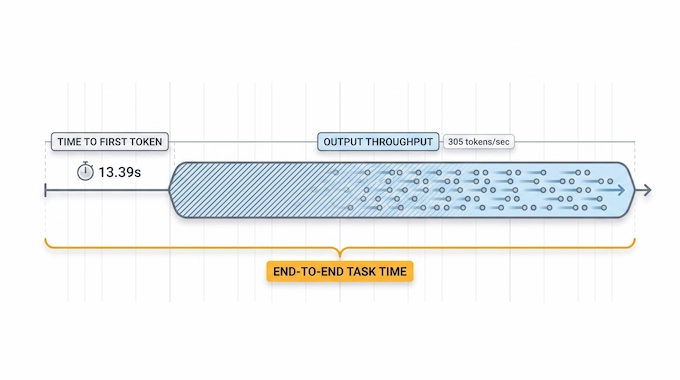
Artificial Analysis measured about 305 output tokens per second at High effort, compared with about 279 tokens per second for 3.7 High. Once the model starts producing text, it is extremely fast.
7.2 Time To First Token
The same comparison reports around 13.39 seconds for 3.8 High versus 10.85 seconds for 3.7 High. So 3.8 can generate faster after it starts while still making the user wait longer before the first visible token.
7.3 End-To-End Task Time
This is the number builders should care about most. A model can have higher output throughput but similar or worse total task time if it reasons longer, calls more tools, or emits more tokens. That explains why a “305 tokens/second” model may not feel dramatically faster during real coding sessions.
For agent systems, measure completion time and success rate together. Raw token speed is useful, but it is only one component of latency.
8. Gemini 3.8 Flash Pricing: Cheap Tokens, Higher Real Cost
The Gemini 3.8 Flash pricing is simple on paper. Through December 31, 2026, the introductory rate is $0.75 per million input tokens and $3.75 per million output tokens. From January 1, 2027, Google lists regular pricing of $1.50 input and $7.50 output per million tokens.
That makes the Gemini 3.8 Flash API pricing dramatically lower than Opus 5 or GPT-5.6 Sol on a per-token basis. But “same token price as 3.7” does not mean “same task cost.”
8.1 Why Same Price Can Cost More
Google’s own explanation is unusually candid: 3.8 works harder. More reasoning steps and repeated tool calls can consume more tokens.
Independent testing reflects that tradeoff. Artificial Analysis estimates roughly $0.24 per evaluated task at Low effort, $0.41 at Medium, and $0.58 at High. Its Intelligence Index rises from 52 to 57 to 59 across those same settings.
That makes Medium an attractive starting point for production evaluation. Moving from Medium to High buys a smaller intelligence gain, from 57 to 59 in that test, while estimated task cost rises from $0.41 to $0.58. High can still be the right choice when one extra successful completion is worth far more than the inference bill.
9. Gemini 3.8 Flash Coding And Agent Use
For coding, 3.8 Flash changes the routing conversation.
Its DeepSWE and Terminal-bench 2.1 results suggest it is a strong default for feature work, code generation, iterative tool use, subagents, frontend tasks, and repeated agent calls. The combination of low token rates and very high throughput makes it particularly attractive when one workflow may invoke the model dozens of times.
The harder question is whether it can replace Opus or Sol completely. Terminal-bench 4.0 says no, at least not yet. For complex architecture, difficult debugging, long-horizon planning with many interacting constraints, and high-stakes tasks where a single failure is expensive, frontier models still make sense as escalation targets.
A practical deployment pattern is Flash first, frontier on escalation. Run the bulk of work through 3.8 Medium, then route low-confidence, failed, or unusually complex tasks to a more expensive model. That can matter more to production economics than picking a single “best model.”
10. Context Window, Multimodal Support And Limitations
The Gemini 3.8 Flash context window reaches up to 1 million input tokens, with up to 64K text output. The model card lists text, images, audio, and video as supported inputs, and Google distributes the model through the Gemini app, Enterprise Agent Platform, AI Studio, Gemini API, AI Mode, and Antigravity.
That is capacity, not a promise of perfect memory. A model accepting 1M tokens does not prove that it will attend equally well to every detail across a million-token prompt. Long-context performance still needs workload-specific testing.
Google also documents familiar foundation-model limits, including hallucinations, occasional slowness or timeouts, and higher token use at stronger effort levels. The formal knowledge cutoff is March 2026, although Google warns that some domains may effectively reflect knowledge only up to January 2025.
One more benchmark caveat belongs here. On LVBench, Google’s comparison used 1,024 video frames for Gemini and GPT models but 300 for Claude models because of API limits. Gemini’s video results are impressive, but that difference makes the cross-model numbers less clean than a simple leaderboard suggests.
11. Who Should Switch, And Who Should Stay On 3.7?
Switch to 3.8 if you do hard coding, agentic workflows, multimodal analysis, research-heavy tasks, or repeated tool use where better completion quality can offset extra reasoning tokens.
Test 3.8 Medium against 3.7 before switching if your system is high-volume and cost-sensitive. For simple latency-sensitive jobs, 3.7 or 3.8 Low may still be the better fit.
Use 3.8 High selectively when the task is difficult enough that a small quality gain has real value. If maximum reasoning quality matters more than cost, compare it directly with Opus 5 and GPT-5.6 Sol on your own task set rather than assuming the Flash label tells you the answer.
The model card itself reinforces this production-oriented view. Gemini 3.8 Flash is intended for cost-effective scaling of production agents, including software engineering, agent tasks, and complex knowledge workflows.
12. Final Verdict: Flash Pricing Has Reached A New Tier
Gemini 3.8 Flash matters because Google has pushed a workhorse-priced model into territory that used to belong mostly to premium systems. It nearly matches Opus 5 on DeepSWE, leads several finance, legal, multimodal, and scientific benchmarks, and does so with API rates that make high-volume use realistic.
The tradeoff is just as important. Part of the capability gain comes from letting the model think and act for longer. That means builders should stop comparing models only by price per million tokens. Quality per task, total task cost, time to completion, and failure rate are the metrics that matter now.
For most teams, the best next step is not a full migration. Put 3.8 Flash Medium beside your current model, replay a representative set of real workloads, and measure success rate, latency, and total token spend. If it wins there, the benchmark story becomes relevant to your business rather than just another leaderboard.
Binary Verse AI will keep tracking Gemini 3.8 Flash benchmarks, pricing, and real-world agent performance as independent data improves. If you are choosing between Gemini, Claude, and GPT models for production, bookmark Binary Verse AI for evidence-first comparisons that focus on what actually changes your stack.
1. Is Gemini 3.8 Flash better than Gemini 3.7 Flash?
Generally, yes for capability. Artificial Analysis currently scores 3.8 Flash High at 59 versus 56 for 3.7 High, while Google reports improvements across coding and agentic benchmarks. However, 3.8 can consume more tokens, so 3.7 can remain attractive for efficiency-first workloads.
2. How much does Gemini 3.8 Flash cost?
Gemini 3.8 Flash’s introductory API pricing is $0.75 per million input tokens and $3.75 per million output tokens through December 31, 2026. Google lists regular pricing of $1.50 input and $7.50 output per million tokens from January 1, 2027.
3. Is Gemini 3.8 Flash good for coding?
Yes. Google positions it specifically for long-horizon software engineering and agentic workflows, and it scores 73.7% on DeepSWE v1.1 and 89.4% on Terminal-Bench 2.1 in Google’s frontier comparison. However, its much lower Terminal-Bench 4.0 result shows that premium models can still be stronger on harder general-agent tasks.
4. Is Gemini 3.8 Flash better than Claude Opus 5?
Not universally. Gemini matches or beats Opus 5 on several reported benchmarks and costs much less per token, but Opus remains substantially stronger on tests such as Terminal-Bench 4.0, GDPval-AA and OSWorld. The better model therefore depends on the workload rather than the number of benchmark wins.
5. What is the Gemini 3.8 Flash context window?
Gemini 3.8 Flash supports up to 1,048,576 input tokens and 65,536 output tokens. A large advertised context window is not the same as guaranteed perfect recall across the entire context, so long-document and large-repository users should test retention on their own workloads