
GPT 5.4 vs Sonnet 4.6 is not a trivial leaderboard fight. It is a clash of working styles. One model feels like a fearless builder who grabs the keyboard and starts shipping. The other feels like the senior engineer who slows down just enough to save you from tomorrow’s mess. Sonnet 4.6 landed on February 17, 2026. GPT-5.4 Thinking followed on March 5, 2026. The releases were close enough that the industry basically got a live A/B test of what “best coding model” even means now.
That is why GPT 5.4 vs Sonnet 4.6 has sparked so much noise among developers. Not because either model is weak. Quite the opposite. Both are strong enough that the old arguments no longer help. “Which one is smarter?” is too vague. The real questions are better: Which one holds a codebase in its head longer. Which one produces cleaner first drafts. Which one burns fewer paid-plan nerves. Which one can turn a hand-wavy prompt into a usable product before your coffee gets cold.
Table of Contents
1. Independent Benchmarks: What The Data Actually Says
Here is the independent benchmark snapshot from the source material, trimmed to the models most relevant to the buying decision.
| Model | SWE-bench | AIME | GPQA | MMMU | IOI | LiveCodeBench | Terminal-Bench 2.0 | Vibe Code Bench v1.1 |
|---|---|---|---|---|---|---|---|---|
| 1. Claude Opus 4.6 (Thinking) | 79.20% | 95.63% | 89.65% | 83.87% | N/A | 84.68% | 58.43% | 53.50% |
| 2. GPT 5.4 | 77.20% | 96.67% | 91.67% | 87.51% | 67.83% | 84.14% | 58.43% | 67.42% |
| 3. Gemini 3 Flash (12/25) | 76.20% | 95.63% | 87.88% | 87.63% | 39.08% | 85.59% | 51.69% | 20.20% |
| 4. Claude Sonnet 4.6 | 76.20% | 92.29% | 85.61% | 83.58% | N/A | N/A | 59.55% | 51.48% |
| 5. GPT 5.2 | 75.40% | 96.88% | 91.67% | 86.67% | 54.83% | 85.36% | 51.69% | 53.50% |
| 6. GPT 5.3 Codex | 75.20% | N/A | N/A | N/A | 43.83% | 87.31% | 64.04% | 61.77% |
| 7. Claude Opus 4.5 (Nonthinking) | 74.60% | N/A | N/A | 81.10% | 23.58% | N/A | 58.43% | N/A |
| 8. Claude Opus 4.5 (Thinking) | 74.20% | 95.42% | 85.86% | 82.95% | 20.25% | 83.67% | 53.93% | N/A |
| 9. Grok 4.20 Beta (Reasoning) | 74.20% | 96.46% | 88.64% | 83.47% | 30.17% | 84.27% | 40.45% | 4.06% |
| 10. Gemini 3 Pro (11/25) | 71.60% | 96.68% | 91.67% | 87.51% | 38.83% | 86.41% | 55.06% | N/A |
On that table alone, GPT 5.4 vs Sonnet 4.6 looks pretty decisive. GPT 5.4 is the broader athlete. It is stronger in raw algorithmic competition, much stronger in end-to-end “build the thing” work, and close enough in classic software engineering that it never feels outclassed. Sonnet 4.6, meanwhile, does not embarrass itself anywhere that matters. It just looks more specialized. It is the model you pick when you care less about crushing an olympiad-style problem and more about whether the code feels sane when you revisit it on Friday.
1.1 The Execution Beast: Why GPT-5.4 Dominates Vibe Coding
This is the cleanest takeaway in GPT 5.4 vs Sonnet 4.6. GPT-5.4 behaves like a model that has stopped apologizing for being ambitious.
The Vibe Code Bench score, 67.42%, matters more than some people want to admit. It captures something developers instantly notice in practice. GPT-5.4 is unusually willing to commit. Give it a fuzzy prompt for a React dashboard, a browser game, or a messy multi-step tool workflow, and it tends to move with real momentum. The official OpenAI launch material also leans into that identity, positioning GPT-5.4 as a general reasoning model that folds in GPT-5.3 Codex’s coding strengths and expands into tool use, computer use, documents, presentations, and spreadsheets.
The subtext is obvious: this model is meant to do work, not just discuss work. The system card itself frames GPT-5.4 Thinking as OpenAI’s latest reasoning model and the first general-purpose model in the line to ship with mitigations for high cyber capability.
That matters because great “vibe coding” is not just about aesthetic front ends. It is about confidence under ambiguity. Developers do not always hand a model a perfect spec. Sometimes the prompt is basically, “Build me the thing I wish I had.” GPT-5.4 is very good at turning that mush into a first pass with surprising shape. Not perfect shape. Real shape.
1.2 The Architectural Wizard: Why Claude Sonnet 4.6 Still Wins Trust
And yet, GPT 5.4 vs Sonnet 4.6 gets more interesting the moment you move from demos to durable systems.
Anthropic’s system card paints Sonnet 4.6 as a serious engineering model, not a lighter consolation prize. Anthropic reports 79.6% on SWE-bench Verified, 59.1% on Terminal-Bench 2.0, 72.5% on OSWorld-Verified, and a GDPval-AA score of 1633. It also notes that Sonnet 4.6 substantially improves on Sonnet 4.5 and, in some evaluations, approaches or matches Claude Opus 4.6.
That lines up with the vibe many developers describe. Sonnet 4.6 often feels less like a sprinter and more like a careful systems thinker. It is good at naming the hidden constraint you forgot. It is good at proposing a structure before it writes 900 lines you will later regret. It is good at the boring, lucrative part of software engineering, which is not dazzling output, but preventing expensive cleanup.
Put differently, GPT-5.4 often gives you a better first demo. Claude Sonnet 4.6 often gives you a calmer second week.
2. Claude Code Vs GPT 5.4 Codex: The Agentic CLI Battle

In GPT 5.4 vs Sonnet 4.6, the tooling story is almost as important as the model story.
OpenAI’s pitch is blunt. GPT-5.4 is not just smarter text. It is wrapped around a stronger agent stack. The release material emphasizes native computer use, stronger tool orchestration, better performance across large tool ecosystems, improved browser workflows, and an experimental Playwright Interactive skill for visually debugging apps while building them. That is a very modern promise. It is not “I can write code.” It is “I can write code, test code, inspect the UI, use tools, and keep going.” The system card backs the broader agent framing by describing GPT-5.4 Thinking as a reasoning model designed to think before it answers and to resist policy bypass attempts more effectively than earlier generations.
Claude’s counterpunch is maturity. Claude Code feels less flashy, but more seasoned. Sonnet 4.6 is explicitly positioned for advanced coding, long-running agents, browser and computer use, and enterprise workflows. Anthropic’s system card also shows strong gains in verification thoroughness, destructive action avoidance, instruction following, adaptability, and efficiency in agentic coding contexts, even while flagging some overeager behavior in GUI settings.
So which one wins?
- If you want an agent that barrels forward, touches many tools, and feels increasingly comfortable with messy execution, GPT-5.4 Codex has the sharper frontier vibe.
- If you want an agent that feels more like a patient repo operator, one that is often better at reading the room before editing the room, Claude Code still has a very strong case.
3. The 1M Token Context Myth: What GPT 5.4 Context Size Really Means
GPT 5.4 vs Sonnet 4.6 also turns into a debate about a number everyone loves and almost nobody should trust blindly: 1M tokens.
On paper, both camps have ammunition. OpenAI’s launch notes describe GPT-5.4 in Codex as having experimental support for a 1M context window, with a standard 272K window still in play for normal usage. Anthropic, for its part, says the 1M token context window for Sonnet 4.6 is in beta on the API, and its system card notes that evaluation contexts are capped at 1M. It also discusses long-context testing through MRCR and GraphWalks, including internal settings needed for some full 1M evaluations.
But a spec sheet is not memory. This is the part people on Reddit keep rediscovering the hard way. GPT 5.4 context size can be huge and still feel slippery when the task is a tangled, multi-file refactor with implicit business rules and twelve half-important documents stuffed into the prompt. Claude can advertise 1M too and still miss something crucial if the retrieval scaffolding is weak or the prompt is badly shaped.
The useful question is not “Can it ingest a million tokens?” The useful question is “Can it stay coherent while using them?” That is different. Bigger windows help planning, search, and retrieval. They do not magically convert noise into understanding.
My read on GPT 5.4 vs Sonnet 4.6 is simple. GPT-5.4 treats long context like fuel for action. Sonnet 4.6 treats long context like something to digest carefully. For giant refactors, audit work, and instruction-heavy repository surgery, I still trust the model that feels more reluctant to improvise.
4. Claude Pro Vs ChatGPT Plus: Which Subscription Actually Feels Better
GPT 5.4 vs Sonnet 4.6 becomes painfully practical once money enters the room. Not API money, subscription money. Everyday developer money. The kind that buys either relief or annoyance.
| Situation | Better Bet | Why |
|---|---|---|
| Fast front-end generation | ChatGPT Plus with GPT-5.4 | Better momentum, better one-shot output, stronger vibe-coding feel. |
| Long architecture discussions | Claude Pro with Sonnet 4.6 | Better calm, cleaner structure, stronger planning instinct. |
| Multi-step agent workflows | GPT-5.4 / Codex stack | More aggressive tool use and computer-use story. |
| Multi-file refactors and review | Sonnet 4.6 / Claude Code | Often feels more careful and less impulsive. |
| User frustration risk | Depends on session style | Claude Pro limits can feel tighter under heavy coding bursts, while ChatGPT often feels roomier for prolonged generation. |
The dirty little truth in Claude Pro vs ChatGPT Plus is that intelligence is not the whole product. Endurance is part of the product. A model can be brilliant and still irritate you if the session feels rationed. That is why Claude Pro limits show up so often in purchasing conversations. Developers do not just want the smartest assistant. They want one that stays in the chair long enough to finish the shift.
This is where GPT 5.4 vs Sonnet 4.6 tilts toward OpenAI for a lot of working coders. Even when Claude Sonnet 4.6 is the model they admire more, GPT-5.4 is often the model they can lean on longer without feeling like every heavy prompt is burning through a precious allowance.
That does not make Claude a bad buy. It makes Claude a more deliberate buy. If your work is architecture-heavy, review-heavy, or deeply instruction-sensitive, Sonnet 4.6 can still justify itself. If your workflow looks like “prototype, iterate, patch, rerun, repeat,” ChatGPT feels easier to live with.
5. Native Computer Use: Real Edge Or Fancy Demo
In GPT 5.4 vs Sonnet 4.6, computer use is one of the most revealing categories because it exposes how each company thinks about agency.
OpenAI’s public release numbers put GPT-5.4 at 75.0% on OSWorld-Verified, ahead of GPT-5.2 and slightly above the human baseline cited in the launch material. Anthropic’s system card reports Claude Sonnet 4.6 at 72.5%, just 0.2 points behind Claude Opus 4.6’s 72.7%. That is not a toy result. It means Sonnet is very much in the game.
Still, the flavor differs. GPT-5.4’s computer-use pitch feels productized. It is wrapped in better confirmation behavior, stronger tool routing, and a broader story about agents that can operate across software, websites, and professional tasks. Claude Sonnet 4.6 feels more like a model that became unexpectedly good at operating a machine because Anthropic kept pushing coding and autonomy hard enough.
For developers right now, native computer use is useful, but not yet the main event. It is great for repetitive browser workflows, QA loops, and sandboxes where clicking around beats writing custom automation. It is less magical when a direct script or API call would solve the problem in one tenth the time. So yes, GPT-5.4’s OSWorld dominance is real enough to matter. No, it does not mean every developer should suddenly replace scripts with mouse moves.
6. The Best Workflow Is The One Reddit Quietly Converged On
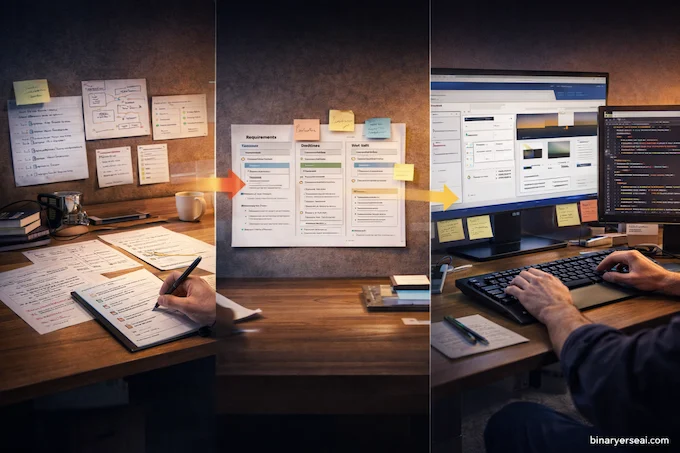
GPT 5.4 vs Sonnet 4.6 sounds like a rivalry. In practice, the smartest workflow often looks like collaboration.
Use Claude Sonnet 4.6 to frame the work. Let it extract requirements, spot ambiguity, define interfaces, review architecture, and tell you where the ugly bugs are likely hiding. Then hand the more brute-force generation phase to GPT-5.4. Let it draft components, wire features together, push through tedious implementation, and chew through the parts of the job where momentum beats elegance.
That is not fence-sitting. It is specialization.
You would not ask your best architect to spend the whole week renaming variables and wiring CRUD forms. You would not ask your fastest implementer to define the whole system contract from scratch if they have a habit of overcommitting early. Models are getting close enough to human work styles that the same division of labor suddenly makes sense.
This is the hidden answer inside GPT 5.4 vs Sonnet 4.6. The winner may be the developer who stops demanding monogamy from their tools.
7. Final Verdict: Which Model Should You Choose In 2026
GPT 5.4 vs Sonnet 4.6 comes down to what kind of pain you want removed.
Choose GPT-5.4 if your real bottleneck is execution. If you want a model that attacks vague prompts, builds polished first drafts, moves comfortably across tools, and makes front-end or product-like work feel fast, GPT-5.4 is the better pick. It feels like momentum in a box.
Choose Claude Sonnet 4.6 if your real bottleneck is judgment. If you need better architectural discipline, steadier long-context behavior, cleaner reasoning around tradeoffs, and an assistant that more often acts like a careful engineer instead of an eager intern with admin access, Sonnet 4.6 is still the sharper knife.
My own bottom line is this. GPT 5.4 vs Sonnet 4.6 is not a story about one model humiliating the other. It is a story about frontier AI splitting into roles. One model is becoming the builder. The other is becoming the reviewer, planner, and stabilizer.
That is good news for developers. It means the market is finally getting more useful, not just more theatrical.
And if you are choosing only one today, be brutally honest about your workflow. Buy the model that fixes your slowest hour, not the one that wins the loudest thread. That is the real lesson of GPT 5.4 vs Sonnet 4.6, and it is also the smartest way to spend your next month of AI budget.
Is Claude better than ChatGPT for coding in 2026?
It depends on the kind of coding you do. GPT-5.4 is stronger when you want fast execution, better one-shot app generation, and more aggressive implementation. Claude Sonnet 4.6 is often the better fit for architecture, code review, debugging nuance, and following complex instructions over long sessions.
Which is worth the $20 per month, Claude Pro or ChatGPT Plus?
For many heavy users, ChatGPT Plus is the safer value because it usually feels more forgiving during long, intense coding sessions. Claude Pro can still be worth it if your work leans toward architecture, long-context reasoning, and careful repo-level thinking rather than nonstop generation.
What is the real context size of GPT-5.4?
Officially, GPT-5.4 supports a much larger context window in certain modes, but real-world usefulness depends on how stable the model stays deep into long tasks. In practice, developers care less about the advertised ceiling and more about whether the model still remembers the right details during large refactors and multi-file workflows.
How does GPT-5.4 Codex compare to Claude Code?
GPT-5.4 Codex feels stronger when you want speed, tool use, visual debugging, and aggressive task completion. Claude Code feels more mature for many developers who want steadier repo work, better planning, and fewer moments where the model charges ahead before thinking through the structure.
What is the Vibe Code Bench?
Vibe Code Bench is an independent benchmark focused on whether a model can produce complete, usable, visually polished end-to-end apps, not just isolated snippets. It matters because it captures something developers notice fast: whether a model can turn a loose prompt into a working product with real momentum.