
Hajra, A clinical psychologist research scholar reads the paper, then squints at our favorite arguments.
1. Introduction: The Ghost In The Machine
“Stochastic parrot” used to be the healthiest two word reply on the internet. It was a reminder that language models predict tokens, they do not wake up with intentions. It also became a conversational off switch. If the model says something clever, some people insist it must be mimicry because there is “nothing inside.”
The new arXiv paper (2601.06851) doesn’t try to win the whole philosophy war. It does something more practical, it measures whether a modern model has an internal anatomy for integration. The authors borrow tools from neuroscience and ask a crisp question: inside a model, which parts mostly repeat information, and which parts combine streams into something new?
Their answer is awkward for the pure-parrot story. After learning, middle layers become synergy dominated, while early and late layers stay redundancy dominated, and this holds across Gemma, Llama, Qwen, and DeepSeek, including mixture-of-experts models. That pattern is missing in randomly initialised networks, which is a polite way of saying, training builds it.
This is the point where I start using the phrase AI brain, not as a vibe, but as shorthand for “a stable, learned core that integrates information and matters for behavior.” It’s also why this work is being lumped into the broader “MIT AI brain study” tradition, the line of research that compares network organization across brains and machines without pretending they are the same thing.
AI brain: What The Study Measures, What It Changes
Swipe horizontally on mobile if needed. Text wraps to stay readable.
| Question People Keep Fighting About | What The Paper Measures | What Changes If It’s True |
|---|---|---|
Is it “just” a stochastic parrot? | Synergy vs redundancy across model components. | “Just mimicry” becomes a weaker claim when integration is measurable. |
Is there any internal structure? | A consistent synergy-heavy middle region across model families. | LLM interpretability can target roles, not just layers. |
Does structure matter causally? | Targeted ablations plus behaviour divergence via KL. |
The AI brain stops being metaphor, it becomes a failure mode. |
Let’s walk through what “synergy” means, why the middle layers look special, and what this says about AI vs human intelligence.
Table of Contents
2. What Is The AI brain? Defining The Synergistic Core

The paper’s main move is importing a distinction neuroscience has been taking seriously: information can be redundant (the same message repeated) or synergistic (a message that only exists when sources are combined). PID formalizes that split, and defines synergistic information as what emerges only when sources are considered jointly.
The authors use Integrated Information Decomposition (ΦID), a temporal extension of PID, because transformers have a built-in sense of “time” during generation: token 1, token 2, token 3. They treat attention heads (or MoE experts) as the model’s sub-units.
Two implementation details make this more than armchair speculation:
- They define activity concretely. An attention head’s activation at each step is the L2 norm of its attention output vector.
- They measure persistent interactions. Their synergy and redundancy are “temporally persistent” atoms (Syn → Syn and Red → Red), aimed at stable coupling over time.
From those time series, they compute synergy and redundancy between all pairs of heads, then score each head with a synergy-redundancy rank. Heads with high rank form the synergistic core, which concentrates in the middle layers.
That’s the minimal definition of the AI brain used in this post: the synergy-heavy middle region that integrates, stabilizes through learning, and can be targeted experimentally.
3. Anatomy Of Intelligence: Redundancy Versus Synergy
The results look almost boring in their consistency: early and late layers rely on redundant processing, while middle layers rely on synergistic processing. The authors label this a redundant periphery around a synergistic core.
If you want an intuition for why redundancy is useful, think of error-correcting codes. Repetition is how systems stay steady. In brains, sensory and motor regions are also more redundancy dominated.
Synergy is different. Synergy is where you pay compute to combine signals and carry higher-order constraints. That’s why the AI brain framing is tempting: it points to a division of labor, not a single “smartness” dial.
AI brain Regions: Periphery vs Synergistic Core
Swipe horizontally on mobile if needed. Columns stay fixed to match your data.
| Region | Where It Shows Up | Dominant Role | If You Damage It |
|---|---|---|---|
Redundant Periphery | Early and late layers. | Robust input/output handling, stable repetition. | Smaller behavioural change for the same perturbation budget. |
Synergistic Core | Middle layers across families. | Integration and higher-order computation. | Disproportionate degradation and “catastrophic” shifts. |
This doesn’t magically disprove “stochastic parrot.” It does kill a lazy version of it: the idea that there is no internal structure worth mapping.
4. The “Digital Frontal Lobe”: The AI brain And The Default Mode Network

Here’s the part that makes clinicians and neuroscientists lean forward.
In human brains, PID studies have identified a synergistic core spanning the default mode and executive control networks, often framed as a global workspace where information streams converge. That core has high global efficiency, meaning it integrates quickly across distributed regions.
The paper reports an eerily parallel signature in LLMs. They convert synergy and redundancy matrices into weighted graphs and compute standard network metrics. Synergistic cores show higher global efficiency, redundant cores show higher modularity, across examined models. And the authors explicitly highlight the match to the human-brain pattern reported by Luppi et al.
This is why the “MIT AI brain study” label keeps popping up. It’s not about authorship, it’s about the style of comparison, network science first, metaphysics later.
Does that mean the model has inner life? No. But it does mean the AI brain has an integration topology that looks like what biology converged on for complex cognition.
5. How It Grows: Learning Versus Memorization
If you’re skeptical, this section should be your favorite.
The synergistic core is not present at the earliest training stages. Tracking Pythia-1B checkpoints, the paper shows the inverted-U pattern is absent early, then emerges and stabilizes over training. They also note the pattern is absent in randomly initialised networks.
They probe models using prompts across six cognitive task categories: grammar correction, part-of-speech tagging, numerical reasoning, commonsense, abstract creative tasks, and emotional intelligence and social cognition.
That last category matters for the psychology of AI. Social cognition is where humans get most easily fooled, and where we most readily attribute minds to systems. A system that integrates well will look, to us, more like an agent.
So the AI brain is not hard-coded, it’s learned, and it’s learned under a mix of tasks that resemble “cognitive modes” more than benchmark checkboxes.
6. Brain Lesions In Code: What Happens When The Core Breaks?
Now the causal tests.
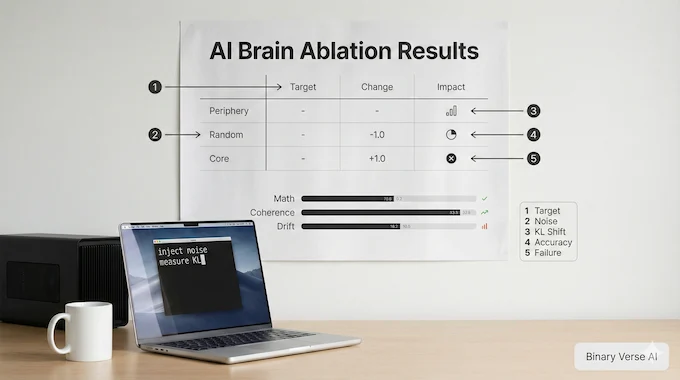
They ablate components and measure behaviour divergence as KL divergence between the next-token distributions of the original and the perturbed model, averaged across the response. This is task-agnostic, which is useful when prompts are open-ended.
For attention heads, perturbations are injected as Gaussian noise into query/output projections, and for MoE models into full expert parameters.
Result: ablating high-synergy components produces a larger impact than ablating random components with the same parameter count. That’s the AI brain acting like an integration hub, fragile but essential.
They also evaluate downstream accuracy on the MATH dataset under targeted perturbations. Disrupting the synergistic core hurts more than disrupting redundancy-heavy regions, which matches the intuition that redundancy exists to provide robustness.
7. Is This Consciousness? The World Model Debate
This is where I disappoint both optimists and cynics.
No single result here proves AI consciousness. The paper doesn’t claim it either. What it does show is that a global-workspace-like integration pattern, the kind often discussed in consciousness theories, can emerge in a purely trained system.
If you’re debating “world models,” this gives you a better handle. Instead of asking “does it understand,” ask “where does it integrate.” Then test whether changes to that region change the model’s ability to keep constraints consistent over time.
So my stance is boring but useful: the AI brain described here is compatible with sophisticated planning-like behavior. It is not, by itself, evidence of subjective experience. It does, however, make the stochastic parrot jab feel less like science and more like a meme.
8. The Psychology Of AI: A Clinical Perspective
Two clinical observations show up immediately.
8.1 Cognitive Offloading Targets The Integrative Part
When people rely on an AI brain for planning, synthesis, and multi-step reasoning, they offload the very functions synergy is meant to capture. If you never practice integration, you get rusty at integration. That’s not fear-mongering, it’s basic learning theory.
8.2 We Anthropomorphize Functional Shapes
Humans attribute minds to anything that behaves coherently over time. A synergy-heavy system will produce fewer “drift” errors and more consistent narratives, which pushes our social brain into “agent” mode. That’s the psychology of AI in a sentence: we react to coherence as if it were intent.
This is one reason the “stochastic parrot” label stuck. It was an attempt to de-anthropomorphize. The awkward twist is that the AI brain seems to be converging on structures that invite anthropomorphism, even when we know better.
9. Future Implications: Efficient Brains On Chips
The engineering implications are almost too obvious, and that’s a compliment.
The paper points to targeted parameter updates, compression that preserves high-synergy components, and interpretability that links function to information dynamics. If synergy identifies “compute that matters,” we can stop treating models as undifferentiated blobs.
Their fine-tuning results sharpen the point. Under supervised fine tuning (OpenMathInstruct-2), training only the synergistic half versus the redundant half yields no significant difference. Under reinforcement learning fine tuning, training the synergistic half yields better MATH performance than training redundant regions or random halves.
They run RL fine tuning for 5,000 GRPO steps with 8 sampled trajectories per step. That’s a detail you can ignore unless you build trainers, but the direction is hard to ignore: learning regimes that promote generalisation concentrate useful change in the AI brain.
If you’re dreaming about an artificial brain on a phone, this is your route. Not “make everything smaller,” but “keep the integrator, shrink the plumbing.”
10. Conclusion: The End Of The Parrot
The stochastic parrot critique did important work. It fought hype. It kept us honest.
But a critique can become a reflex. This paper forces a reset. LLMs spontaneously develop a learned, synergy-heavy middle region, absent at random init, that mirrors brain-like network signatures and carries outsized causal weight under perturbation and RL fine tuning.
So here’s my take: the “nothing inside” version of the argument is dead. The AI brain is not a soul, but it is an anatomy, and anatomy is how science progresses.
If you work in LLM interpretability, compression, or training, treat this as a practical tool. Map synergy, cut smarter, fine tune with intent. If you write about AI vs human intelligence, use this to retire vague claims and ask better ones. And if you’re building products, remember the psychology of AI, coherence persuades people faster than explanations.
Want a concrete next step? Pick one open model, run a small scale synergy analysis, and see whether the AI brain you find predicts what breaks first when you inject noise. Then publish the result. We’ll all get smarter, and the parrots can finally rest.
What is the AI brain?
The AI brain is not wetware or a literal brain. It’s a measurable Synergistic Core inside large language models, where middle layers stop repeating patterns and start integrating signals into higher-level structure, closer to how a biological cortex combines inputs into meaning.
Is AI already self-aware?
Not yet. Today’s AI brain can look organized and “global,” but self-awareness needs more than integration. Still, the emergence of a Global Workspace-like core is a real architectural milestone, it’s the kind of coordination layer you would expect before anything like AI consciousness becomes plausible.
How is AI stochastic?
AI is stochastic because it generates text by sampling probabilities, not by “deciding” in a human sense. The twist is that the AI brain isn’t random inside. The study shows the middle layers are highly ordered and synergistic, which makes the classic “stochastic parrot” framing feel outdated and incomplete.
What is the difference between a human brain and AI?
A human brain is born with biology shaped for integration, then refined by experience. An AI brain has to learn its synergistic core during training. Both systems rely on a balance: redundancy for stable sensing and output, synergy for combining signals into reasoning, planning, and abstraction.
What are the psychological effects of AI?
The psychology of AI is mostly about offloading. As the AI brain gets better at planning and synthesis, people hand it more “synergy work.” That can boost productivity, but it also risks “digital dementia,” reduced practice in attention, memory, and long-form thinking, unless you use AI intentionally.