
Introduction
For the last two years, the AI industry has operated under a tacit assumption: closed-source models are the ceiling, and open-source models are the floor. We assumed that if you wanted state-of-the-art reasoning, you had to pay the proprietary tax to OpenAI or Google. We assumed that open weights were for hobbyists or edge cases where privacy trumped raw intelligence. That assumption just died.
With the release of DeepSeek V3.2 Speciale, the team at DeepSeek-AI hasn’t just nudged the bar upward; they have shattered the ceiling. We are looking at a model that has achieved gold-medal performance in the International Mathematical Olympiad (IMO) and the International Olympiad in Informatics (IOI). This isn’t “good for open source.” This is just good. Period.
I have spent the last few days analyzing the technical report and testing the weights, and the conclusion is startling. DeepSeek V3.2 Speciale is currently outperforming GPT-5 High on key reasoning benchmarks and trading blows with Gemini 3.0 Pro. If you are an engineer, a researcher, or just someone who cares about the democratization of intelligence, you need to pay attention to what just happened.
Table of Contents
1. The Breakdown: DeepSeek V3.2 vs. V3.2 Speciale
Before we look at the numbers, we need to clear up the naming convention, because it is slightly confusing. DeepSeek dropped two primary distinct flavors in this release, and knowing the difference is critical for your use case.
1.1 DeepSeek V3.2 (The Generalist)
This is your workhorse. It is designed for agentic workflows, tool use, and general conversation. It balances efficiency with intelligence. It utilizes a sophisticated context management system to handle long chains of thought without blowing up your context window. If you are building a coding agent or a search bot, this is the model you deploy.
1.2 DeepSeek V3.2 Speciale (The Thinker)
This is the monster. The “Speciale” variant is a pure reasoning engine. It does not support tool calling. It does not browse the web. What it does is think. The researchers relaxed the length constraints during the Reinforcement Learning (RL) phase, allowing the model to generate massive chains of thought to solve incredibly complex problems.
Think of DeepSeek V3.2 Speciale as a professor locked in a room with a whiteboard and infinite chalk. It isn’t going to check its email for you, but it will solve the Riemann Hypothesis if you give it enough time. This is the model that is putting up the terrifying numbers we are about to discuss.
2. DeepSeek Benchmarks: The Data That Shocked the Industry

In the world of LLMs, we often see “cherry-picked” charts. But looking at the raw data for DeepSeek V3.2 Speciale, the consistency across diverse, hard domains is undeniable.
The most shocking metric is the AIME 2025 score. The American Invitational Mathematics Examination is a brutal test of mathematical creativity and precision. DeepSeek V3.2 Speciale scored 96.0%. For context, GPT-5 High scored 94.6%.
Here is the full breakdown of how the open-source contender stacks up against the proprietary giants:
DeepSeek V3.2 Speciale Benchmark Results
| Benchmark | GPT-5 High | Gemini-3.0 Pro | Kimi-K2 Thinking | DeepSeek-V3.2 Thinking | DeepSeek-V3.2 Speciale |
|---|---|---|---|---|---|
| AIME 2025 | 94.6 (13k) | 95.0 (15k) | 94.5 (24k) | 93.1 (16k) | 96.0 (23k) |
| HMMT Feb 2025 | 88.3 (16k) | 97.5 (16k) | 89.4 (31k) | 92.5 (19k) | 99.2 (27k) |
| IMOAnswerBench | 76.0 (31k) | 83.3 (18k) | 78.6 (37k) | 78.3 (27k) | 84.5 (45k) |
| CodeForces | 2537 | 2708 | – | 2386 | 2701 |
| GPQA Diamond | 85.7 | 91.9 | 84.5 | 82.4 | 85.7 |
| HLE (Humanity’s Last Exam) | 26.3 | 37.7 | 23.9 | 25.1 | 30.6 |
2.1 The Coding Proficiency
Look at the CodeForces rating. A rating of 2701 places DeepSeek V3.2 Speciale in the “Grandmaster” tier of human competitive programmers. It is effectively writing code better than 99% of human software engineers. While Gemini 3.0 Pro edges it out slightly (2708), the difference is negligible in practice.
2.2 The Caveat
We have to be honest observers here. DeepSeek V3.2 Speciale is not winning everywhere. On “Humanity’s Last Exam” (HLE), a benchmark designed to be exceptionally difficult, Gemini 3.0 Pro still holds a significant lead (37.7 vs 30.6). This suggests that while DeepSeek has mastered reasoning patterns (Math/Code), it might still lag slightly in the sheer breadth of world knowledge or multi-modal understanding that Google possesses.
However, for a model you can download and run yourself (hardware permitting), being within striking distance of Google’s flagship is a monumental achievement.
3. Inside the Architecture: DeepSeek Sparse Attention (DSA)
How did they do this? The easy answer is “more compute,” but the technical report reveals something more elegant: DeepSeek Sparse Attention (DSA).
Standard Transformer models use “vanilla” attention, which scales quadratically. As your context gets longer, the computation required explodes. This is why most models get stupid or slow when you feed them a book.
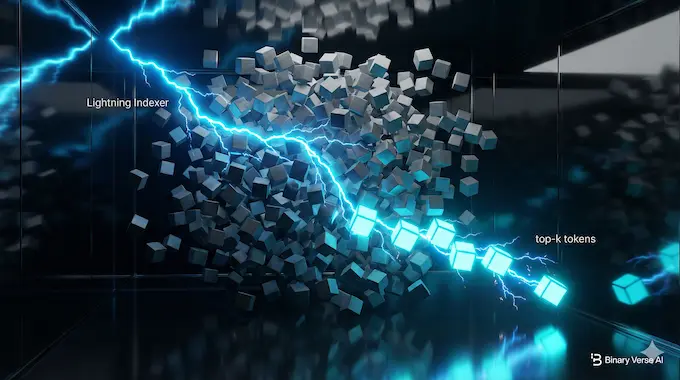
DSA changes the game by using a “lightning indexer” and a fine-grained token selection mechanism. Instead of every token paying attention to every other token, DSA intelligently selects the top-k most relevant tokens for the query.
Imagine you are at a loud cocktail party. Vanilla attention is trying to listen to every single conversation in the room simultaneously to understand the context. DSA is the ability to tune out the background noise and focus laser-sharp attention only on the three people discussing the topic you care about.
This efficiency allowed DeepSeek to extend the context window to 128K tokens without the massive performance degradation we usually see. It also frees up compute budget. Instead of burning GPU cycles on irrelevant context, they burn those cycles on Reinforcement Learning.
3.1 Scalable RL: The “Speciale” Sauce
The report explicitly states that their post-training computational budget exceeded 10% of the pre-training cost. This is a massive shift. Historically, pre-training was the expensive part. DeepSeek is proving that the “magic” happens in the post-training RL phase, where they let the model think, fail, and learn from its own reasoning traces. This is the same philosophy behind OpenAI’s o1, but applied to open weights.
4. DeepSeek API Pricing vs. The Competition
If the benchmarks are the hook, the pricing is the sinker. DeepSeek has aggressively positioned itself to undercut the market.
DeepSeek API pricing is currently set at:
- Input (Cache Hit): $0.028 per 1M tokens
- Input (Cache Miss): $0.28 per 1M tokens
- Output: $0.42 per 1M tokens
Compare this to the industry standard. OpenAI and Anthropic are significantly more expensive for similar reasoning capabilities. The “Cache Hit” pricing is particularly aggressive, making DeepSeek V3.2 Speciale incredibly attractive for workflows involving repetitive contexts, like coding agents or document analysis.
4.1 The Expiration Date Warning
There is a catch you need to know about. The endpoint for the high-compute model, deepseek-reasoner (serving DeepSeek V3.2 Speciale), has a hard expiration date. According to the documentation, the v3.2_speciale_expires_on_20251215 endpoint goes dark on December 15, 2025.
Why? Likely because running a model that thinks this hard is expensive, even for them. It serves as a “flex”, a demonstration of capability and a way to gather valuable interaction data, before they likely roll its capabilities into a more efficient, optimized V4. If you want to test the absolute peak of open-source intelligence, do it now.
5. How to Run DeepSeek V3.2 Locally (Python Guide)

For the privacy-conscious or the curious, the run DeepSeek locally question is paramount. Can you run DeepSeek V3.2 Speciale on your home rig? Technically, yes. Practically, it depends on your wallet.
This is a massive model. While the exact parameter count for the Speciale variant’s active parameters usually hovers in the hundreds of billions (likely a Mixture-of-Experts architecture), you will need significant VRAM. We are talking about multiple A100s or H100s for full precision, or a cluster of consumer GPUs (RTX 4090s) if you rely on heavy quantization.
However, getting it running involves a new chat template. You cannot just swap the model ID in your old script. You need to handle the “thinking” tokens correctly.
Here is how you set up the inference using the new encoding_dsv32 helper provided in their repo:
import transformers
# Ensure you have the 'encoding_dsv32.py' file from the DeepSeek repo in your path
from encoding_dsv32 import encode_messages, parse_message_from_completion_text

# Load the tokenizer
model_id = "deepseek-ai/DeepSeek-V3.2"
tokenizer = transformers.AutoTokenizer.from_pretrained(model_id)

# Define your conversation
messages = [
    {"role": "user", "content": "Write a Python script to simulate a double pendulum."},
    {"role": "assistant", "content": "I will simulate the physics...", "reasoning_content": "deriving equations of motion..."},
    {"role": "user", "content": "Now add air resistance to the model."}
]

# Configure the encoder to handle the 'thinking' tags
encode_config = dict(
    thinking_mode="thinking",
    drop_thinking=True,  # Set to False if you want to feed the thinking back in
    add_default_bos_token=True
)

# Convert to the specific prompt format DeepSeek expects
prompt = encode_messages(messages, **encode_config)

# Encode to tokens
input_ids = tokenizer.encode(prompt, return_tensors="pt")

# Inference (Pseudo-code for the generation step)
# output = model.generate(input_ids, max_new_tokens=4096, temperature=1.0)
The key here is the thinking_mode. DeepSeek V3.2 Speciale relies on internal monologue to error-check itself. If you strip that out or format it incorrectly, you cripple the model’s IQ.
6. Agentic Capabilities: The “Synthesis Pipeline”
While DeepSeek V3.2 Speciale is the pure thinker, the standard V3.2 model is where the architectural innovation for agents shines.
The report details a “Large-Scale Agentic Task Synthesis Pipeline.” In plain English, they didn’t just train the model on code; they built a simulation factory. They created thousands of synthetic environments—virtual operating systems, browsers, and coding sandboxes—and forced the model to navigate them.
When you ask the model to “book a flight and add it to my calendar,” it isn’t just predicting the next word. It is drawing on millions of synthetic training runs where it learned the logic of API calls, error handling, and verification.
For developers building agents, the standard V3.2 is likely the best open source LLM currently available. It supports tool calling natively, which the Speciale variant does not. It is a specialized surgeon compared to Speciale’s theoretical physicist.
7. Conclusion: Is This the End of the Closed-Source Moat?
For a long time, the argument for DeepSeek vs ChatGPT or Claude was purely one of cost or privacy. You used DeepSeek because you couldn’t send your data to OpenAI, or because you were broke.
DeepSeek V3.2 Speciale changes the calculus. You might now choose DeepSeek simply because it is smarter at math and code.
We are witnessing the commoditization of reasoning. When a research lab can release a model under an MIT license that rivals the best output of a trillion-dollar company, the “moat” that OpenAI and Google built around their proprietary weights starts to look very shallow.
This is a victory for open science. It validates the idea that efficient architecture (DSA) and clever training data synthesis matter more than just raw parameter count.
Next Step: I highly recommend you go to the HuggingFace repo and star it, but more importantly, grab an API key and test the DeepSeek V3.2 Speciale endpoint before it vanishes in December. Throw your hardest logic puzzles at it. The results might just terrify you, in the best way possible.
Is DeepSeek V3.2 Speciale actually better than GPT-5 and Gemini?
Yes, but specifically in pure reasoning tasks. DeepSeek V3.2 Speciale achieved a 96.0% score on AIME 2025 and Gold Medals in the IMO and IOI, outperforming GPT-5 High (94.6%) in mathematical precision. However, for broad world knowledge and multi-modal tasks, Gemini 3.0 Pro still holds a slight lead (37.7% vs 30.6% on HLE).
What is the difference between DeepSeek V3.2 “Thinking” and “Speciale”?
The key difference is utility versus raw power. DeepSeek V3.2 (General) is an agentic model designed to use tools, browse the web, and handle search tasks efficiently. DeepSeek V3.2 Speciale is a pure “thinking” model that does not support tools; it uses a relaxed length penalty to generate massive internal reasoning chains for solving complex logic puzzles.
Why does the DeepSeek Speciale API have an expiration date?
The API endpoint v3.2_speciale_expires_on_20251215 expires on December 15, 2025, likely due to the extreme computational cost of running this specific model. “Speciale” allows for significantly longer reasoning traces (thinking tokens) than standard models, making it expensive to serve. DeepSeek is likely using this window to gather data before optimizing a more efficient V4.
What are the hardware requirements to run DeepSeek V3.2 locally?
Running DeepSeek V3.2 locally is resource-intensive due to its 685B parameter size (with ~37B active parameters per token). For full precision, you would need a cluster of 8x NVIDIA A100 (80GB) GPUs. For consumer hardware, you will need to use heavy quantization (e.g., 4-bit) and run it on a high-end setup like a Mac Studio (M2/M3 Ultra with 192GB RAM) or a dual RTX 4090 rig.
Is the DeepSeek API cheaper than OpenAI and Anthropic?
Yes, DeepSeek V3.2 is significantly more affordable. It utilizes a cache-hit pricing model where input tokens cost $0.028 per 1 million (if cached) and $0.28 per 1 million (cache miss). This is orders of magnitude cheaper than GPT-5 or Claude 4.5 Sonnet, making it highly attractive for developers building high-volume agentic workflows.