Best LLM for Coding updated: September 1, 2026
2026 Update for Best LLM for Coding
Launch decks are fun. Real work starts when a model lands in an editor, opens a repository, meets a failing test, and has to repair something without turning the rest of the project into smoke. That is why this update treats the best llm for coding as a multi-benchmark question, not a single leaderboard headline.
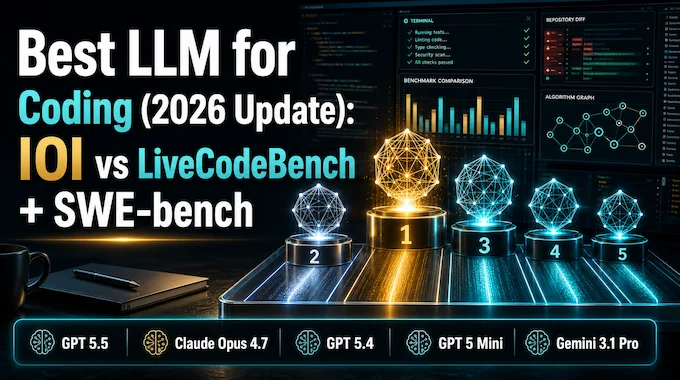
Short answer: Claude Opus 5 remains the best LLM for coding in our September 2026 five-benchmark ranking, with a balanced score of 99.1. It leads SWE-bench Verified at 97.00% and IOI at 91.67%, while remaining near the top of Terminal-Bench 2.1, Vibe Code Bench and LiveCodeBench. Claude Fable 5 remains second overall at 96.0, followed by GPT-5.6 Sol at 95.4 and GPT-5.6 Terra at 90.4.
For everyday coding rather than maximum frontier performance, GPT 5 Mini remains the best daily-driver value. Vals reports 86.61% on LiveCodeBench and specifically highlights its combination of strong performance, price and latency. Claude Fable 5 remains the raw LiveCodeBench leader at 89.78%.
The newest results reinforce why there is no universal coding winner. Claude Opus 5 is the strongest balanced choice, GPT-5.6 Sol leads terminal work, Claude Fable 5 leads app building and LiveCodeBench, and DeepSeek V4 Pro has climbed to 96.40% on SWE-bench Verified. This September 2026 update uses the same five-benchmark basket and the same fixed weights as the previous version, so changes in rank come from new published benchmark results rather than a changed methodology.
Best LLM for Coding 2026: Quick Verdict
Current Vals AI results across repository repair, terminal work, app building, competitive coding and IOI.
| Category | Winner | Why |
|---|---|---|
| Best overall | Claude Opus 5 | 99.1 balanced score; leads SWE-bench and IOI. |
| Best daily-driver value | GPT 5 Mini | 86.61% LiveCodeBench; Vals highlights its price/latency trade-off. |
| Best terminal agent | GPT-5.6 Sol | Terminal-Bench 2.1 leader at 85.77%. |
| Best app builder | Claude Fable 5 | Vibe Code leader at 90.35%. |
| Best LiveCodeBench | Claude Fable 5 | 89.78% accuracy. |
| Best C++ / algorithms | Claude Opus 5 | IOI leader at 91.67%. |
| Best repository repair | Claude Opus 5 | SWE-bench Verified leader at 97.00%. |
| Best open-weight balanced contender | DeepSeek V4 Pro | 96.40% SWE-bench and 84.2 balanced score across all five published results. |
Table of Contents
1. What the IOI Benchmark Is Actually Testing
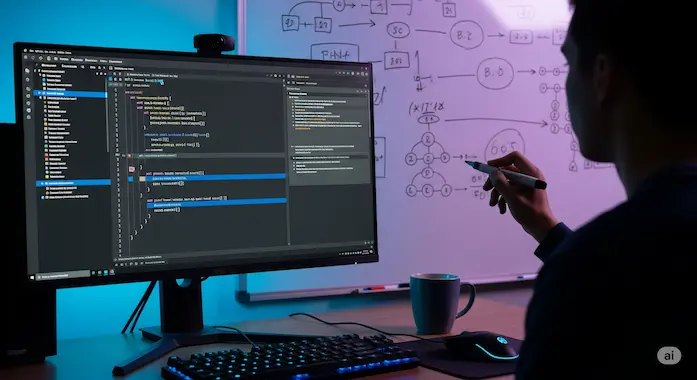
The IOI benchmark is not about wiring views or calling SaaS APIs. It is a pressure test for deep algorithmic reasoning: graphs, dynamic programming, combinatorics, and C++ solutions that must survive automated grading. In the current Vals AI IOI snapshot, Claude Opus 5 leads at 91.67%, followed by GPT-5.6 Sol at 86.67%. Qwen3.8 Max is now third at 73.00%, narrowly ahead of GPT-5.6 Luna at 72.92% and Claude Fable 5 at 72.25%.
IOI matters because it rewards planning and repair rather than a single lucky answer. Agents receive a C++ execution environment and can make up to 50 graded submissions, with partial credit accumulated across subtasks. That makes IOI especially useful when asking which is the best LLM for C++ or for algorithm-heavy coding where the model must plan, compile, debug, and improve its solution rather than simply produce a short function.
2. What the LiveCodeBench Benchmark Measures
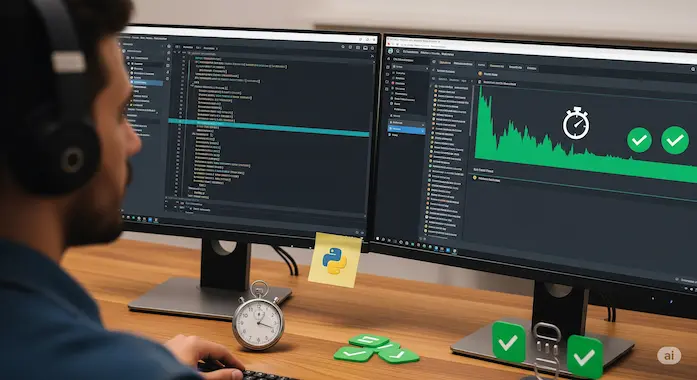
LiveCodeBench tests code generation against hidden test cases using competitive-programming problems from sources including LeetCode, AtCoder, and Codeforces. Unlike repository benchmarks, it focuses on whether a model can understand a programming problem, design an algorithm, produce correct Python code, and handle edge cases. That makes it a useful LLM coding benchmark for everyday problem solving, even though it does not reproduce the full environment of professional software engineering.
In the latest published Vals results, Claude Fable 5 remains the LiveCodeBench leader at 89.78%, followed by Claude Opus 5 at 89.03%. The latest public result set also places Gemini 3.7 Flash at 88.65%, Gemini 3.1 Pro Preview at 88.48%, Grok 4.6 at 88.22%, and Gemini 3.6 Flash at 88.08%. For high-volume everyday coding, however, GPT 5 Mini remains our daily-driver value pick: Vals highlights its 86.61% result as especially attractive after accounting for price and latency.
3. Coding Benchmark Results at a Glance
The table below combines the latest available Vals AI results across five coding benchmarks. The current data cut is SWE-bench Verified: August 30, 2026; Terminal-Bench 2.1: August 26, 2026; Vibe Code Bench v1.1: August 30, 2026; LiveCodeBench: latest current public result snapshot; and IOI: August 9, 2026. Together they cover repository repair, terminal and tool use, full-app construction, competitive coding and deep algorithmic reasoning.
The balanced score uses the same fixed basket for every model: SWE-bench 30%, Terminal-Bench 2.1 20%, Vibe Code 20%, LiveCodeBench 20%, and IOI 10%. Each result is divided by the current leader on that benchmark before applying the weight. The normalization maxima for this update are SWE 97.00, Terminal 85.77, Vibe 90.35, LiveCodeBench 89.78, and IOI 91.67. Only models with published Vals results across all five benchmarks qualify for the main Top 10; missing values are no longer estimated or borrowed from another model.
Top 10 LLMs for Coding by Balanced Score
Fixed basket: SWE 30% · Terminal 20% · Vibe 20% · LiveCodeBench 20% · IOI 10%
| Rank | Model | Score | SWE | Terminal | Vibe | LCB | IOI | Best use |
|---|---|---|---|---|---|---|---|---|
| 1 | Claude Opus 5 | 99.14 | 97.00 | 84.64 | 88.40 | 89.03 | 91.67 | Hard repositories + algorithms |
| 2 | Claude Fable 5 | 96.04 | 95.00 | 80.52 | 90.35 | 89.78 | 72.25 | Full apps + high-accuracy coding |
| 3 | GPT-5.6 Sol | 95.43 | 96.20 | 85.77 | 80.50 | 82.60 | 86.67 | Terminal and tool-heavy agents |
| 4 | GPT-5.6 Terra | 90.36 | 95.40 | 77.53 | 74.59 | 85.93 | 65.25 | Repository-heavy general coding |
| 5 | DeepSeek V4 Pro | 84.19 | 96.40 | 54.68 | 82.30 | 87.53 | 35.83 | Open-weight repository repair |
| 6 | Qwen3.8 Max | 84.05 | 85.60 | 67.42 | 64.70 | 87.85 | 73.00 | Open-weight coding + algorithms |
| 7 | Claude Opus 4.7 | 81.15 | 82.00 | 68.54 | 71.00 | 85.07 | 47.08 | Older but broad all-rounder |
| 8 | Qwen3.7 Max | 70.56 | 68.80 | 61.05 | 47.67 | 87.06 | 46.75 | Competitive coding |
| 9 | GPT-5.4 Mini | 64.80 | 73.00 | 54.68 | 47.97 | 81.47 | 6.42 | Smaller general coding jobs |
| 10 | Gemini 3 Flash | 63.57 | 75.00 | 53.93 | 20.20 | 85.59 | 39.08 | Hidden-test coding / fast iteration |
The new ranking still produces the same top three, but the eligible field is deeper. Claude Opus 5 remains the best LLM for coding overall with a balanced score of 99.1, followed by Claude Fable 5 at 96.0 and GPT-5.6 Sol at 95.4. GPT-5.6 Terra is fourth at 90.4. DeepSeek V4 Pro and Qwen3.8 Max are effectively tied at 84.2 and 84.1; because they are within 0.5 points, the fixed tie-break applies and DeepSeek ranks fifth on its higher SWE-bench score.
4. Why the Leaderboards Disagree, and Why That Is Useful
LLM coding benchmarks disagree because they test different slices of software work. SWE-bench Verified asks models to resolve real GitHub issues using a minimal bash-based agent harness. Terminal-Bench 2.1 tests whether they can complete difficult tasks inside a sandboxed terminal. Vibe Code Bench asks whether a model can turn a natural-language specification into a working application. LiveCodeBench focuses on competitive-programming correctness against hidden tests, while IOI pushes much deeper into C++ algorithms, iterative submissions, and partial-credit problem solving.
That is why the best LLM for coding is not necessarily the model that tops one coding benchmark. A model can be exceptional at repairing repositories and still lag when building an application from scratch, or dominate competitive programming while being less capable in a terminal. The balanced score rewards models that remain strong across all five types of work instead of treating one leaderboard as a universal measure of software-engineering ability.
Workflow also changes what a score means. LiveCodeBench grades a generated solution against hidden tests, while IOI allows repeated submissions and combines credit across subtasks. Terminal-Bench requires models to operate tools correctly, and Vibe Code evaluates complete applications rather than isolated functions. Those differences are not benchmark trivia; they explain why the same models move up and down across an LLM coding comparison.
5. Model Philosophies in Practice
Claude Opus 5, the balanced winner. Claude Opus 5 has the strongest profile across the five benchmarks in this update. It leads SWE-bench Verified at 97.00% and IOI at 91.67%, while placing just behind the leaders on Terminal-Bench 2.1, Vibe Code, and LiveCodeBench. That combination matters more than any single #1 result: Opus 5 is the model in this comparison with the fewest obvious weak spots, which is why it takes the overall balanced-score crown.
Claude Fable 5, the app-building and everyday-coding leader. Fable 5 leads Vibe Code Bench at 90.35% and LiveCodeBench at 89.78%, while also scoring 95.00% on SWE-bench. That makes it particularly compelling when the job is less about olympiad-style algorithms and more about turning requirements into working software or solving a steady stream of coding problems correctly.
GPT-5.6 Sol, the terminal specialist. GPT-5.6 Sol leads Terminal-Bench 2.1 at 85.77%, edges Opus 5 on that benchmark, and also posts 96.20% on SWE-bench and 86.67% on IOI. It is the strongest first choice in this ranking when the task depends heavily on shells, tools, repository navigation, and iterative problem solving rather than code generation alone.
GPT 5 Mini, the daily-driver value model. GPT 5 Mini is not the overall frontier winner, but that is not the job we assign it. Vals gives it 86.61% on LiveCodeBench and specifically highlights the model after accounting for price and latency. For small scripts, tests, quick edits, and repeated everyday requests, that combination makes it our practical default before escalating difficult work to a heavier model.
DeepSeek V4 Pro, the open-weight repository specialist. The open-weight picture has changed sharply. Vals now places DeepSeek V4 Pro second overall on SWE-bench Verified at 96.40%, only 0.60 points behind Claude Opus 5. It also posts 82.30% on Vibe Code and 87.53% on LiveCodeBench. Its weaker Terminal-Bench and IOI results keep it well below the closed-model leaders in the five-benchmark balanced score, but for developers prioritizing open weights and real repository repair, it is now the model to watch most closely.
Qwen3.8 Max, the more algorithmically balanced open-weight alternative. Qwen3.8 Max trails DeepSeek on SWE-bench but reaches 73.00% on IOI and 87.85% on LiveCodeBench, giving it a different strength profile. It ranks immediately behind DeepSeek in our complete five-benchmark basket.
6. Cost and Speed Are Product Features
Accuracy wins leaderboard headlines, but latency and cost determine what developers can afford to run all day. Claude Opus 5 is the best LLM for coding in the balanced ranking, but that does not automatically make it the best default for every autocomplete, test, refactor, or small script. LiveCodeBench illustrates the trade-off well: Claude Fable 5 leads raw accuracy at 89.78%, while Vals highlights GPT 5 Mini at 86.61% as a strong option after accounting for price and latency.
That is why the practical answer is usually a model stack rather than one winner. Start with a fast, economical model for routine work, escalate repository or terminal-heavy tasks to Claude Opus 5 or GPT-5.6 Sol, and use Claude Fable 5 when maximum everyday coding accuracy or build-from-scratch app performance matters. The few points you give up on a benchmark can be worth it when a faster model is called hundreds of times during a normal development cycle.
7. A Practical Build: The Tiered Model Stack

There is no single model you should send every task to. The most reliable setup is a small routing stack. Use the cheap fast model while the problem is small. Escalate when the work becomes agentic, multi-file, algorithmic, or risky.
Recommended Coding Model Stack
Route by workload instead of paying frontier-model prices for every request.
| Workflow | Default | Escalate to | Why |
|---|---|---|---|
| Routine scripts, tests, edits | GPT 5 Mini | Claude Fable 5 | Vals explicitly highlights GPT 5 Mini’s LiveCodeBench performance after price and latency; Fable leads raw LCB accuracy. |
| Repository repair | Claude Opus 5 | GPT-5.6 Sol | Opus leads SWE-bench; Sol is the better specialist when repository work becomes terminal-heavy. |
| Terminal / agent workflows | GPT-5.6 Sol | Claude Opus 5 | Sol leads Terminal-Bench 2.1; Opus offers the strongest broader five-benchmark profile. |
| Build a full application | Claude Fable 5 | Claude Opus 5 | Fable leads Vibe Code and LiveCodeBench; Opus is the escalation path for harder mixed workloads. |
| C++ / algorithmic problems | Claude Opus 5 | GPT-5.6 Sol | Opus leads IOI at 91.67%; Sol is second at 86.67%. |
| Open-weight coding | DeepSeek V4 Pro | Qwen3.8 Max | DeepSeek has the stronger repository profile; Qwen is substantially stronger on IOI-style algorithmic work. |
The pattern is the important part: the overall benchmark winner and the workflow winner are not always the same model. Claude Opus 5 gives you the strongest balanced profile, GPT-5.6 Sol is the terminal specialist, Claude Fable 5 leads app building and LiveCodeBench, and GPT 5 Mini remains the economical daily default. A useful coding stack routes work according to the task instead of asking one model to be optimal at everything.
8. Prompt Design That Survives Production
Benchmarks do not include your prompt. Your prompt becomes the task surface. For LiveCodeBench style problems, keep instructions short and explicit. Ask for a single Python function with no extra logs. Include a tiny test harness and request only the function body. For IOI style work, use a two stage plan. First, ask for a step by step plan with estimated complexity. Second, ask for code that follows that plan. This is a core part of effective context engineering. This cuts down on flailing. It also narrows token use, which improves your llm latency and cost.
When you evaluate internally, mirror the public setups. For an IOI shaped ticket, give your agent a compiler and a budget of submissions. For a LiveCodeBench shaped task, measure pass at one with hidden tests and strict I O. This is how you keep your own llm coding comparison honest.
9. Where to Double-Click, With Deeper Reads
If you want to double-check the ranking, start with the five Vals AI benchmark pages linked in the sources, then compare your own repository tests against the same pattern. For a broader OpenAI baseline, read our GPT-5 benchmarks explainer and the hands on GPT-5 guide. For daily AI coverage, use the weekly news roundup to catch model releases that may change the next update cycle.
10. Caveats Worth Keeping
A benchmark snapshot is not a contract. Different coding benchmarks use different languages, tools, agents, prompts and scoring systems, so small score differences should not automatically be treated as meaningful differences in real development work. SWE-bench Verified is also increasingly compressed at the frontier: Vals now reports that seven of 86 evaluated models reach 95% or better, with Claude Opus 5 leading at 97.00%. That leaves little room for SWE-bench alone to separate the strongest models, which is another reason to retain the multi-benchmark basket.
There is also an important Terminal-Bench 2.1 caveat. Vals says the Claude Opus 5 and Claude Fable 5 evaluations used Claude Opus 4.8 as a refusal fallback. For Opus 5 specifically, counting its nine fallback-assisted passes as failures would lower its Terminal-Bench score from 84.64% to 81.27%. That does not overturn the overall result in our weighted basket, but readers should know what sits behind the headline number.
Finally, none of these benchmarks perfectly reproduces your repository, toolchain, engineering standards, or deployment constraints. IOI emphasizes C++ algorithms; LiveCodeBench emphasizes hidden-test programming; Vibe Code tests complete applications; Terminal-Bench tests sandboxed command-line work; and SWE-bench uses real repository issues. Treat the leaderboards as strong comparative signals, then rerun the finalists on your own code before standardizing on one model.
11. So, Which Is the Best LLM for Coding 2026?
If you want one answer, Claude Opus 5 remains the best LLM for coding in our September 2026 balanced ranking, scoring 99.1 across the fixed five-benchmark basket. It leads SWE-bench Verified and IOI while remaining close to the leaders on Terminal-Bench 2.1, Vibe Code and LiveCodeBench. The ranking continues to use only published results; missing benchmark values are not estimated or borrowed.
The more useful answer depends on your workload. Choose GPT 5 Mini for frequent everyday coding where value matters. Choose GPT-5.6 Sol for terminal and tool-heavy workflows. Choose Claude Fable 5 for build-from-scratch applications or maximum LiveCodeBench accuracy. Choose Claude Opus 5 for difficult repository work and C++ or IOI-style algorithms. If open weights matter, DeepSeek V4 Pro is now the strongest repository-repair contender, while Qwen3.8 Max offers a more algorithmically balanced profile.
The larger lesson has not changed: software engineering is not one task, so one coding benchmark cannot identify the best model for every developer. The most useful LLM coding comparison combines multiple benchmarks, then maps those results back to the kind of work you actually do.
12. How to Reproduce Signal in Your Own Repository
Benchmarks are a compass, not a destination. You will learn more in a day by testing on your code than a week of screenshots. Here is a simple plan that any team can run. It helps you pick the best llm for coding in 2026 for your own stack and it produces artifacts you can keep.
- Curate ten to twenty tasks from your backlog. Pick a mix. A simple parsing function. A medium difficulty dynamic programming problem. A tricky refactor across several files. Add two short tickets that rely on third party SDKs you actually use.
- Write hidden tests. Do not publish them in prompts. Mirror the LiveCodeBench benchmark style, where the model only sees the signature and one example, then gets graded on a larger suite.
- For agentic trials, borrow ideas from the IOI benchmark harness. Give the model a compiler, a submission budget, and a way to inspect failed cases. Log each attempt.
- Keep prompts short and stable. For one pass Python, ask for a single function and nothing else. For algorithms, use a two stage plan, plan then code. Fix temperature and stop sequences.
- Track three numbers for every run. Pass at one. Wall clock latency. Estimated token cost. These map directly to AI coding accuracy, llm latency and cost, which is what leadership will ask about.
Do not rush to a single provider. Build a small switch that lets you route the same task to different backends, then collect correctness, latency, and cost in a simple comparison table. You may see the same pattern that appears in the public benchmarks: a fast model such as GPT 5 Mini can cover routine work, GPT-5.6 Sol can take tool-heavy terminal tasks, Claude Fable 5 can handle app-building and high-accuracy coding, and Claude Opus 5 can take the hardest repository and algorithmic problems. Your own best LLM for coding may ultimately look more like a small team than a single model.
Azmat – Founder of Binary Verse AI | Tech Explorer and Observer of the Machine Mind Revolution.
Looking for more model comparisons? Explore our AI IQ Test 2025, follow the Weekly AI News Roundup, or browse more analysis on BinaryVerseAI.com. For questions or feedback, feel free to contact us.
Q: What is the best LLM for coding 2026 right now?
IIn our September 2026 five-benchmark ranking, Claude Opus 5 remains the best LLM for coding overall, scoring 99.1 after normalization across SWE-bench Verified, Terminal-Bench 2.1, Vibe Code Bench, LiveCodeBench and IOI.
Which LLM is best for C plus plus and IOI style algorithm problems?
Yes. Latency changes how a model feels in a real development loop, and a slightly less accurate model can be the better choice when it is called hundreds of times per day. That is why this article separates the best balanced model from the daily-driver value winner. Claude Opus 5 leads the balanced ranking, while Vals specifically highlights GPT 5 Mini on LiveCodeBench after accounting for price and latency.
What is the best LLM for everyday coding?
For maximum LiveCodeBench accuracy, Claude Fable 5 currently leads at 89.78%. For frequent everyday work where price and latency also matter, GPT 5 Mini is our daily-driver value pick; Vals highlights its 86.61% LiveCodeBench result as a strong option after accounting for cost and latency.
Which model is best for terminal and coding-agent workflows?
GPT-5.6 Sol leads Terminal-Bench 2.1 at 85.77%, just ahead of Claude Opus 5 at 84.64%. It also performs strongly on SWE-bench and IOI, making it particularly well suited to tasks that involve command-line tools, repository navigation, and iterative problem solving.
What is the best open-weight LLM for coding?
DeepSeek V4 Pro is now the strongest open-weight repository-repair contender in the current Vals data, reaching 96.40% on SWE-bench Verified. In our strict five-benchmark basket it scores 84.2, narrowly ahead of Qwen3.8 Max at 84.1. Qwen3.8 Max is stronger on IOI-style algorithmic work, so the better open-weight choice depends on whether your workload is repository repair or competitive/algorithmic coding.
Is latency an important factor when choosing an AI for coding?
Yes. Latency changes how a model feels in a real workflow. A model that is slightly less accurate but much faster can be better for everyday development. That is why this article separates best overall with the marked IOI fallback, best no-assumption five-benchmark model, and best daily driver instead of pretending one model should handle every coding task.
Should I use one AI model for all coding tasks or a specialized stack?
A specialized stack is usually more practical. Use GPT 5 Mini for routine high-volume coding, GPT-5.6 Sol for terminal-heavy work, Claude Fable 5 for app building and high LiveCodeBench accuracy, and Claude Opus 5 for difficult repository work and algorithms. The balanced ranking identifies the strongest all-rounder, but your workflow determines which model should handle each request.