Introduction
World models have a funny habit of turning grown engineers into wide-eyed kids. Show someone a clip where you steer a camera through a new environment, and they instantly ask the same two questions: “Is this a simulation, or just a fancy video?” and “Can I run it on my GPU?”
That’s the entire conversation, distilled.
On one side you’ve got Genie 3, the shiny, closed demo that many people first encounter through “genie 3 google” search results. Outside of the keyword soup, Google is just the distribution layer, not the benchmark. On the other, you’ve got LingBot, an open release that dares to put code and weights on the table. Not a teaser, a repo. It does not just show you a world, it gives you something you can debug. That alone changes the tone of the debate.
This post is a reality check, not a fan club. We’re going to compare the two the way practitioners do, by asking boring questions that matter: what counts as a world model AI, what “memory” actually looks like, how interactive it feels at 16 FPS, why one-minute horizons are hard, and what it takes to try LingBot without sacrificing a weekend.
Table of Contents
1. What This Comparison Actually Means In 2026
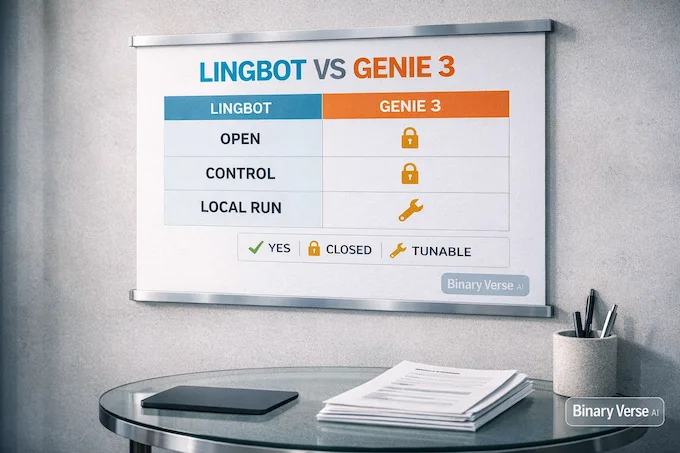
Before we zoom in, here’s a compact scoreboard. It’s the lens I use when comparing an open release to a closed demo.
LingBot: World Simulator Tradeoffs
| Dimension | Open Weights World Simulator | Closed Demo World Simulator |
|---|---|---|
| Reproducibility | You can rerun, instrument, and break it | You mostly observe outputs |
| Control | You can change knobs, code, and sampling | You get the interface you’re given |
| Iteration Speed | Slower at first, faster after setup | Fast to try, slow to deeply test |
| Reliability | Depends on your setup and drivers | Usually smoother, until you hit limits |
| Learning Value | High, because you see the guts | Medium, because you infer the guts |
1.1 You Can’t Benchmark What You Can’t Touch
Let’s get the awkward part out first. “Open vs closed” is not just ideology, it’s measurement. If you can’t inspect training data, action space, inference stack, or even the exact model version, any head-to-head claim is basically vibes.
The LingBot paper is blunt about the ambition: it frames the goal as moving from passive video generation to “text-to-world” simulation, where the model behaves less like a dreamer and more like a simulator that respects causality and object persistence. LingBot is trying to be judged on simulator rules, not video rules.
1.2 The Only Fair Lens: Trade-Offs
The table above is not a verdict, it’s a map. It explains why two people can watch the same demo and walk away with different conclusions.
If you want to ship a product today, the closed path often feels smoother. If you want to learn, measure, or build on top of the work, the open path usually wins. It’s the right mental model here, because “open” is a feature with consequences.
If you want the one-sentence takeaway: LingBot teaches you more, Genie 3 usually looks better on day one.
2. Quick Verdict For Skimmers
If you only have two minutes, here’s the punch list.
- LingBot wins on controllability and auditability, because you can see how actions are represented and injected.
- Genie 3 wins on polish, distribution, and the “it just works” factor, assuming you have access.
- LingBot makes the world model debate concrete, since you can run your own “is it remembering, or faking it?” tests.
- Genie 3 sets the bar for responsiveness and stability in public perception, even when the details stay opaque.
- The real story is not who “wins,” it’s what open releases unlock when LingBot-style world simulation starts acting like a real engineering platform.
3. What The Open Model Actually Is
3.1 A Plain-English TLDR Of The World Model Paper
LingBot is presented as an open-sourced world simulator “stemming from video generation,” with three headline claims: minute-level horizons, real-time interactivity, and public access to code and weights. It even pins a concrete interactive target, under one second latency while producing 16 frames per second.
That’s the promise. The interesting part is how LingBot tries to get there.
3.2 The Engineering Pillars That Matter
The system is built around three pillars: a scalable data engine that mixes real footage with game engine recordings and synthetic data from Unreal Engine, a multi-stage training pipeline that evolves a video generator into an interactive simulator, and a post-training step that distills the model toward sub-second inference.
This is the subtle but important shift. It’s not “we trained a bigger video model.” It’s “we built a pipeline that treats interactivity as a first-class requirement,” and LingBot is the artifact you can actually study.
3.3 Actions Aren’t Magic, They’re Representations
One thing I like about the paper’s framing is that it doesn’t pretend “control” is mystical. It describes action representation as a hybrid, continuous camera rotation plus discrete keyboard-like inputs such as W, A, S, and D.
That choice matters. It makes the model legible. You can reason about what it can and cannot do, because the action space is explicit.
4. What Genie 3 Is, And Why People Keep Saying “Project Genie”
Let’s talk about the other side without inventing details. Genie 3 is tied to DeepMind, but it’s still mostly experienced through controlled surfaces.
Genie 3 is the reference point because it popularized the idea that you can “drive” a generated world. People search for it as google genie 3, deepmind genie 3, and yes, the wonderfully awkward phrase genie 3 google, because what they want is not a paper. They want a hands-on toy that feels like a simulator.
“Project Genie” is best understood as the experience layer, the product-shaped wrapper around a model. Branding aside, the core dynamic is simple: Genie 3 is closed. You can’t pull the weights, swap the action encoding, or profile latency end-to-end on your own machine. You can only test what the interface exposes.
That’s not a moral judgment. It’s just the boundary of what “competition” can mean.
5. Access Reality, And Why It Shapes The Conversation
Access is the hidden variable in every “AI world models vs LLM” thread. Closed demos create a paradox. They are vivid enough to anchor everyone’s imagination, but constrained enough that we argue about shadows. Open releases do the opposite. They are messy, they break, they ask you to install things, but they let you turn disagreement into an experiment.
The LingBot authors are explicit about this motivation, they contrast their release with recent interactive world models that remain closed-source, and position full open-source availability as the differentiator.
So if you’re asking “is it a real competitor,” the answer depends on what you mean by competitor. Product adoption, no. Scientific and engineering leverage, yes, and that’s where LingBot shines.
6. Open Weights Vs Closed World-Building
6.1 Why Open Beats “Better” In The Long Run
Closed models can be stronger today and still lose the long game. Open weights let researchers run ablations, measure failure modes, and build tooling around them. The ecosystem compounds.
This is where LingBot matters most. Not because it will instantly outperform a top secret system, but because it gives the community a concrete object to poke. That’s how real progress happens, with people filing issues, shipping forks, and turning one demo into ten applications.
6.2 The Unsexy Benefits, Debuggability
When something is open, you can ask useful questions:
- Does drift come from sampling, from action conditioning, or from the training distribution?
- Does “memory” improve if you change the prompt structure?
- Does latency bottleneck on the transformer, the VAE, or IO?
With a closed system, you can only guess. With an open system, you can measure, and that’s the whole point of releases like LingBot.
7. The World Model Debate, Simulation Or Action-Conditioned Video
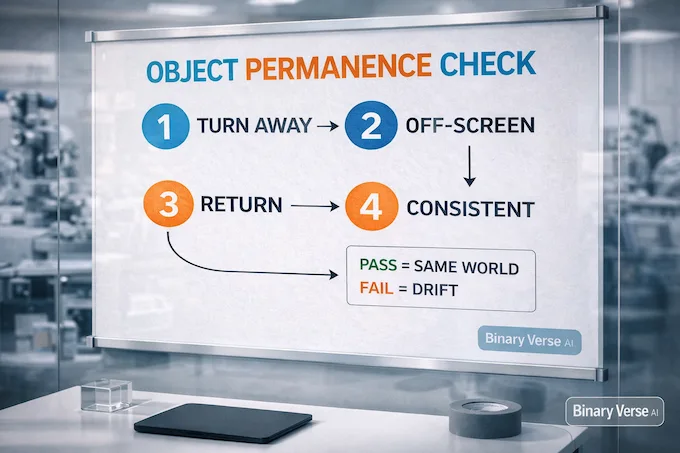
Here’s my litmus test: if you change an action, does the world respond in a way that respects hidden state?
A video generator can look coherent for a few seconds and still be a dreamer, stitching plausible pixels without caring what’s behind the wall. The LingBot paper names this directly, the gap between dreamers that hallucinate transitions and simulators that preserve causality and object permanence.
So what would a simulator do that a video model struggles with?
- Keep landmarks consistent after they leave the view.
- Evolve off-screen objects in a plausible way.
- Make actions feel causal, not decorative.
The key is not perfection. The key is whether those behaviors show up systematically when you stress the model.
8. The Proof People Care About, Object Permanence And Off-Screen State
8.1 The Stonehenge Test Exists For A Reason
If you’ve been on Reddit or X lately, you’ve seen some version of this argument: “Show me it remembers a landmark after I look away.”
The LingBot paper reports an “emergent memory capability” where landmarks like statues and Stonehenge remain structurally consistent after being out of view for up to 60 seconds. That’s not a trivial claim, because it’s testing global consistency, not just local texture. It’s also the kind of test that lets LingBot separate itself from pure video parlor tricks.
8.2 Memory Is Not A Database
A crucial nuance: the same section is clear that this is implicit memory. It’s not an explicit 3D map or a saved state. It’s the model carrying enough internal structure to make reappearance coherent, and even to evolve unobserved state in plausible ways, like a vehicle leaving the frame and later reappearing where physics would suggest.
That’s why people argue about “world model or just video.” The behavior can look like memory even when it’s a learned prior. In practice, you care less about philosophical purity and more about whether the illusion holds under pressure.
9. Real-Time Claims, FPS, Latency, And What “Playable” Feels Like
The paper pins a specific interactivity target: under one second latency at 16 FPS. That’s refreshingly concrete, and it makes the system easy to discuss without hand-waving.
Also, 16 FPS is not buttery. It’s closer to “early console game” than “modern esports.” But interactivity is not just FPS. It’s end-to-end responsiveness. If your input changes the next frame quickly, your brain forgives a lot. If your input takes three seconds to show up, even 60 FPS doesn’t feel interactive, because it’s not.
The authors describe post-training that distills the diffusion process toward an efficient system with sub-second latency. That’s the right move if you want “playable” instead of “rendered.”
10. Hardware Requirements, Can You Run It Or Is This Data-Center Only

10.1 Why Multi-GPU Shows Up In The First Place
The model is large, and long-horizon generation blows up memory. The paper describes distributing parameters and optimizer state across multiple GPUs as a practical necessity for training, using sharding approaches like FSDP. The same reality tends to spill into inference workflows for longer or higher-resolution runs.
10.2 Three Tiers That Match Real Life
Here’s the pragmatic view, based on how these systems behave in the wild.
LingBot: Run Goals and Expectations
| Goal | What You Actually Run | What To Expect |
|---|---|---|
| “I Just Want To Test” | Short clips, lower resolution, possibly quantized weights | Fast feedback, more artifacts, weaker long-horizon consistency |
| “I Want 480p Interactive” | A single strong GPU, tuned batch sizes, shorter horizons | Playable demos, some drift, decent control |
| “I Want Long 720p And Long Horizon” | Multi-GPU box, careful memory tuning | Better fidelity and duration, higher cost, more setup pain |
The paper also calls out the elephant in the room: inference cost is still high and requires enterprise-grade GPUs, which pushes it out of consumer reach today.
11. How To Try The Open Release Without Wasting A Weekend
This section is where most “open source competitor” narratives go to die, because reality arrives with a stack of dependencies. A few rules that will save you time:
- Treat the environment like a project, not a one-off command. Pin versions. Use a clean virtualenv. Keep notes.
- Expect the first run to fail. Plan for it. Most failures are boring, mismatch between your torch build and your CUDA stack, or a missing optimized attention kernel.
- Decide early, local GPU or rented GPU. If you don’t have the VRAM budget, you can still learn a lot by running short horizons.
Also, be honest about your goal. If you want to read outputs, a closed demo is fine. If you want to understand the mechanism, run the open system and instrument it.
If you’re the kind of person who reads error logs for fun, this is your moment. If you’re not, borrow a friend who is, or rent a machine that already has a sane CUDA stack. Either way, treat it like building a small research rig, not like installing a phone app.
12. Where It Still Breaks, And What To Watch Next
If you want trust, you talk about failure modes. The paper lists limitations in plain language: memory stability is emergent from the context window and can get inconsistent over long runs, inference cost is high, the action space is limited mostly to navigation, fine-grained object-level interaction is hard, and generation can drift as duration increases.
That set of problems is exactly what you’d predict for this stage of the field. You can generate coherent worlds, but keeping them stable for “infinite gameplay” is a higher bar.
The nice part is that the roadmap is also concrete: expand action space, improve physics, build an explicit memory module, and attack drifting so longer generation becomes practical.
So where does that leave us?
Genie 3 is the glossy poster of what’s possible. The open release is the messy workshop where capability turns into craft. If you’re building games, robotics datasets, or interactive content, you want the workshop.
If you’re curious, don’t just watch videos. Download the code. Run the tests. Break things. Then share what you learn, because that’s how open ecosystems win.
If you want more deep dives like this, subscribe to Binary Verse AI, and drop your most annoying world model question in the comments. I’ll turn it into an experiment.
The model weights are available for those ready to dive in, and the growing community of developers working with agentic AI tools continues to push the boundaries of what’s possible with open-source AI.
What is Genie 3 and how does it work?
Genie 3 is a research-grade interactive world generator from Google / Google DeepMind that aims to model how scenes evolve when actions happen, not just render a fixed clip. Think action-conditioned rollouts: you provide inputs, it predicts the next moments of the world.
Is Google Genie 3 available to the public?
Not broadly. google genie 3 access is still limited and inconsistent across demos, prototypes, and research previews. That gap is exactly why comparisons keep trending: people can watch it, but most can’t run it on demand like an open repo. (You’ll also see the phrase genie 3 google used loosely in social posts.)
What is a “world model AI” (and how is it different from video generation)?
A world model AI predicts how a world changes under actions, while video generation mainly predicts pixels that look plausible. A world model must stay consistent when you turn away and return, and it must react coherently to inputs over time. Video can look amazing and still fail causality.
Can you run LingBot-World locally, and what GPU do you need?
Yes, you can run LingBot-World locally, but “local” can mean anything from a trimmed, quantized test run to multi-GPU inference for long rollouts. If you want smooth interactive experiments, plan for a serious GPU setup and enough VRAM headroom, plus the usual CUDA and attention-kernel headaches.
LingBot-World vs Genie 3: which one is better for real-time interactive worlds?
If you care about actually running experiments today, LingBot-World has the practical edge because it’s open and deployable. If you care about polished closed demos, deepmind genie 3 may look stronger in curated showcases. The honest answer: one wins on access and iteration speed, the other may win on refinement when you can get in.