Introduction
Benchmarks are the awkward job interviews of AI. Everyone shows up polished. Everyone claims they “love hard problems.” And somewhere in the middle, you’re just trying to answer one practical question: which model will save me time, money, and sanity on real work?
That’s what Kimi K2.5 vs GLM 4.7 is really about. Not vibes. Not a single cherry-picked screenshot. Not “it felt smart in chat.” You want independent numbers, you want pricing that matches reality, and you want to know who wins when the task becomes a loop: write, test, fix, repeat.
So here’s the deal. We’re going to treat Kimi K2.5 vs GLM 4.7 like engineers, because we are engineers. We’ll look at independent scores across multiple benchmarks, then translate accuracy into cost-per-finished-task. Along the way, we’ll call out where these tests actually map to your day-to-day workflows and where they don’t.
Table of Contents
1. What This Comparison Measures, And What It Does Not
The cleanest mental model for Kimi K2.5 vs GLM 4.7 is this: you’re comparing two different “work styles,” using imperfect but useful proxies.
Benchmarks are proxies. They’re not the thing. They’re measurements of the thing. And if you’ve ever optimized a system, you already know what happens when you mistake the proxy for the goal.
1.1 Independent Benchmarks Vs Vendor Scoreboards
Vendor benchmarks are good for seeing what a team believes their model is best at. Independent benchmarks are better for comparing across ecosystems, because everyone gets graded with the same ruler.
That matters because Kimi K2.5 vs GLM 4.7 is often framed as “Chinese open models versus Western closed models,” and those conversations can drift into ideology fast. Independent numbers pull it back to the only question that pays your bills: “Does it solve my tasks?”
1.2 Why Arena Vibes Are Not Enough
Chat arenas are fun. They’re also chaos. They overweight fluency, confidence, and the kind of social cleverness that gets you applause in a comment thread. They underweight the boring stuff that makes a model useful: sticking to constraints, editing code safely, and not silently forgetting a critical detail at token 80,000.
If you want an LLM benchmark leaderboard that predicts productivity, you need more than vibe checks.
1.3 Complete Independent Benchmark Table
This is the independent benchmark snapshot we’ll use throughout the article. It’s ranked by IOI performance, and includes multiple “AI benchmark tests” spanning coding, tool use, math, science, and broad knowledge. In other words, it’s a decent single-table view of the current AI benchmark ranking landscape.
Kimi K2.5 vs GLM 4.7 Benchmark Table
| # | Model Name | IOI | LiveCode | SWE-bench | Terminal | AIME | GPQA | MMLU Pro |
|---|---|---|---|---|---|---|---|---|
| 1 | GPT 5.2 | |||||||
| 2 | Gemini 3 Flash (12/25) | |||||||
| 3 | Gemini 3 Pro (11/25) | |||||||
| 4 | Grok 4 | |||||||
| 5 | Claude Opus 4.5 (Nonthinking) | |||||||
| 6 | GPT 5.1 | |||||||
| 7 | GPT 5.1 Codex Max | – | – | – | – | |||
| 8 | Claude Opus 4.5 (Thinking) | |||||||
| 9 | GPT 5 | |||||||
| 10 | Claude Sonnet 4.5 (Thinking) | |||||||
| 11 | Kimi K2.5 | |||||||
| 12 | Gemini 2.5 Pro | – | – | – | – | – | ||
| 13 | Qwen 3 Max | |||||||
| 14 | DeepSeek V3.2 (Nonthinking) | – | ||||||
| 15 | Claude Opus 4.1 (Nonthinking) | – | – | – | ||||
| 16 | Grok 4 Fast (Reasoning) | |||||||
| 17 | DeepSeek V3.2 (Thinking) | – | ||||||
| 18 | GPT 5 Codex | – | – | – | – | |||
| 19 | Qwen 3 Max Preview | – | – | |||||
| 20 | Grok 4.1 Fast Non-Reasoning | – | ||||||
| 21 | GLM 4.7 | |||||||
| Data source: vals.ai/benchmarks | ||||||||
2. The 20 Second Verdict, Who Should Pick What In 2026
If you’re here for the punchline, here it is. Kimi K2.5 vs GLM 4.7 is not a “one is always better” story. It’s a “what do you do all day” story.
- If your work smells like: multi-step coding, debugging loops, repo edits, and tool use, pick Kimi K2.5 vs GLM 4.7 in favor of Kimi.
- If your work smells like: high-volume generation, long outputs, and cost-sensitive writing, Kimi K2.5 vs GLM 4.7 often leans GLM on raw token economics.
- If you’re building agent loops and you care about “keeps trying,” Kimi tends to be the safer default.
- If you want a model that feels easier to steer turn-by-turn, GLM often feels more obedient.
One line verdict:
- Coding and repair loops: Kimi.
- Cheap long-form output: GLM.
- Agentic persistence: Kimi.
- Instruction adherence feel: GLM.
3. Reading The Leaderboard Without Lying To Yourself
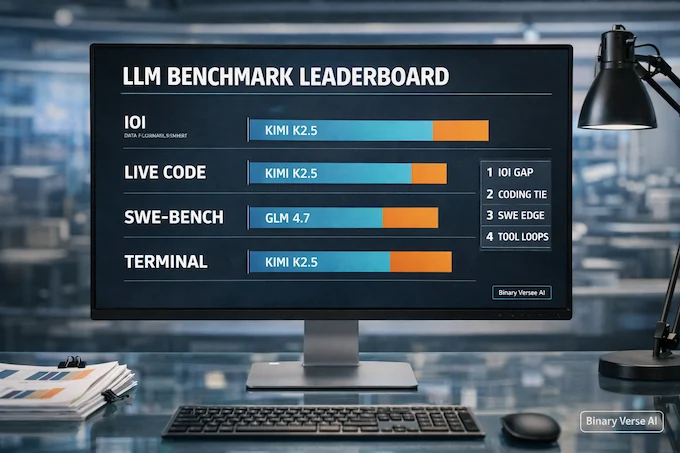
Let’s talk about what the table is quietly screaming. First, the obvious: the frontier models are doing frontier things. IOI is a brutal filter and the top tier is in a different league. Now zoom in to Kimi K2.5 vs GLM 4.7.
- On IOI, Kimi’s 17.67% versus GLM’s 7.58% is not “a small edge.” It’s a different tier of programming contest performance.
- On LiveCodeBench, the gap nearly disappears. 83.87% versus 82.23% is basically “same neighborhood.”
- On SWE-bench and Terminal-Bench, Kimi is ahead, but not by a landslide.
That combination is telling: Kimi looks stronger in deep algorithmic pressure, while GLM hangs close on more “practical coding snippets.” If you’ve ever hired engineers, you know this pattern. Some people ace whiteboards. Some people ship features. Some do both. The tests are trying to tease that apart.
This is also why AI benchmark results can confuse readers. If you only look at one axis, you’ll overfit your conclusion.
4. Accuracy Vs Cost, When Cheaper Tokens Lose Money
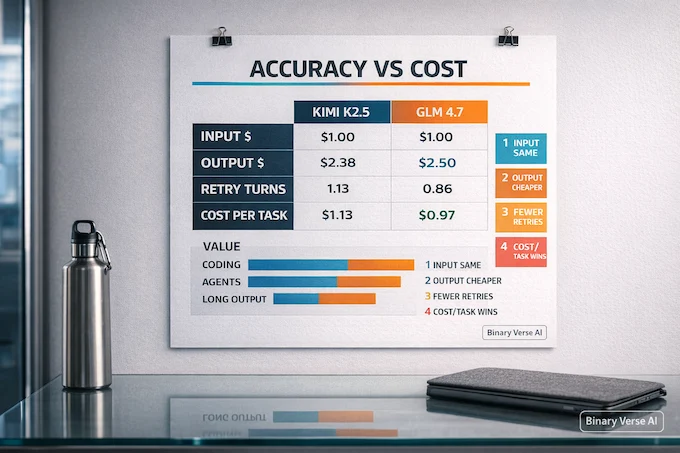
Now we get to the part that decides budgets and schedules: cost per completed task. Token pricing is easy to screenshot. Cost-per-task is the thing you actually pay. Because if a model is 20% cheaper per output token but needs two extra repair passes, it’s not cheaper. It’s a coupon for wasting time.
This is where Kimi K2.5 vs GLM 4.7 becomes interesting. GLM’s output token price is lower. But for multi-turn agentic tests, Kimi can still win on cost-per-test because it tends to converge faster.
4.1 Accuracy And Cost Analysis Table
Kimi K2.5 vs GLM 4.7 Benchmark Advantages
| Benchmark | Metric | Kimi K2.5 | GLM 4.7 | Advantage |
|---|---|---|---|---|
| IOI (Programming) | Accuracy | Kimi (+10.09%) | ||
| Cost (In / Out) | $0.60 / $3.00 | $0.60 / $2.20 | GLM (Cheaper Output) | |
| LiveCodeBench | Accuracy | Kimi (+1.64%) | ||
| Cost (In / Out) | $0.60 / $3.00 | $0.60 / $2.20 | GLM (Cheaper Output) | |
| SWE-bench | Accuracy | Kimi (+1.60%) | ||
| Cost per Test | $0.21 | $0.45 | Kimi (53% Cheaper) | |
| Terminal-Bench | Accuracy | Kimi (+2.25%) | ||
| Cost per Test | $0.14 | $0.18 | Kimi (22% Cheaper) | |
| AIME (Math) | Accuracy | Kimi (+2.30%) | ||
| Cost (In / Out) | $0.60 / $3.00 | $0.60 / $2.20 | GLM (Cheaper Output) | |
| GPQA (Science) | Accuracy | Kimi (+4.04%) | ||
| Cost (In / Out) | $0.60 / $3.00 | $0.60 / $2.20 | GLM (Cheaper Output) | |
| MMLU Pro (General) | Accuracy | Kimi (+3.17%) | ||
| Cost (In / Out) | $0.60 / $3.00 | $0.60 / $2.20 | GLM (Cheaper Output) |
Here’s the practical translation for Kimi K2.5 vs GLM 4.7:
- If you’re doing lots of long, polished output, GLM’s cheaper output tokens matter. This is where the glm 4.7 price story looks good.
- If you’re doing tasks where failure creates retries, Kimi’s slightly higher accuracy turns into fewer loops. That’s how Kimi can be cheaper per SWE-bench and Terminal-Bench test even if its output tokens cost more.
This is why an LLM coding benchmark leaderboard is only half the story. The other half is how many times you have to say, “No, run the tests again, you broke something.”
5. LiveCodeBench Vs SWE-bench, Same Vibe, Different Pain
A lot of people treat LiveCodeBench and SWE-bench as interchangeable “AI coding benchmarks.” They’re not. LiveCodeBench is often closer to: read a prompt, write a solution, maybe handle edge cases. It rewards crisp code and direct reasoning.
SWE-bench is closer to: you have a real repo, a failing test, a moving target, and the correct fix might require touching three files and resisting the urge to rewrite the universe. It rewards restraint, debugging discipline, and good local search.
So when Kimi K2.5 vs GLM 4.7 looks near-tied on LiveCodeBench but Kimi edges SWE-bench, that’s consistent with the story that Kimi behaves better inside messy repair loops. If your day job is “take a codebase from slightly broken to working,” treat SWE-bench as the more relevant signal.
6. Agentic Workflows, Terminal-Bench And The Art Of Not Giving Up
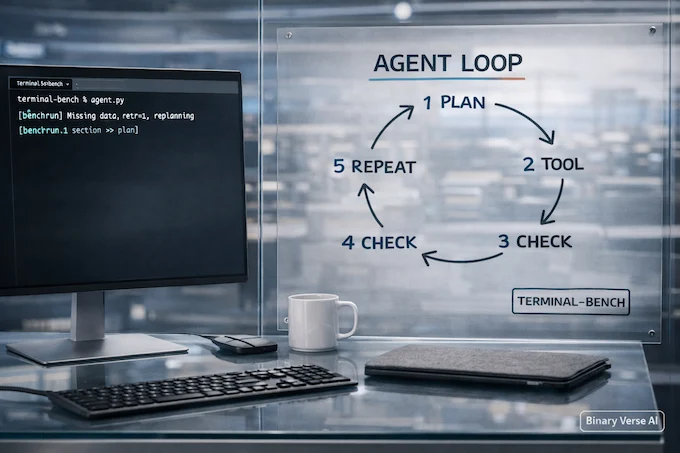
Terminal-Bench is where models stop being clever parrots and start behaving like apprentices in your shell. The difference between “tries one fix” and “keeps trying intelligently” is the difference between a toy agent and a useful one. In practice, that means:
- It executes tools without panicking.
- It notices when output contradicts expectations.
- It updates the plan instead of repeating it.
On the numbers, Kimi K2.5 vs GLM 4.7 favors Kimi again, 40.45% versus 38.20%. That’s not a massive spread, but it compounds because terminal workflows are inherently multi-step. Every extra correction turn costs tokens and attention.
This is also why “AI benchmark ranking” discussions sometimes miss the point. It’s not just whether the model gets it right. It’s whether the model makes you feel like you’re supervising progress, instead of babysitting confusion.
7. Long Context And Stability, What Breaks Past 100k Tokens
Long context is where models either become your second brain or your most convincing liar. What breaks first is not intelligence. It’s bookkeeping. At very long contexts, you see failure modes like:
- Answering the wrong sub-question because it latched onto an earlier instruction.
- “Drift,” where the style stays consistent but the constraints quietly evaporate.
- Forgetting the one detail that makes the whole task valid.
In Kimi K2.5 vs GLM 4.7, a lot of users experience these differences as “stability.” One model feels like it stays on the rails longer. The other feels like it needs tighter steering. The mitigation playbook is boring, but it works:
- Summarize state every N turns, in a consistent schema.
- Keep tool output structured, and avoid dumping massive logs unfiltered.
- Store invariants explicitly: requirements, constraints, file paths, acceptance criteria.
- Treat long contexts like distributed systems. If you don’t make state observable, you’ll debug ghosts.
If that sounds dramatic, good. Long context debugging is dramatic. It’s just drama with JSON.
8. Control And Prompt Adherence, Why One Feels Easier To Steer
A model can be smart and still be annoying. Control is the art of getting the model to do exactly what you asked, in the shape you asked, without improvising.
In Kimi K2.5 vs GLM 4.7, GLM often gets praised for feeling easier to steer, especially in agent frameworks where you want predictable tool calls and consistent formatting. That lines up with the way GLM emphasizes thinking modes that preserve multi-turn consistency in agent scenarios.
Kimi, on the other hand, often feels more “energetic.” That can be great when you want exploration. It can be frustrating when you want compliance.
My take: control is not just a model trait. It’s also a prompt and workflow trait. If you build a clean harness, both models get easier to manage. If you run them in a chaotic chat thread with shifting goals, both will eventually wander.
9. Chinese Open Models Vs Western Closed Models, The Real Story
People want a simple narrative. “Open wins.” “Closed wins.” “China is catching up.” “The West is ahead.” Reality is messier, and more interesting. The table shows something important: the gap between ecosystems is no longer a punchline. It’s a trade space.
In Kimi K2.5 vs GLM 4.7, you’re looking at models that are genuinely competitive on practical coding and general reasoning, even if the very top of IOI is dominated by the frontier leaders. The healthier way to think about it:
- Closed models still define the ceiling on some hard benchmarks.
- Open and open-ish models are increasingly defining the best value curve.
- The “best model” depends on your workload and budget, not your flag.
If you’re building products, this is great news. Competition pushes quality up and cost down. That’s the only ideology you need.
10. Where To Use Them, Providers, Plans, And The Myth Of Free
Most people don’t “use a model.” They use a provider wrapper around a model. For Kimi K2.5 vs GLM 4.7, the two common access patterns are:
- Kimi through its official channels, plus third-party providers.
- GLM through Z.ai, and also via aggregators that route calls across models.
If you’re comparison shopping, you’ll run into OpenRouter quickly. It’s basically a marketplace lens. It’s also where “openrouter glm 4.7” becomes a real search phrase because people want the same API surface for multiple models.
The key practical point: “free” is usually a trial. It’s a marketing budget. It’s not a sustainable operating plan. When you hit scale, token economics show up like gravity. So if you’re making a real choice, treat Kimi K2.5 vs GLM 4.7 as a production decision: latency, reliability, quotas, and billing clarity matter as much as raw scores.
11. Can You Run Them Locally, Hardware Reality And When It’s Not Worth It
Let’s talk about the fantasy that refuses to die: “I’ll just run it locally.” Sometimes you should. Often you shouldn’t. “running kimi k2.5 locally” can make sense if:
- You have the hardware already.
- You need control, privacy, or offline capability.
- You’re willing to trade convenience for tinkering time.
But the hidden costs are real:
- Big models are bandwidth monsters. Loading and swapping can be the bottleneck, not compute.
- Ultra-low-bit quantization can technically run, but can also turn a great model into a sluggish, degraded approximation.
- Debugging local inference stacks is its own hobby.
For local deployments, the most honest advice is: start with your goal, then pick your stack. If your goal is “ship features this week,” hosted APIs win. If your goal is “own the whole pipeline,” local becomes worth the friction. Also, if your use case is mainly long-form writing, and glm 4.7 price is the lever you care about, local might be a distraction. You’d be optimizing the wrong variable.
12. Conclusion, Pick The Model That Matches Your Loop
So where do we land? Kimi K2.5 vs GLM 4.7 isn’t a cage match where one model gets carried out on a stretcher. It’s a split decision, and the judge is your workflow.
- If you live in repair loops, repo edits, and terminal toolchains, Kimi K2.5 vs GLM 4.7 leans Kimi on both accuracy and effective cost-per-finished-task.
- If you live in long outputs and high-volume generation, Kimi K2.5 vs GLM 4.7 can lean GLM because cheaper output tokens add up fast.
If you want the simplest heuristic, it’s this: choose the model that reduces retries. Retries are the silent killer. They burn tokens, time, and attention, and they’re the reason “cheap” models sometimes cost more in practice.
Now do the useful next step. Don’t argue about the scoreboard. Run your own mini-eval. Take five tasks you actually do, the kind that show up on a Tuesday afternoon when you’re tired. Try both models. Track how many turns it takes to finish, how often you need to restate constraints, and how often you catch subtle mistakes.
Then commit.
And if you want a deeper breakdown of the LLM benchmark leaderboard context, the AI benchmark results logic, and how to translate AI coding benchmarks into real-world selection, publish your comparison with your own task traces. Your future self will thank you, and so will every reader who’s tired of hype.
Is GLM 4.5 better than ChatGPT?
It depends on what you mean by “ChatGPT.” If you’re comparing to top-tier reasoning models, ChatGPT can be stronger on broad reasoning and writing. If you’re comparing price-to-output for coding-heavy usage, GLM can be the better deal. “Better” flips based on your workload: long tool loops, structured outputs, or general reasoning.
What is the GLM 4.7 code plan?
The GLM 4.7 code plan is Z.ai’s developer-focused subscription aimed at coding workflows. It’s positioned as higher usage at lower cost versus typical premium coding assistants, with multiple tiers (the entry tier is advertised as starting at $3/month).
Is GLM 4.7 API free?
The flagship GLM-4.7 API is not free, it’s priced per token. Z.ai does list free options like GLM-4.7-Flash Free, and also shows “limited-time free” cached input storage on the pricing page.
Is GLM 4.5 free?
The GLM-4.5 flagship is priced per token, but Z.ai also lists GLM-4.5-Flash Free as a free model option.
Can you run Kimi K2.5 locally, and what hardware do you need?
Yes, you can run it locally, but “can” and “comfortable” are different things. Expect very large disk and memory needs, and plan on quantization if you’re not running multi-GPU server hardware. A practical setup often involves high RAM plus one or more high-VRAM GPUs, depending on the quant and speed you want.