Introduction
If you feel like AI shipped a whole new operating system while you were making coffee, you’re not imagining it. This week’s releases rhyme. Bigger context windows are turning models into persistent coworkers. Agentic tooling is sliding into the places we actually live, IDEs, terminals, spreadsheets, labs. And the research side is quietly rewriting the “slow at inference” assumption for images, plus automating the last stubborn part of paper-writing, figures.
That’s the vibe of AI News February 7 2026. It’s less about one shiny demo and more about a pipeline shift. Planning, execution, verification, and packaging are collapsing into fewer primitives, which means “one model” can now touch more of the job. You can feel it in the new AI model releases, and you can definitely feel it in the market reaction.
Below are the top AI news stories and AI world updates I’d flag if you only had ten minutes. You’ll see AI Advancements from the big labs, open source AI projects that look oddly deployable, and a few new AI papers arXiv that hint at the next bottlenecks. Call it Agentic AI News, call it AI updates this week, call it survival training for builders, just don’t miss the pattern.
Table of Contents
1. Claude Opus 4.6 Launches With 1M Context, Agentic Coding Gains
Anthropic’s Claude Opus 4.6 goes straight for the long game: a 1-million-token context window in beta and steadier behavior on multi-hour work. Think less “chatbot with a good memory,” more “teammate that can hold the whole repo in its head.” Anthropic pitches it for agentic coding, debugging, and knowledge work inside its Cowork environment.
The headline isn’t just the number of tokens. It’s what that number enables: fewer hand-built wrappers, more end-to-end workflows. Once a model can read a giant codebase or a messy folder of docs without “context rot,” you stop fighting the interface and start delegating real projects.
How Claude Opus 4.6 performs on agentic and independent benchmarks.
2. Xcode 26.3 Adds Claude Agent SDK, Autonomous AI Coding Inside IDE
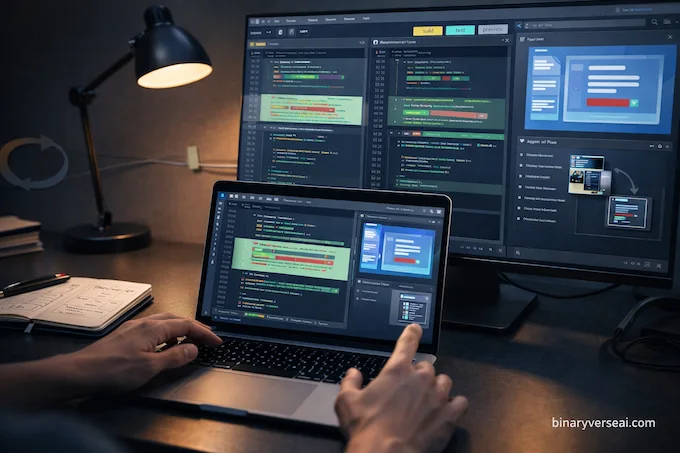
Apple’s Xcode 26.3 is treating the IDE like an agent cockpit. With native support for the Claude Agent SDK, the workflow shifts from step-by-step prompts to higher-level goals, and the agent handles planning, file edits, and iterations without bouncing you to a separate app. It’s Claude Code logic, but where the project context already lives. That’s a small UI change with a big shift.
The fun part is feedback. The agent can capture and inspect Xcode Previews, then adjust SwiftUI until the UI looks right. That closes the loop between “compiled” and “feels correct,” which is where real dev time goes, especially in UI-heavy apps.
How Claude Agent SDK enables context engineering and long memory for autonomous coding.
3. GPT-5.3-Codex Debuts As Fast, General-Purpose Agentic Coding Model
In AI News February 7 2026, OpenAI’s GPT-5.3-Codex is pitched as the “coding agent that doesn’t stop at code.” It blends strong programming with broader knowledge-work ability, and OpenAI claims it runs faster than the previous generation while staying capable on long-running tasks. In practice, that means one agent can research, plan, edit, run, debug, and keep going without you babysitting every step.
Benchmarks back the positioning: high scores on software engineering tests like Terminal-Bench 2.0 and OSWorld-Verified, plus competitive results on knowledge-work evaluations across real workflows. The meta-message is clear, agentic development is moving from tool demos to something you can plausibly wire into daily work.
How GPT-5.3-Codex performs on Terminal-Bench and OSWorld with complete benchmarks.
4. Codex App Launches On macOS, Brings Multi-Agent Coding Workflows
The new Codex app for macOS looks like a mission control panel for multiple agents. Each agent can work in its own thread and even in isolated worktrees, so parallel tasks don’t instantly collide. You supervise via diffs, comments, and quick reviews, while the agents keep grinding through longer tasks, even when you step away.
OpenAI also adds “skills” and Automations, letting agents run repeatable routines like triaging issues, summarizing CI failures, or drafting release notes on a schedule, then queue results for review. The bigger idea is orchestration, not clever autocomplete. You’re managing a small team that never sleeps, but still asks permission before running risky commands. Learn more about the Codex App.
How Codex App handles VSCode setup, worktrees, and multi-agent orchestration.
5. GPT-5 Cuts Protein Production Costs 40% With Autonomous Lab
In AI News February 7 2026, this one feels like a preview of the next decade. OpenAI reports GPT-5 drove a closed-loop “autonomous lab” setup that cut cell-free protein synthesis costs by about 40%, working with a robotic lab to design, run, and interpret experiments over multiple rounds. Tens of thousands of reactions later, the system found cheaper mixtures that still perform.
If you’re tracking artificial intelligence breakthroughs, this is a clean example of AI leaving the screen. Models aren’t just summarizing papers, they’re proposing experiments and steering hardware. It’s early and narrow, but the direction is hard to miss. Labs are becoming loops, not meetings.
How AI Co-Scientist GPT-5 accelerates early science and lab automation.
6. Mistral Voxtral Transcribe 2 Launches With Real-Time, Low-Cost Speech AI
Mistral’s Voxtral Transcribe 2 is a practical upgrade for speech apps: real-time transcription, diarization, timestamps, and low-latency streaming. The realtime model is open-weights under Apache 2.0, which matters for privacy-heavy deployments where audio can’t leave the device. Mistral also ships an in-browser playground to test features quickly, which lowers the friction to prototype.
The performance pitch is latency without falling apart on accuracy. The streaming variant targets sub-200ms response times, while the batch model aims for strong word-error rates at low cost per minute. In the “AI news this week February 2026” bucket, this is the sleeper hit for builders. Check out Mistral’s latest updates.
How Mistral 3 handles benchmarks, API pricing, and local install options.
7. Qwen3-Coder-Next Delivers Efficient Agentic Coding With 3B Active Parameters
Alibaba’s Qwen team is pushing the efficiency frontier with Qwen3-Coder-Next, an open-weight coding model built for agent scaffolds and local workflows. The hook is “small at runtime, big in capacity,” a mixture-of-experts setup that activates about 3B parameters per token while still behaving like a much larger system for agent loops.
The team frames it as training for execution, not just next-token prediction: multi-turn tool use, error recovery, and long-horizon planning. Reported results on SWE-Bench Verified cross the 70% mark under an agent scaffold, which is the kind of number that makes local deployments feel less like a compromise for teams. Read our Qwen3-Coder review.
How Qwen3-Coder-Next performs locally with GGUF setup and efficiency benchmarks.
8. LingBot-World Launches Open-Source Real-Time World Model With Long Memory
LingBot-World is a new open-source world model that aims for interactivity, not just pretty clips. The project claims real-time generation with sub-second latency and up to 16 frames per second, plus “minute-level” memory to keep dynamics coherent across longer sequences. It’s built on the Wan2.2 architecture and ships code and weights, plus lighter quantized options for modest GPUs.
Why it matters: interactive world models are a missing middle layer between video generation and robotics simulation. If open projects can hold continuity and respond to actions, you get better tools for games, training, and embodied agents, without waiting for closed platforms to trickle features down. Compare with other world models.
How LingBot-World compares to Genie 3 for real-time world modeling.
9. Grok Imagine 1.0 Supercharges 10-Second 720p Video With Rich Audio
xAI’s Grok Imagine 1.0 pushes short-form video toward “actually watchable.” The company is talking about 10-second clips at 720p, smoother motion, and better prompt-following across iterations, which is the difference between a fun toy and a usable creator tool. The bigger claimed leap is audio: more expressive voices and music that syncs with the scene.
Audio is the realism tax. When it’s off by half a beat, the whole video feels fake. If Imagine 1.0 is truly stronger here, it makes AI video less like a slideshow and more like a tiny film generator, which is exactly why creators are hammering these tools daily. Learn about Grok Imagine features.
How Grok Imagine 1.0 handles video, audio generation, and API pricing limits.
10. NVIDIA Earth-2 Opens End-To-End Weather AI For Sovereign Forecasting At Scale
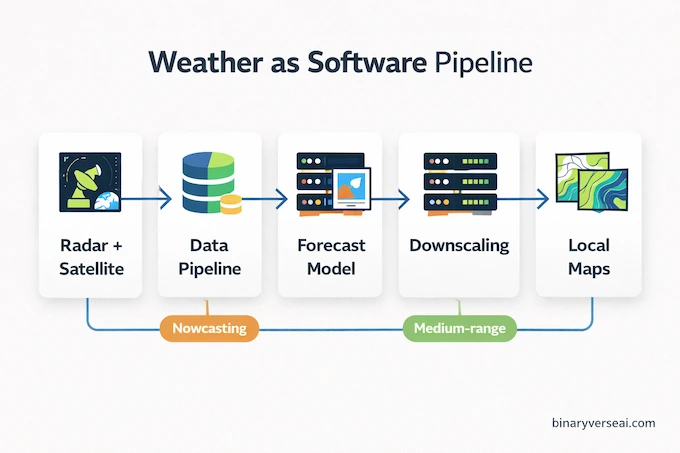
In AI News February 7 2026, NVIDIA’s Earth-2 story is “weather as software.” The pitch is an open, GPU-accelerated stack that lets teams run data pipelines, forecasting, downscaling, and visualization without a national supercomputer. Earth-2 highlights medium-range forecasting, fast nowcasting for radar and satellite, and generative downscaling for local detail, plus tooling through Earth2Studio.
If you care about AI world updates with real public impact, this is big. Sovereign forecasting means regions can run and tune their own models, on their own infrastructure, for their own hazards. It’s an infrastructure play, but the downstream effect is faster warnings and better planning. Explore NVIDIA Earth-2 locally.
How NVIDIA Earth-2 enables local install with Earth2Studio and FCN3.
11. Upwork In-Demand Skills 2026 Shows AI Skill Demand Doubles Fast
Upwork’s In-Demand Skills 2026 report reads like a labor-market snapshot from the near future, with Human+Agent collaboration baked in. Demand for top AI-enabled skills more than doubled year over year, and “apply AI inside a normal job” grew 109%. The biggest spikes are brutally practical: AI video work (+329%), AI integration (+178%), annotation (+154%), and chatbot development (+71%).
The twist is that human skills still price well. Upwork also reports that many leaders will pay a premium for creative, innovative talent, and 77% say AI increases their need for specialized, fractional experts. The message is simple: learn to direct tools, but keep the judgment. See how AI impacts productivity.
How AI and Productivity automation reshapes agentic workflows for teams.
12. Claude Opus 4.6 Rattles Markets As AI Targets Office Software
In AI News February 7 2026, markets are starting to price “agents as competitors.” After Anthropic shipped more capable Cowork tooling and pushed Opus 4.6, investors hit traditional software and data firms, worried that agents could eat workflows that used to require a stack of niche SaaS products. Reuters describes a selloff across software names tied to legal and data work.
This isn’t pure panic. Enterprise adoption is slow, and security review is real. But the direction is clear: if an agent can draft docs, model finances, and do research in one interface, the value shifts from “feature checklist” to “trusted workflow.” That’s a nasty pivot for incumbents. Understand enterprise agentic AI.
How Agentic AI Enterprise impacts tools, workflows, and business strategy.
13. Perplexity Model Council Lets You Query Three Models, One Answer
Perplexity’s Model Council is an explicit move toward ensemble workflows. The product idea is simple: run your prompt through multiple frontier models, then use a synthesizer to produce one answer that highlights consensus and disagreement. It’s model selection as automation, which feels overdue as the model zoo gets more specialized and users get tired of guessing.
For research tasks, the value is epistemic hygiene. If three models converge, you move faster. If they split, you know exactly where to verify. It’s less “trust the oracle” and more “treat models like a panel,” which is a healthier mental model for AI News in 2026 and high-stakes decisions. Compare with ChatGPT Atlas.
How ChatGPT Atlas delivers smarter research with multi-model agent workflows.
14. Drifting Models Achieve One-Step ImageNet Generation With Record FID
A new arXiv paper, “Generative Modeling via Drifting,” argues you can push the iterative work into training and keep inference to a single step. Instead of running a diffusion process at runtime, the method evolves the generated distribution during training using a “drifting field,” then samples in one pass at inference, which is great for latency and cost.
On ImageNet 256×256, the authors report strong one-step results, including FID 1.54 in latent space and 1.61 in pixel space. If this line scales, it’s a real crack in the assumption that high-quality generation must be slow at inference, and it could reshape video too. Learn about LLM inference optimization.
How LLM Inference optimization techniques improve speed and reduce latency.
15. ERNIE 5.0 Unifies Text, Image, Audio, And Video In One Model
Baidu’s ERNIE 5.0 technical report aims at the holy grail of multimodality: one autoregressive backbone that handles text, image, audio, and video in a shared token space. The authors argue this avoids the “ability seesaw” where bolting on modality heads improves one thing and weakens another.
The architecture leans on ultra-sparse mixture-of-experts routing that is modality-agnostic, so experts are shared rather than hard-partitioned. The practical bet is that unified training yields better cross-modal reasoning and generation without paying full compute for every token, plus easier deployment across modalities. It’s ambitious, and it’s pointed at the next wave of generalist models. Explore Gemini’s multimodal capabilities.
How Gemini 3 handles multimodal benchmarks, API pricing, and CLI workflows.
16. PaperBanana Automates Research Diagrams With Agentic AI Illustration System
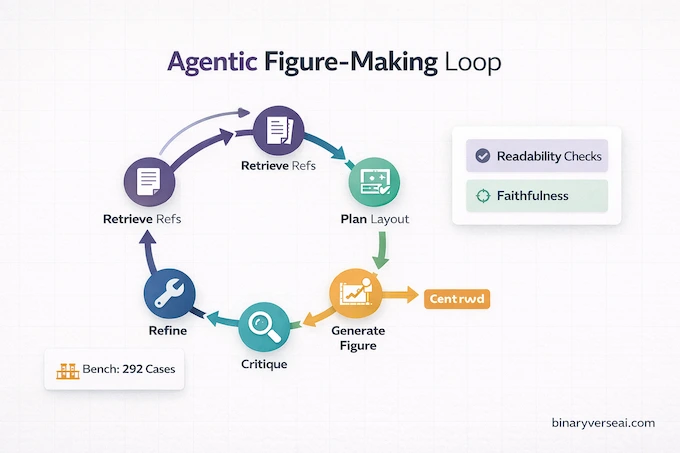
PaperBanana targets the most annoying part of publishing: making figures that look like you belong at a top conference. The project proposes a multi-agent pipeline that retrieves reference diagrams, plans structure, generates an image, then iteratively critiques and refines until the illustration is readable and faithful to the method.
The team also introduces PaperBananaBench with 292 test cases derived from NeurIPS 2025 papers. If the benchmark holds up, this is a real step toward “AI scientist” workflows where text, code, and visuals all get produced with the same level of polish. In AI News February 7 2026, that’s the quiet productivity revolution. Read about AI Scientist tools.
How AI Scientist tools like Kosmos and Edison automate research discoveries.
Closing Thoughts
If you zoom out, the week’s theme is consolidation. Models are getting longer memory, tighter tool loops, and more authority to act, which pulls work out of scattered apps and into agent-driven workflows. That’s exciting, and it’s also why AI regulation news and safety engineering will matter more, not less, as these systems touch money, code, and the physical world.
I’ll keep tracking the biggest shifts and the best open releases as this year’s AI News keeps accelerating. If you want the next edition of AI News February 7 2026 style coverage, subscribe, share this with a builder friend, and drop a comment with the one tool you’re actually using day to day. See you next week.
- Anthropic: Claude Opus 4.6 Announcement
- Anthropic: Apple Xcode Claude Agent SDK
- OpenAI: Introducing GPT-5.3-Codex
- OpenAI: Introducing the Codex App
- OpenAI: GPT-5 Lowers Protein Synthesis Cost
- Mistral: Voxtral Transcribe 2
- Qwen: Qwen3-Coder-Next Blog
- GitHub: LingBot-World Repository
- xAI on X: Grok Imagine 1.0 Announcement
- NVIDIA: Earth-2 Platform
- Upwork: In-Demand Skills 2026 Report
- CNN: Anthropic Opus Update Impact on Software Stocks
- Perplexity: Introducing Model Council
- arXiv: Generative Modeling via Drifting
- arXiv: ERNIE 5.0 Technical Report
- arXiv: PaperBanana Research
1) In AI News February 7 2026, what’s the real upgrade in Claude Opus 4.6?
Claude Opus 4.6 is being positioned less as a chatbot and more as a long-running “work engine”: agentic coding, stronger debugging, and a 1M-token context window (beta) for huge repos and document stacks. The practical shift is endurance, it can hold the thread across messy, multi-step work without collapsing into shallow recall.
2) In AI News February 7 2026, how is Xcode 26.3 changing day-to-day iOS development?
Xcode 26.3 moves AI from “help me write this function” to “take this goal and drive the task,” with agentic coding support and tighter IDE-level actions. The headline is workflow compression: an agent can reason across project structure, run steps, and iterate inside the same environment developers already live in.
3) In AI News February 7 2026, what makes GPT-5.3-Codex different from a normal coding assistant?
GPT-5.3-Codex is being pitched as a general-purpose computer-work agent that’s faster and better at long tasks: planning, tool use, terminal work, and multi-file changes with less babysitting. The point isn’t “writes code,” it’s “runs the loop,” choose actions, check outcomes, recover, and keep going.
4) In AI News February 7 2026, why is NVIDIA Earth-2 showing up in weather conversations now?
Earth-2 is framed as an open, end-to-end weather AI stack: models, tooling, and deployment pathways that let orgs run forecasting workflows on their own infrastructure. The strategic idea is “sovereign forecasting” at scale, faster cycles from data to forecast, plus nowcasting and downscaling options for hazards and local detail.
5) In AI News February 7 2026, what’s the big deal with Drifting Models being “one-step”?
Drifting Models push the iterative work into training so inference can be a single pass instead of dozens of sampling steps. If that scales, it’s a direct attack on the “slow generation tax” that makes diffusion-style pipelines expensive for real-time use. The reported ImageNet FID results are why people are paying attention.