
An abelian variety can acquire new divisor classes on reduction modulo a prime, even when the special fiber stays smooth. What number should you get when you intersect those divisors with a Hodge class carried over from characteristic zero? Milne’s rationality conjecture says the answer is a single rational number. OpenAI’s manuscript proves that for abelian varieties over the algebraic numbers with good reduction. For each fixed class and complementary divisor product, every prime-to- étale realization and the crystalline realization give the same value, even in residue characteristic . The proof reduces the problem to determinant classes and shows why each either pairs to zero or comes from one rational expression in divisors.
Table of Contents
1. What Is Milne’s Rationality Conjecture for Abelian Varieties?
An abelian variety is a projective algebraic group. Over the complex numbers it is also a complex torus, and its cohomology is generated by exterior products of its first cohomology. A rational Hodge class of codimension is a rational class in cohomological degree whose complex Hodge type is , in the usual untwisted notation. Divisors are codimension-one algebraic cycles. Their classes and products provide concrete ways to test a higher-degree class by multiplying it up to top degree and taking its trace.
Milne asked whether the pairing of a Hodge class specialized from a CM abelian variety with a complementary Lefschetz class, a rational combination of divisor products, is rational across realizations. The new theorem covers good reduction of abelian varieties whether or not the original variety has complex multiplication.
2. The Exact Theorem: One Rational Number Across Cohomology Theories
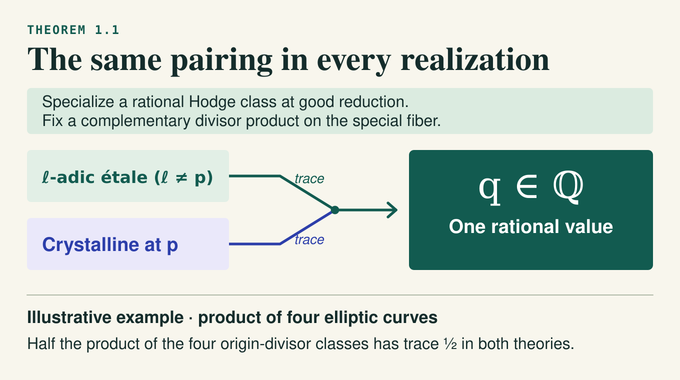
Theorem 1.1 of OpenAI’s manuscript fixes a prime and a place of above it. Write for the original abelian variety of dimension and for its geometric special fiber over . Good reduction is taken after descending to a number field and making a finite extension at the chosen place if needed. Start with a rational Hodge class , with , and Cartier divisors on .
Using for either or the crystalline component , the manuscript’s normalized trace identities have one common value and can be written together as
Here is the specialized class and the first Chern class in the chosen realization. The top Tate twist normalizes the trace so that a zero-cycle class gives its degree. The equality is read in for étale cohomology and in , the completed algebraic closure at used in the paper, for crystalline cohomology. The same rational maps into each field.
On a fourfold with , the test uses two divisors. Their degree-two classes combine with the degree-four Hodge class to reach degree eight. For a concrete case, take a product of four elliptic curves with good reduction and use the pullbacks of the origin divisors from the first two factors to form , with coefficient . Use the reduced origin divisors from the last two factors as the test. Their full product is half the origin point class, so in every realization. The theorem extends this agreement to classes whose cycle representatives need not be known. In top codimension the divisor product is the unit.
3. Why Good Reduction Creates a Difficult Rationality Problem
Specialization carries cohomological information from the generic fiber to the special fiber. If the original class comes from a rational algebraic cycle, the test is easy to interpret. Specialize that cycle, intersect it with the given divisors on the special fiber, and take the rational degree. Every realization computes that same degree by functoriality of cycle classes.
For a Hodge class alone, this argument lacks the starting cycle. A second obstacle is that smoothness of the special fiber can coexist with a larger supply of divisor classes. If the test divisors lift to the given characteristic-zero model, their product can be paired with the Hodge class in rational Betti cohomology first. A new divisor class on the reduction may have no such lift. The agreement of the specialized Hodge tensors then leaves an extra question about the pairing against this newly available class.
4. What Mathematicians Knew Before OpenAI’s Proof
Deligne proved that Hodge classes on abelian varieties are absolute Hodge, a property that gives the class realizations compatible with passage between characteristic-zero descriptions. Blasius’s comparison theorem gives the required -adic compatibility. Milne’s theory of Lefschetz classes supplies a rational divisor algebra with a perfect pairing between complementary codimensions. The missing ingredient was a common rational value for tests mixing the specialized tensors with arbitrary divisors on the reduction.
Milne recorded a positive case in Rational Tate Classes. When a CM abelian variety has simple ordinary reduction, all divisor classes on the reduction and its powers lift. For the general problem, he proposed lifting a specialized CM Hodge class together with a divisor, up to isogeny, and later formulated a weak lifting criterion. The new argument supplies a suitable lift when a determinant class can pair nontrivially.
5. The Four-Stage Roadmap Behind OpenAI’s Proof
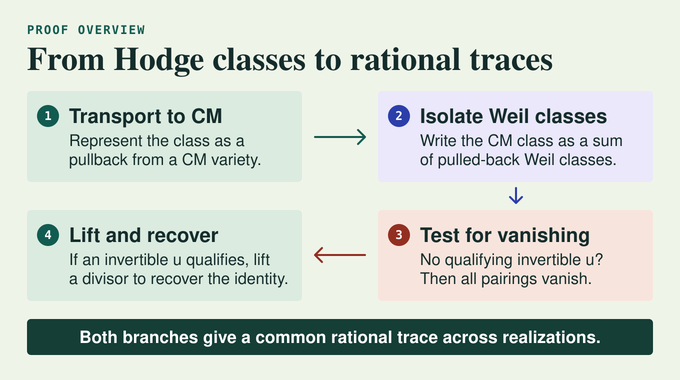
OpenAI’s release announcement credits an internal frontier model for the collection and also reports Lean formalizations for some results. The catalog entry for Milne’s theorem points to the October 7 manuscript. Its proof overview supplies the order of the four deductions below. The release gives no discovery chronology for those steps.
- Move to a variety with more symmetry. Replace the original setup by a CM auxiliary and carry the Hodge class through a marked map between reductions. A rational calibration keeps its scale consistent.
- Reduce to determinant classes. On the CM side, separate the action of a number field by its embeddings. Balanced pieces of the resulting exterior algebra supply the Weil classes needed to recover the transported class.
- Test whether a nonzero pairing is possible. An endomorphism criterion either forces every divisor test to vanish or gives a divisor with a nondegenerate form on each piece. In the second case, design a filtration that preserves that divisor.
- Realize the filtration and read off a divisor identity. Lift the selected divisor and the relevant field action together on a second auxiliary. Taking coefficients of a polynomial isolates the determinant classes. Specialize the rational identity and pull it back.
6. Stage 1: Transporting Hodge Classes to CM Abelian Varieties
A CM abelian variety of dimension admits a commutative semisimple algebra of rational endomorphisms of dimension . Corollary 3.4 uses this richer symmetry without assuming it on the original variety. The Mumford–Tate group encodes the symmetries fixing its Hodge tensors. The first branch of Proposition 3.1 uses Kisin and Zhou’s special-point theorem to obtain a CM variety and a quasi-isogeny . A quasi-isogeny is invertible in the category allowing rational homomorphisms. The inclusion selects the first factor.
The tensor comparison initially determines the polarization only up to a scalar in each realization. Pair the transported polarization with the complementary power of the original rational ample class and divide by that class’s top self-intersection. Both degrees are rational, and ampleness makes the denominator positive. This fixes one rational scale, so the codimension- tensor can be normalized by a common factor. The result is a rational Hodge class satisfying
The equation holds componentwise on the special fibers. This lets the argument solve the pairing problem on and bring the answer back along one rational map.
7. Stage 2: Reducing CM Hodge Classes to Balanced Weil Classes
Lemma 6.1 diagonalizes a CM endomorphism algebra after extending the coefficient field. The rationality of the Hodge class forces every conjugate of a contributing exterior component to have the required Hodge type. The proof uses those components to construct rational idempotent factors of powers of the CM variety. These factors are abelian varieties up to isogeny and retain good reduction.
On each factor, a CM field , a totally imaginary quadratic extension of a totally real field, acts on first homology with rank over . The polarization induces conjugation on . At each embedding of the signature is . A top alternating form on that eigenspace uses entries of each Hodge type, giving a determinant class of type before twisting. The rational classes defined by these determinant spaces are balanced Weil classes.
The original CM class is a sum of rational pullbacks of these classes. Lemma 2.3 preserves the pairing property under pullback even between different dimensions. By the projection formula, a complementary test on the source can be pushed forward. Its coordinates in the target’s divisor algebra come from solving the same invertible rational intersection system in every realization. Thus the reduction to determinant classes preserves the precise rationality the theorem needs.
8. Stage 3: The Rosati Endomorphism Dichotomy That Makes the Proof Work
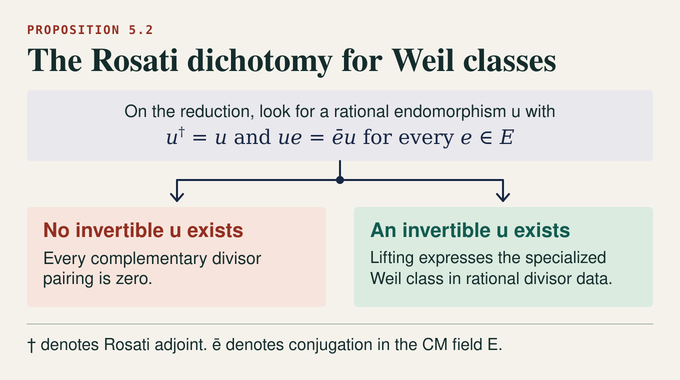
Let be a balanced Weil variety’s reduction, and let denote the Rosati involution, the adjoint operation induced by its polarization. Write for endomorphisms with rational coefficients and for the conjugate of . Proposition 5.2 examines the space
If has no invertible element, every complementary Lefschetz pairing of the specialized Weil class vanishes. To see why, suppose a pairing survives. Hard Lefschetz reduces the test to divisor factors times a polarization power. A pure determinant term already fills one eigenspace. The polarization pairs conjugate eigenspaces, so the divisors must fill the conjugate space on their own. Their nonzero product yields a divisor combination nondegenerate on that space. Projecting to conjugation-swapping blocks and using density gives a rational candidate in . Any positive-dimensional kernel would be -stable and contribute at every embedding, contradicting nondegeneracy there.
If an invertible exists, its divisor form is nondegenerate separately on each eigenspace. Theorem 4.1 constructs a half-dimensional isotropic Hodge filtration stable under and . The construction splits first crystalline cohomology into symplectic blocks using the actions of and . It chooses Lagrangians in one block of each conjugate pair and transports them to the other by . Polynomial minors of bounded degree control their intersections with subobjects. A single finite extension supplies a choice avoiding all the relevant zeros.
9. Stage 4: Simultaneously Lifting Divisors and Recovering a Rational Identity
The chosen filtration is weakly admissible. Its total Hodge and Newton numbers agree, and every Frobenius-stable subobject has Hodge number at most its Newton number. The Hodge number counts dimensions assigned to the nonzero filtration step, and the Newton number sums Frobenius slopes. The proof first checks subobjects stable under the extra endomorphisms via minimal intersections in symplectic blocks. The largest subobject maximizing the Hodge minus Newton difference is fixed by the extra endomorphisms, so checking the stable subobjects suffices. With finite local descent, Colmez–Fontaine turns weak admissibility into admissibility.
Proposition 3.1 realizes this filtration on a local auxiliary abelian variety using the Kisin–Zhou integral model and local Shimura uniformization. The marking identifies its reduction with a power of up to isogeny. It makes the first-factor projector, its field action, and the selected divisor compatible with the filtration, so all three lift together. This auxiliary is defined over a finite extension of the fraction field of the Witt vectors of . The construction permits a lift without complex multiplication.
On an abstract complex realization of , write for the component of the lifted divisor form at embedding . For , pullback by its action multiplies this component by . Lemma 5.4 studies the th power of that pullback as a polynomial in the independent embedding coordinates .
The coefficient of is , a nonzero generator of the determinant line. For with two embeddings, the pure coefficient of is , and the mixed coefficient of is . Rational evaluations span a space containing these coefficients after scalar extension, by density. Descent gives a rational divisor expression for the rational Weil class on the lifted summand. The identity specializes and pulls back to with the same coefficients throughout.
10. Why Étale and Crystalline Cohomology Give the Same Rational Pairing
Smooth proper specialization carries the prime-to- étale classes to the reduction. The absolute-Hodge and -adic comparison results identify the crystalline component with the de Rham specialization after the prescribed scalar extension. They also respect divisor classes, products, Tate twists, and pullbacks. If an integer clears the denominator of a rational map , pullback in degree uses . The same normalization applies throughout.
The zero branch contributes zero in each theory. In the other branch each evaluation is the degree of the same rational divisor intersection. Proposition 3.1 checks the integral-model hypotheses at , including the reduced relative root condition in the auxiliary construction. The argument therefore includes characteristic two as part of its stated range.
11. What Milne’s Conjecture Now Establishes and What Requires Another Theorem
Theorem 1.1 settles the common value of divisor tests. Corollary 6.3 uses Milne’s existence criterion to fix a good theory of rational Tate classes before varying the variety or Hodge class. Every specialized Hodge class then comes from a unique class in that fixed theory. The theory packages the realizations in one rational algebra and is compatible with pullback and pushforward.
Corollary 6.4 goes further using the companion CM Hodge theorem. It represents the CM class by a rational algebraic cycle, specializes that cycle, and pulls it back with rational normalization. One cycle on the special fiber then represents the original specialization, and arbitrary complementary algebraic cycles become valid rational intersection tests. The scope is the fixed reduction place. Algebraicity on the original characteristic-zero fiber in general remains a separate question. The companion paper also derives the Tate conjecture for abelian varieties over finite fields using Milne’s earlier work, as covered in our explainer on the CM Hodge conjecture.
Milne’s rationality conjecture now has an answer even when the available divisors change under reduction. The proof explains why a determinant class contributes either nothing to every complementary test or a degree computed from rational divisor data. Follow Binary Verse AI for more research explainers that trace results back to their proofs.
What did OpenAI prove about Milne’s rationality conjecture?
After good reduction of an abelian variety over the algebraic numbers, a specialized rational Hodge class pairs with any complementary product of divisor classes to give one rational number. Every -adic étale realization with and the crystalline realization at give that same value.
Why was Milne’s rationality conjecture difficult to prove?
Good reduction can introduce divisor classes that do not lift to the original characteristic-zero variety. Comparison theorems give compatible realizations of the Hodge class. A separate argument is needed to show that the pairings with those additional divisors give a common rational value.
What role do CM abelian varieties and Weil classes play in the proof?
The proof transports the class to a CM abelian variety by a rational map on special fibers. It then expresses the CM Hodge class as a sum of pullbacks of balanced Weil classes. These determinant classes let the proof use the endomorphisms of the reduction to control all complementary divisor tests.
What is the key mathematical breakthrough in OpenAI’s argument?
For a specialized balanced Weil class, the endomorphisms of the reduction determine the branch of the proof. Either every complementary Lefschetz pairing is zero, or the class is given by one rational divisor expression in every realization. In the second branch, the proof constructs an admissible filtration so that a selected divisor, a projector, and a CM-field action lift together.
Does the proof work in characteristic 2?
Yes. Theorem 1.1 covers every residue characteristic, including . The paper checks the integral-model hypotheses for the auxiliary constructions at that prime, and the trace identity includes both prime-to- étale and crystalline cohomology.
Does OpenAI’s proof establish that specialized Hodge classes are algebraic?
Yes, with a separate input. Corollary 6.4 combines the paper’s CM transport with the companion CM Hodge theorem to represent each specialization by one rational algebraic cycle in all the stated realizations. The main rationality theorem itself establishes agreement for divisor tests independently of that companion theorem.
Does proving Milne’s rationality conjecture also prove the Tate conjecture?
The rationality theorem establishes common values for divisor pairings. The companion CM Hodge paper derives the rational Tate conjecture for abelian varieties over finite fields by applying Milne’s earlier work to its CM Hodge theorem.