In the double cover, every plumbing edge has one end where the right cap is selected. On an odd cycle, the same two colors cannot alternate all the way around. That difference drives OpenAI’s Borel Conjecture counterexample in dimension four. The preprint constructs two closed, connected, aspherical topological four-manifolds that are homotopy equivalent but not homeomorphic. They have the same word-hyperbolic fundamental group. It also constructs a self-homotopy equivalence of one manifold that no homeomorphism represents. A separate symmetry argument turns the odd-cycle obstruction into a proof of nonhomeomorphism.
Table of Contents
1. What the Borel Conjecture Counterexample Actually Proves
| Topic | Result |
|---|---|
| Theorem 1.1 | Two closed aspherical topological four-manifolds share a homotopy type. No homeomorphism exists. |
| Theorem 1.2 | One manifold has a self-homotopy equivalence with no homeomorphism in its homotopy class. |
| Common Group | Word-hyperbolic, with finite outer automorphism group. |
| Marked Fillings | The double cover admits one. Odd degrees three and higher admit none. |
Theorem 1.1 answers the existence question. Theorem 1.2 answers a different question about a prescribed homotopy class. There is a homotopy equivalence from the first manifold to itself that cannot be continuously deformed into a homeomorphism. The identity belongs to another homotopy class, so the first theorem alone cannot supply this self-map example.
2. Why Aspherical Manifolds Were Expected to Be Topologically Rigid
A connected manifold is aspherical when its universal cover is contractible. All its higher homotopy groups then vanish, and it has the homotopy type of a space denoted , where is its fundamental group. In this setting an isomorphism of fundamental groups gives a homotopy equivalence. Homotopy equivalences have inverses up to continuous deformation. A homeomorphism has an actual continuous inverse and preserves the topology point for point.
The topological Borel Conjecture asks whether every homotopy equivalence between closed aspherical manifolds can be deformed into a homeomorphism. Its weaker form asks whether a homeomorphism exists in any homotopy class. Borel’s 1953 letter to Serre already posed the existence question for compact manifolds that are classifying spaces. Asphericity explains why the fundamental group is sufficient for homotopy classification. Rigidity would make it sufficient for homeomorphism classification as well. The Poincaré conjecture concerns closed simply connected three-manifolds.
3. Why Dimension Four Escaped Earlier Rigidity Proofs
The preprint traces rigidity through the classical low-dimensional cases and through geometrization for closed orientable aspherical three-manifolds. In dimensions five and up, Bartels and Lück’s rigidity theorem covers word-hyperbolic groups and groups acting geometrically on finite-dimensional CAT(0) spaces. Their four-dimensional application adds a good-group hypothesis in Freedman’s sense, which permits the disk-embedding arguments used in four-dimensional topology.
Khan’s result for torsion-free word-hyperbolic groups in dimension four gives rigidity up to topological s-cobordism. Such a cobordism has boundary inclusions that are homotopy equivalences with vanishing Whitehead torsion. A product cobordism would identify its ends, but the cited Freedman–Quinn product theorem requires a good fundamental group. The distinction is also sharper than finding exotic smooth structures on one topological manifold. Earlier reflection examples share a homeomorphism type but have different diffeomorphism types.
4. Constructing the Four-Dimensional Chamber
The construction starts with a smooth four-dimensional plumbing block. Plumbing interchanges base and fiber in a small product patch, making the two core disks meet transversely. Each paired plumbing has two ports of the same color. The authors use five plumbing types of each color, together with extra free loops. A grope in the block starts with a punctured torus and branches into two upper punctured tori. Each upper torus has a red cap and a blue cap, giving four tips overall.
The marked grope replacements produce a compact four-manifold with boundary and free fundamental group . Its middle homotopy module has a specified basis of framed immersed hyperbolic pairs. The two members of a pair have algebraic intersection one, with the prescribed self-intersection invariants zero. Attaching three-cells to the basis spheres kills the middle module and leaves a chamber of graph homotopy type with the original boundary collar. The pair still satisfies four-dimensional Poincaré duality. The marking remembers how the boundary maps into that graph type, which is essential when testing a proposed filling. A filling must preserve that inclusion up to homotopy.
5. Why the Double Cyclic Cover Admits a Filling
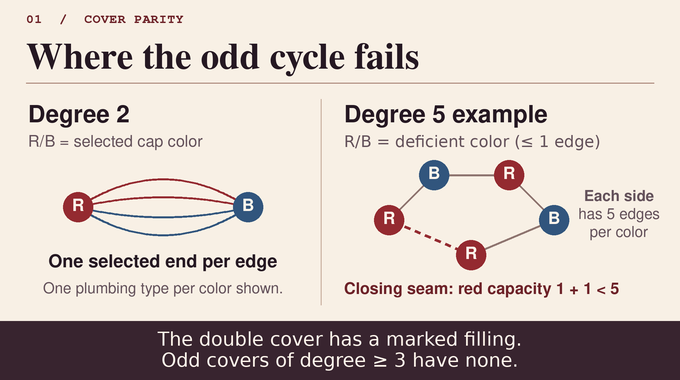
The covering character sends each plumbing generator to one and the extra loop and normal-circle generators to zero. Reduction modulo the cover degree puts successive plumbing blocks at successive residues. In the degree-two cover, choose red ports at vertex zero and blue ports at vertex one. Every edge runs between the two vertices and exactly one of its two ends is selected. This applies to both lifts of each base plumbing.
Compress each upper grope torus along its selected cap. Disjoint cap sheets yield embedded framed sphere pairs with one transverse intersection within a pair and none between pairs. Each pair has a neighborhood homeomorphic to a punctured . Replacing those neighborhoods with four-balls preserves the marked fundamental group and removes the full middle basis. The resulting filling has the homotopy type of the covered graph chamber , by an equivalence that is the identity on its boundary .
6. The Odd-Cycle Obstruction: Why Three, Five and Other Odd Covers Fail
A hypothetical marked filling in odd degree can be modified by attaching dual handles. Three-dimensional cuts then separate the resulting manifold into vertex pieces. Between successive vertices there are five red and five blue cut edges. The two red–blue pairs of a grope supply a nested commutator law in four slots. For every choice of two red and two blue incident edges, the corresponding marked laws bound disks in the vertex piece. Their holonomy relations yield products of slot coordinates in a gradient ideal. The marked tensor companion preprint supplies the algebraicity input for these cut potentials.
The endpoint theorem uses transverse linear matching across the cuts and cancellation of the local potentials. Its tensor contraction is nonzero, while the four-slot laws force certain coefficients to vanish. A surviving term assigns each edge to one endpoint. No vertex can receive two edges of each color, so every vertex has a deficient color in which it receives at most one edge.
For a five-cycle, start with red as the deficient color. Its neighbor must use blue. If both used red, they could receive at most two of the five red edges between them, leaving edges without an endpoint assignment. The forced sequence is red, blue, red, blue, red. The closing edge meets two red vertices, so the assignment fails. Three and every larger odd degree fail by the same argument. The caps selected in the double cover are geometric choices. The deficient colors on an odd cycle are consequences of the tensor theorem under the hypothetical filling.
7. Turning a Filling Obstruction Into an Aspherical Complex
Davis reflection glues copies of the chamber across panels given by dual blocks in a boundary triangulation. Labels start as binary vectors, and crossing a panel toggles its coordinate. The triangulation is flag, so every clique spans a simplex, and it has no induced four-cycle. The companion paper on Poincaré duality and manifold realization supplies the reflection result. The full reflection is an aspherical four-dimensional Poincaré complex. A closed manifold model would produce a filling that respects the chamber marking.
In cyclic covers, a further finite cover separates the lifted panels that share a downstairs coordinate. This is a manifold-realization question of a different kind from Wall’s D(2) problem, which asks for a lower-dimensional CW model. The filling implication can then be applied with a separate label per lifted panel. The authors also quotient by an eight-dimensional binary relation space. The proof distinguishes the relation generators by their support sizes and uses the overlaps to mark the four vertices of one tetrahedron. Its nonzero vectors have too much support to fix a point of a chamber, since at most four panels meet there. The relations also eliminate every nonidentity simplicial symmetry preserving them. The quotient complex retains the obstruction because a manifold model for an odd cyclic cover would lift to a model upstairs and produce the forbidden filling.
8. Building Two Manifolds From the Same Homotopy Type
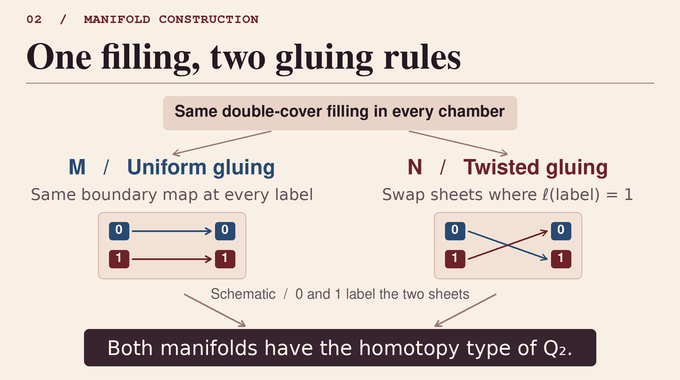
The double cover has copies of as chambers. Replace each with the double-cover filling. For , use the same boundary identification in every chamber. For , use the deck involution to twist the identification according to a nonzero linear functional on the quotient label group .
Near panel intersections, the boundary collars supply the sectors needed to glue a manifold chart. The relative equivalences from the fillings to the chambers glue to homotopy equivalences to . Both spaces are therefore closed aspherical four-manifolds with common group . Translation of chamber labels acts by homeomorphisms on both. Under the comparison maps to , a translation on the twisted model also applies the deck involution whenever the functional on the translation is one.
9. The Cyclic-Cover Criterion and the Unrealizable Self-Map
Write for the outer class induced by the deck involution on . It corresponds to a self-homotopy equivalence of . Suppose a homeomorphism induces it. On the infinite cyclic cover of , a suitably chosen lift commutes with the generating deck translation . A proper height function increases by one under . The height displacement under the lift is invariant under , so compactness of bounds its absolute value by .
For an integer , compose with a large translation. The composite has uniformly positive height displacement.
Iterating moves height off every bounded interval. The action is free and properly discontinuous, and each orbit meets a compact height band, so the quotient is a closed manifold. To identify its group, choose with covering character one. The deck translation comes from , while the homeomorphism lift acts on the kernel by conjugation by . Their composite acts by conjugation by . The quotient has the fundamental group of and is aspherical, giving a forbidden manifold model. The contradiction works for any realizing homeomorphism, regardless of its order.
10. Why the Common Fundamental Group Is Word-Hyperbolic
The support cubulation gives a proper cocompact action on a CAT(0) cube complex. Its edge graph combines motion along a tree with moves by right-angled Coxeter generators. Opposite edges of grid squares have the same labels. Finite supports bound how far tree moves can persist beside a fixed Coxeter move. In a grid made from Coxeter moves alone, the absence of induced squares in the lifted triangulation forces one of the two sets of direction labels to form a clique, also of bounded size.
The uniform grid bound gives hyperbolicity of the cubical edge graph and hence word-hyperbolicity of . In a Cayley graph of a word-hyperbolic group, each side of a geodesic triangle stays uniformly close to the other two. This is the group property that also appears in the Cannon Conjecture, where the geometry of the group boundary is central. The next step rules out splittings over virtually cyclic subgroups. A splitting would give a nonzero degree-one cohomology class detected by paths in its associated tree. Four-dimensional Poincaré duality and the homological Shapiro lemma would identify its cohomology group with degree-three homology of the edge group. The edge group is trivial or infinite cyclic, so that homology vanishes. For this hyperbolic group, an infinite outer automorphism group would force such a splitting. Thus , the automorphism group modulo inner automorphisms, is finite. That finiteness makes the Sylow argument possible.
11. The Final Proof That No Homeomorphism Can Exist
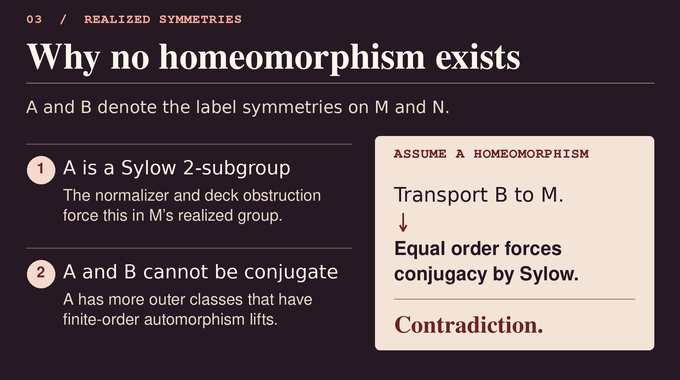
Inside , the model realizes the horizontal label subgroup . The twisted model realizes the graph subgroup , where second coordinate one means applying . The two subgroups agree over the kernel of the functional. Outside that kernel, an element of the graph subgroup has only infinite-order lifts to actual automorphisms, because each lift has odd covering character. Some label generator outside the kernel has an involutory Coxeter lift in the horizontal subgroup. The counts of elements with finite-order lifts differ, so the subgroups cannot be conjugate.
There could still be other outer symmetries realized on . To control them, the authors calculate the normalizer, the subgroup whose conjugation preserves . Coxeter generator rigidity and the binary label relations force any induced symmetry of the lifted triangulation to come from a deck transformation. The calculation gives
Since is unrealizable on , the normalizer of inside the group realized on is just . A proper subgroup of a finite 2-group is strictly contained in its normalizer, so is a Sylow 2-subgroup of the realized group. Now suppose a homeomorphism identifies the two models. Transporting to puts it inside that realized group. It has the same order as , so the Sylow conjugacy theorem forces the two to be conjugate in the ambient outer automorphism group. This contradicts the finite-order lift count.
12. What the Four-Dimensional Counterexample Changes and Where It Applies
The Borel Conjecture fails in dimension four even for closed aspherical topological manifolds with a common word-hyperbolic group. The dimension and good-group hypotheses in the earlier rigidity theorems still govern their conclusions. Which four-manifold groups admit multiple models remains a separate classification question.
The proof is an October 2026 preprint and uses the marked tensor and controlled realization results from two companion preprints. OpenAI’s release announcement describes Lean formalizations for parts of the wider collection. The evidence for the result discussed here is the written argument and its cited dependencies.
Parity forces one symmetry out of the homeomorphism group. The normalizer and Sylow argument then show why changing the homotopy class cannot save a homeomorphism between the two models. Follow Binary Verse AI for more paper-led explanations of manifold symmetries and rigidity and counterexamples in geometry.
What does the Borel conjecture say in geometric topology?
It predicts topological rigidity for closed aspherical manifolds. Every homotopy equivalence should be homotopic to a homeomorphism. Its weaker formulation only requires a homeomorphism to exist between homotopy-equivalent manifolds.
How does the OpenAI proof provide a counterexample to the Borel conjecture?
It constructs two closed aspherical topological four-manifolds with the same homotopy type. No homeomorphism exists between them, so even the weaker homeomorphism-existence formulation fails.
Why does the fundamental group determine the homotopy type of an aspherical manifold?
An aspherical manifold has a contractible universal cover and has the homotopy type of a K(π, 1) space. Its fundamental group determines that homotopy type. The construction shows that a single such group can occur for distinct homeomorphism types.
Why is dimension four different from higher dimensions in the Borel conjecture?
Higher-dimensional rigidity theorems use techniques that do not automatically extend to dimension four. The relevant four-dimensional surgery and topological s-cobordism arguments use additional hypotheses, such as a good fundamental group in Freedman’s sense.
Why does the double cyclic cover admit a filling while odd covers do not?
The double cover permits compatible red and blue cap choices. In odd degree three or higher, a hypothetical marked filling would force deficient colors to alternate around the cycle. The alternation cannot close.
How does the proof establish that the manifolds are not homeomorphic?
It identifies nonconjugate subgroups of the common outer automorphism group. Finiteness, a normalizer calculation and the Sylow conjugacy theorem would force those subgroups to be conjugate if there were a homeomorphism. That contradiction rules out every homeomorphism.
Does the counterexample invalidate all known Borel rigidity results?
The counterexample disproves the unrestricted topological conjecture in dimension four. Established rigidity theorems still apply under their stated dimensional and group-theoretic hypotheses.