
A sphere map can double topological feature every iteration while its observable orbit complexity grows slower than exponentially. OpenAI’s proof makes that mismatch explicit: the general C¹ self-map formulation of the Shub entropy conjecture is false. Its construction has zero topological entropy but an eigenvalue of 2 on second real homology. The mechanism combines slowing clock, amplified memory, and precisely aligned pushes. Understanding why those ingredients work also explains why the result preserves earlier entropy theorems.
Table of Contents
01. What Did Shub’s Entropy Conjecture Predict?
Topological entropy measures how quickly distinguishable orbit histories proliferate. Follow two starting points for steps and compare their largest separation. At fixed resolution, count the largest collection of mutually distinguishable histories. Entropy records their exponential growth rate as resolution becomes arbitrarily fine. Zero entropy permits complicated transients and polynomial growth.
Homology records global topological features using algebra. With real coefficients, continuous map induces linear operator on the direct sum of the homology groups. Its spectral radius is the largest absolute value of its eigenvalues.
The Shub entropy conjecture formula links these two measurements:
The proposed inequality says that growth visible in topology should force sufficient orbit complexity. An eigenvalue of 2 would require entropy at least . All logarithms here are natural.
The distinction is between rates, not raw counts. Doubling homology class repeatedly gives exponential algebraic growth. Zero entropy says that distinguishable histories have zero exponential growth rate at each fixed resolution. It does not require every trajectory to become constant.
| Feature | Verified Statement |
|---|---|
| Source | OpenAI, September 25, 2026. |
| Domain | , for some finite positive integer . |
| Regularity | A continuously differentiable, noninvertible self-map. |
| Entropy | . |
| Homology | Eigenvalue on , so . |
| Scope | A counterexample to the general C¹ self-map formulation, not the C∞ theorem. |
02. Why Earlier Entropy Theorems Could Not Settle The C¹ Case
The paper’s introduction separates several positive results. Manning controls first homology for every continuous map. Misiurewicz and Przytycki obtain C¹ lower bound from topological degree, which concerns top-dimensional homology. Neither statement automatically controls every intermediate homology group.
Yomdin proves the full inequality for C∞ maps, connecting homological growth, volume growth, and entropy. C∞ means derivatives exist continuously at every order. C¹ guarantees continuous first derivatives. Lipschitz continuity only bounds distance expansion and does not require differentiability. Earlier Lipschitz counterexamples therefore left the C¹ question unresolved.
There are also affirmative results for particular diffeomorphisms, including partially hyperbolic systems with one-dimensional center and systems away from homoclinic tangencies. Those hypotheses matter: diffeomorphism has differentiable inverse.
The new example occupies different combination of assumptions: finite regularity, noninvertibility, and growth in intermediate homology. The contradiction appears there, without invalidating the established theorems.
In particular, second homology here is neither the first group covered by Manning nor the top group controlled by degree. Checking the dimension is essential to understanding why those lower bounds remain consistent with this example.
03. OpenAI’s Counterexample: Zero Entropy With An Eigenvalue Of 2
Theorem 1.1 in the original research paper constructs C¹ map on compact smooth manifold without boundary:
The first factor is circle with circumference 100. One sphere carries the main complex coordinate, while additional spheres hold registers. The paper chooses finitely many channels through covering argument, rather than specifying numerical .
Its exact contradiction is:
This is an existence theorem about an explicitly defined dynamical system. Registers are mathematical coordinates, not hardware memory measurements. Likewise, clock passage describes movement around the circle rather than measured runtime. The argument supplies no numerical speedup or practical performance comparison, and none is needed to refute the inequality.
Second homology is intermediate because the manifold has dimension . The theorem establishes an eigenvalue, so the conclusion needed here is spectral radius of at least 2.
OpenAI’s mathematics release announcement provides publication context. The mathematical evidence here is the supplied proof, not the announcement. This article does not assert that this particular construction has been fully formalized in Lean, independently replicated computationally, or benchmarked as an algorithm.
04. Why Squaring The Riemann Sphere Normally Produces Entropy
Identify the sphere with and consider , including . Writing reveals two effects: the radius squares and the angle doubles.
For example, radius of one-half becomes one-quarter and then one-sixteenth. A radius of two becomes four and then sixteen. On the unit circle, however, the radius remains one. Angle doubling supports exponentially many distinguishable histories, giving that invariant circle entropy .
Squaring also has degree two on the oriented sphere. The value 1 has preimages 1 and −1, both contributing positive local degree. Thus sphere squaring acts by multiplication by 2 on second homology.
The construction must retain that homological action while preventing persistent angle-doubling complexity. Merely slowing the clock would leave the unit-circle dynamics untouched. Additional coordinates must push trajectories away from it, with their own dynamics remaining entropy-free.
05. Inside The Construction: The Clock, Main Coordinate, And Registers
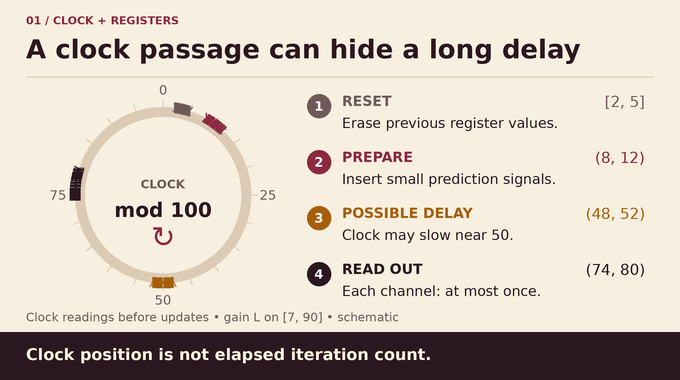
Every update uses the old state simultaneously:
The clock increment lies between zero and one. It can slow only near 50. For small main-coordinate radius, smooth clock function prevents crossing 50 from below. For radius at least three-quarters, including infinity, the increment is exactly one.
The function equals the identity on the closed unit disk, is bounded in modulus by 3, and vanishes near infinity. Thus registers can amplify small signals while remaining globally defined sphere coordinates. The gain is zero during reset and equals from clock 7 through 90.
Here denotes the periodic readout cutoff. inserts preparation signals, and the main-coordinate addition reads their stored values. Neither operation uses values newly produced during the same update.
06. How An Infinite Prediction Series Preserves C¹ Smoothness
Predict future clock readings using the uncontrolled map . Let be its clock coordinate after iterations. On one clock period, the input is:
Here selects preparation times. The cutoff vanishes near zero and infinity and equals one for radii between one-half and one. The angular expression is extended by zero at both poles. Importantly, inside the series is not periodized: it predicts readout in that lifted period only.
Compactness bounds the derivative of by constant . Consequently, the derivative of is bounded by . Angular differentiation costs order . Choose .
For the mth summand, the combined function and derivative bound is:
These bounds add through the product rule. Geometric decay gives uniform convergence of both functions and first derivatives, proving C¹ regularity. A finite prediction horizon could miss the compulsory readout after an arbitrarily long delay.
There is no need to differentiate selected hitting time, which could behave badly near stalled clock. Every possible delay already has smooth summand. Uniform derivative control handles nearby states whose first relevant summands occur arbitrarily far along the series. Preparation also vanishes near the periodic seam, allowing C¹ extension around the clock circle.
07. How Stored Signals Survive The Delay Without Saturating
Smooth inputs alone do not justify treating register as linear amplifier. The proof first establishes separate bound, without assuming phase alignment.
A complete passage starts near one multiple of 100 and reaches the next. Reset erases arbitrary initial register contents before preparation. Since the clock advances by one during preparation, there are at most five preparation indices in set called .
Each channel’s readout support fits inside an interval shorter than one. The clock advances by one throughout readout, so that channel is read at most once. Predicted and actual clocks agree until readout begins. They continue agreeing through all readouts because clock speed there is independent of the main coordinate, even after additions change it.
A signal entered at iteration i is read at iteration j after intervening gains. Its coefficient cancels exactly:
Candidate register values at an intermediate index have modulus at most for . Induction then proves the actual register equals that candidate throughout amplification. remains the identity until the channel’s readout. Later saturation is harmless because that channel will not be read again during the passage.
Reset is exact, including for register initially at infinity. Both the gain and the preparation input vanish there, so the next register value is zero. This removes dependence on arbitrary stored data before the estimates begin. Register channels do not feed one another, which keeps each channel’s linearity argument independent.
08. The Phase-Alignment Argument That Forces Escape
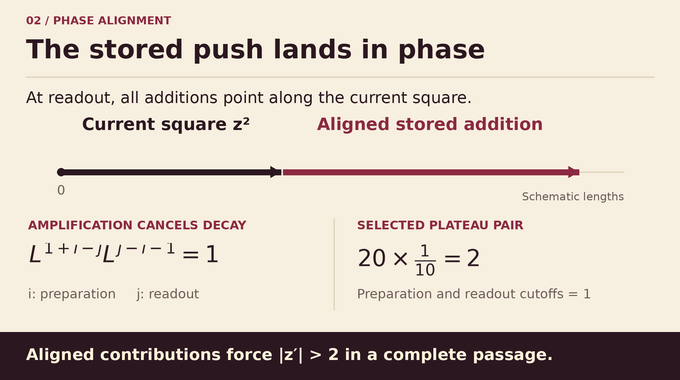
Now the proof can use the stored phases. In complete passage, each preparation value has radius greater than one-half. Otherwise repeated squaring would keep it small and the clock could never cross 50, contradicting completion.
Before readout, exact squaring doubles every phase. A signal prepared at i for j stores the phase of the square at j through the exponent . Consequently, every readout addition points along the current square, with nonnegative coefficient. Different channels reinforce rather than cancel.
Throughout the relevant part of the passage:
If preparation radius already exceeds one, escape has begun. Otherwise all preparation radii lie between one-half and one, where equals one. There is preparation index with equal to one and readout index with some equal to one.
That pair contributes exactly 2 to the output radius: the input factor one-tenth meets the readout factor 20. Two factors occur, one from preparation prediction and one from readout. Their product is one on the selected plateau. Hence that output radius exceeds 2 before the passage ends.
09. Why Every Orbit Approaches One Of Two Invariant Sets
Lift the clock to nondecreasing real sequence . If it stays bounded, its increments tend to zero. Since dominates and vanishes only at 50 modulo 100, the clock approaches that reading.
Eventually it avoids all readouts. Radius at least three-quarters would force clock increment one, so the main coordinate eventually lies strictly inside that radius and repeatedly squares toward zero. The orbit approaches , defined by clock 50 and main coordinate zero. Registers need not vanish: this set includes every register configuration.
If the clock lift is unbounded, it completes successive passages. After one passage produces radius greater than one, the square lower bound persists across subsequent periods. Between readouts there is exact squaring, and reset removes old register data before fresh preparation.
For suitable index :
Thus the main coordinate tends to infinity on the sphere. Eventually vanishes permanently, and later reset makes every register identically zero. The orbit approaches , where the clock rotates and the other coordinates are infinity and zero respectively. These are pointwise conclusions with no uniform waiting-time bound.
10. Proving Zero Topological Entropy Without Uniform Convergence
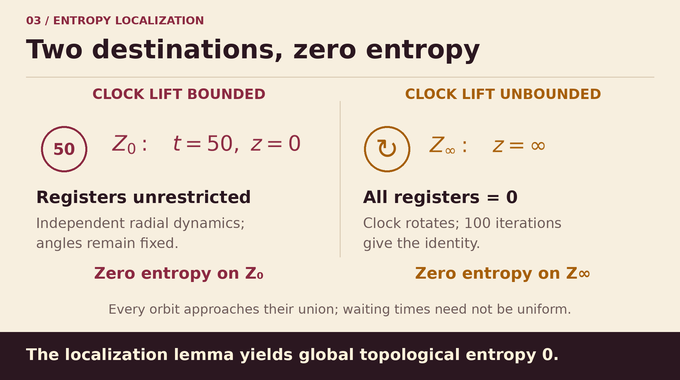
Pointwise approach needs an entropy argument, because different starting points can have arbitrarily long transients. Lemma 4.1 supplies it for compact forward-invariant set with zero entropy.
Fix resolution and block length . Cover neighborhood of using orbit-metric balls, and cover the whole space using such balls. Compactness gives constant such that among successive blocks, at most are exceptional, for any chosen .
The number of possible descriptions is bounded by:
The bound controls the proportion of exceptions, not their last occurrence. Taking exponential growth rates, then sending to zero and to infinity, localizes entropy to .
The order of these limits matters. For fixed , the global cover size may be large, but its contribution disappears when tends to zero. Only afterward is the block length increased to use the zero-entropy hypothesis on .
For this construction, . On the latter set, 100 iterations give the identity. On the former, registers evolve independently by .
After one register update, radii lie in disk where the radial map is nondecreasing and angles remain fixed. With radial labels, length- radial itineraries number at most . Their order is by initial radius, not necessarily time. Finitely many register coordinates therefore give polynomial orbit-description growth. Both restrictions have zero entropy, completing the global argument.
11. Why The Homological Eigenvalue Survives And What Remains Open
Let project to the main sphere. Its output is squaring plus bounded correction. Scaling that correction continuously to zero gives homotopy between and . The paper checks continuity at infinity using inverse coordinates.
That check matters because the affine complex chart excludes infinity. A bound uniform in the clock, registers, and homotopy parameter makes the extension valid on the whole compact sphere, completing the topological argument.
Homotopy invariance therefore yields:
Fixing other coordinates gives section, so is surjective and nonzero. If were invertible on second homology, the identity would force , contradiction. Thus 2 is an eigenvalue. This homological identity is not dynamical semiconjugacy transferring sphere entropy.
Noninvertibility follows because vanishes near register’s infinity: distinct nearby register states give identical outputs. The construction consequently leaves the general diffeomorphism question untouched. The supplied theorem proves C¹ regularity. A separate expository construction by Andrey Gogolev extends the phenomenon to every fixed finite differentiability order. Neither statement supplies C∞ counterexample or contradicts Yomdin.
For each finite order, the construction can be chosen to control that many derivatives. This is family of finite-regularity examples, not one map whose derivatives have been controlled at every order simultaneously. Keeping those quantifiers distinct prevents an incorrect conclusion about smooth dynamics.
The Shub entropy conjecture counterexample identifies precise separation: homological growth can survive after persistent orbit complexity disappears. Read the original proof alongside Binary Verse AI’s research explainers, and share this explanation with readers investigating how regularity changes dynamical conclusions.
What is Shub’s entropy conjecture?
It proposes that a map’s topological entropy is at least the logarithm of the spectral radius of its induced action on real homology. OpenAI’s counterexample disproves the general C¹ self-map formulation on compact smooth manifolds without boundary.
What exactly does OpenAI’s C¹ counterexample prove?
It constructs a noninvertible C¹ self-map on a compact smooth manifold whose topological entropy is zero, even though its action on second real homology has eigenvalue 2. Its homological spectral radius is therefore at least 2.
How can homology grow while topological entropy remains zero?
The map retains the degree-two homological behavior of sphere squaring through a homotopy, while every orbit approaches one of two zero-entropy invariant sets. The projection intertwines the maps on homology. It is not a dynamical semiconjugacy that would transfer the sphere map’s entropy.
Why are the clock and memory registers necessary?
The clock creates potentially arbitrarily long delays. The registers prepare, amplify, and deliver aligned contributions that force the main coordinate beyond the unit circle during every complete clock passage. Registers reset before preparation and stay in their linear region until readout.
How does the infinite prediction series remain continuously differentiable?
Its coefficients decay geometrically as L to the power 1−m. Choosing L greater than both B and 2 dominates the growth of prediction derivatives and angular derivatives. The series of functions and first derivatives converge uniformly, including near data with arbitrarily late predicted readouts.
Why does convergence toward two invariant sets imply zero topological entropy?
The paper’s entropy-localization lemma applies because the union is compact and forward invariant, every orbit approaches it, and the restricted dynamics have zero entropy. Compactness controls the proportion of exceptional orbit blocks without requiring a uniform eventual-entry time.
Does OpenAI’s proof disprove the entropy conjecture for all smooth maps and diffeomorphisms?
No. The supplied paper disproves the general C¹ self-map formulation using a noninvertible map. It does not settle the general diffeomorphism question or contradict Yomdin’s C∞ theorem. A separate supporting exposition extends the counterexample phenomenon to every fixed finite differentiability order, which is different from a single C∞ example.