
A symmetry can be continuous without being smooth. The Hilbert Smith conjecture asks whether faithful symmetries of a finite-dimensional manifold must nevertheless form a Lie group, the familiar mathematical setting for rotations and other continuously parameterized transformations. OpenAI’s September 23, 2026 manuscript presents a proof in every finite dimension, including the unrestricted continuous cases beyond dimension three.
Its decisive move is arithmetic: a hypothetical faithful action of the p-adic integers would force an integral signature invariant into arbitrarily small equal pieces. A fixed denominator bound makes that impossible. This Hilbert Smith conjecture proof uses sheaf duality, Witt groups, and odd-dimensional spheres. Below, “the proof” refers to the argument in the OpenAI research manuscript, rather than a claim that independent scrutiny is complete.
Table of Contents
1. Hilbert Smith Conjecture: The Problem Beyond Three Dimensions
A topological -manifold looks locally like -dimensional Euclidean space. A locally compact group has compact neighborhoods around its elements. A Lie group also has a compatible finite-dimensional smooth manifold structure, with smooth multiplication and inversion. The theorem constrains the group’s structure, without asserting that the given action becomes smooth.
Theorem 1.1 assumes a connected Hausdorff, second-countable manifold without boundary and a locally compact, Hausdorff, second-countable acting group. Hausdorff means distinct points admit disjoint neighborhoods. Second-countable means the topology has a countable base. Joint continuity requires group elements and manifold points to vary continuously together.
| Feature | Precise Scope |
|---|---|
| Main conclusion | Every group satisfying the stated action hypotheses is a Lie group. |
| Faithful action | Only the identity fixes every point. Individual points may have nontrivial stabilizers. |
| Dimension | Every positive finite dimension. A connected zero-dimensional manifold is a point. |
| Central exclusion | Every continuous action has nonzero kernel and factors through a finite quotient. |
| Evidence status | September 2026 manuscript. Its argument is distinct from the separate Hexagon proof. |
The local-versus-global distinction is familiar from our Poincaré conjecture explainer: looking Euclidean nearby does not determine a manifold’s global topology.
2. Why Earlier Proofs Stopped Short of Every Dimension
Hilbert’s fifth problem concerned removing differentiability assumptions from transformation-group theory. Its locally Euclidean group formulation was resolved in 1952. Hilbert–Smith asks a different question: can a group inherit Lie structure merely because it acts faithfully on a manifold?
Dimensions one and two were classical. John Pardon’s three-manifold proof, published in 2013, used invariant open regions, incompressible surfaces, and surface mapping class groups. Those tools exploit three-dimensional geometry rather than supply an automatic induction to all dimensions. Our Cannon conjecture analysis explores another precise connection between groups and three-dimensional geometry.
Other results imposed regularity, including differentiable, Lipschitz, and quasiconformal actions. Dimension-raising arguments constrained orbit spaces, but needed additional metric control to produce contradictions. Arbitrary continuous transformations need not preserve the estimates those arguments require.
Consequently, the barrier was not just a missing numerical dimension bound. It was controlling actions without adding hypotheses. As our Borsuk conjecture coverage illustrates in a different setting, the role of dimension must be read from the actual theorem.
3. Why Faithful p-Adic Actions Are the Central Obstruction
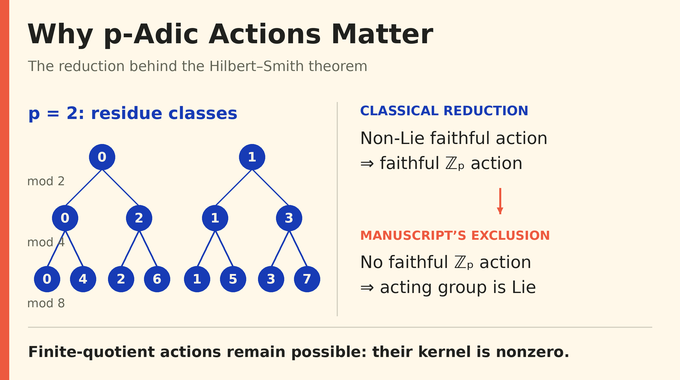
For a prime , the p-adic integers form the inverse limit
An element is a compatible sequence of residues modulo , , and higher powers. Two elements are close when they agree modulo a large power. This topology makes compact and totally disconnected, with arbitrarily small nontrivial open subgroups .
That last feature conflicts with Lie-group behavior: Lie groups have a neighborhood of the identity containing no nontrivial subgroup. The classical Hilbert–Smith reduction combines locally compact group structure theory with restrictions imposed by manifold actions. A faithful non-Lie action would contain a faithful action of some .
Therefore, excluding these additive p-adic groups settles the group theorem. This is stronger than checking particular rotations or finite cyclic actions. Finite quotients remain allowed, because a nonfaithful action can discard an entire open subgroup. The word “faithful” carries the obstruction. For basic embedding vocabulary, our Boone–Higman explainer discusses preserving a group without identifying distinct elements.
4. Newman’s Rigidity Theorem Produces a Local Invariant Chart
The proof first turns a hypothetical global action into a local one it can analyze. Newman’s rigidity theorem says a finite-order homeomorphism of a connected manifold that fixes a nonempty open subset pointwise must be the identity everywhere.
Using that rigidity, the manuscript finds a point near which no open p-adic subgroup acts trivially. It then takes a small coordinate ball and an open subgroup whose translates stay inside one chart. Their union supplies a connected invariant open subset of Euclidean space.
The restricted action remains faithful: a nonzero closed subgroup of is open, so a nonzero restriction kernel would contradict the selected point’s property. Passing to a further open subgroup ensures orientation preservation.
This local orientation does not require global orientability. Nor does faithfulness mean freeness. A rotation can fix its center while moving other points. Likewise, the argument allows fixed points and arbitrary stabilizers, provided no nonidentity group element fixes the entire manifold.
5. Why the OpenAI Proof Moves to an Odd-Dimensional Sphere
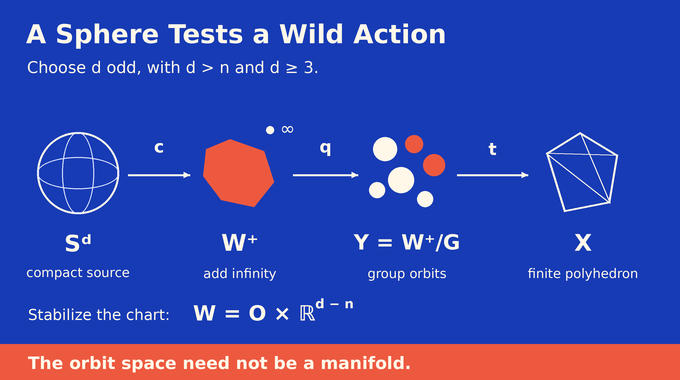
Choose an odd integer , with , and stabilize the chart:
The group acts trivially on the added coordinates. This preserves faithfulness while putting the local problem inside an oriented space of the chosen dimension. The oddness is needed later for rational homotopy arguments, rather than for a smooth approximation.
Let be the one-point compactification, adding a point at infinity. Collapse the complement of in to that point, take the orbit space , then map into a compact test space homeomorphic to a finite polyhedron.
The sphere is the compact polyhedral source even when the intermediate spaces are complicated. The point at infinity maps to a distinguished target point with contractible neighborhoods. This creates a controlled location for localization later.
Averaging a sphere-valued pinch map in Euclidean coordinates, then normalizing, produces an invariant test whose composite from the sphere has degree one. Degree measures the signed wrapping of one oriented sphere around another.
6. Compact-Source Sheaves and Verdier Duality Build the Invariant
A sheaf records local data and how those data agree on overlapping regions. Here, derived direct images record fiber cohomology from maps out of compact finite polyhedra. The generators have the form , where maps the compact polyhedron to the test space and the coefficients are real.
Starting from these generators, the manuscript permits finite sums, shifts, mapping cones, and direct summands. Finiteness comes from the source and the finite construction. It does not mean every resulting stalk has finite dimension or every image admits a tame stratification.
Verdier duality generalizes the relationship between local cohomology and orientation. The paper must show that duality stays inside its generated categories. It also verifies the cylinder construction that supplies homotopy invariance, meaning continuously deforming a test map does not change the resulting class.
These checks matter because the original maps are merely continuous. Importing results that require constructible sheaves would leave a gap. The compact orbit spaces enter through direct images, averaging, and Čech cohomology. The argument does not put manifold duality on those orbit spaces.
7. Witt Groups Turn Topology Into Additive Signatures
For an ordinary real symmetric form, its signature counts positive directions minus negative directions. A Witt group packages such forms additively while declaring neutral forms, which possess suitable lagrangians, equivalent to zero.
The manuscript uses shifted symmetric dualities to accommodate complexes of sheaves. Its notation means the degree- Witt group of the generated category on the sphere. The constant sheaf with orientation pairing gives the class . After tensoring the abelian group with the rational numbers,
Thus every rationalized class lies on one signature line. “Integral” here describes a class before rationalization, not integer-valued sheaf coefficients. The sheaves retain real coefficients throughout.
That distinction is central: rationalization simplifies the invariant but can erase arithmetic restrictions. Our Hodge conjecture analysis likewise emphasizes why coefficient choices matter, although its geometric problem is different. Here the required next step is to recover a uniform restriction on denominators.
8. The Fixed Integral Lattice Is the Crucial New Argument
Theorem 4.7 places every rational image of an integral sphere class in , for one fixed positive integer . This integer depends on the sphere comparison, independently of the hypothetical action and later character partitions.
The comparison begins with semialgebraic maps, where finite collections of sheaves become well behaved on a common dense open set. On a small oriented ball there, ordinary integral signature evaluates finite Witt relations.
Localization then transfers information toward the continuous category. Cutting off compact polyhedral sources identifies quotient morphisms with germs near closed sets. For suitable dense subcategories, a doubling construction makes the comparison kernel and cokernel annihilated by two. Finite localization arguments propagate this to a uniform power-of-two bound on the sphere.
The exponent-two statement concerns annihilation: multiplying an element of the comparison kernel or cokernel by two gives zero. It does not say either group has only two elements. Repeated finite comparisons can enlarge the power required, but still leave a bound independent of individual classes. That uniformity is what the final argument spends.
Merely knowing the theories agree rationally would not suffice. Integers and fractions with arbitrarily large power-of-two denominators span the same rational line. Only a fixed denominator rules out indefinitely finer pieces. The difficulty is establishing that fixedness before selecting .
9. Character Partitions Produce Equal Rational Signature Classes
For each , faithfulness supplies a region where the finite quotient map from modulo to its orbit space has separate sheets. This is a local statement. The original action need not be globally free.
Characters, which encode the group’s action through roots of unity, partition the coefficient data into parts. Self-adjoint projectors select those parts away from the distinguished target point. A projector need not extend to a global summand.
The manuscript avoids demanding that extension. For a projector , the operator is an involution. Twisting the existing form by that involution and adding the untwisted form produces a class that integral localization lifts. No global splitting of quotient idempotents is required.
Rational orbit cohomology and odd-sphere homotopy theory let a positive-degree postcomposition concentrate the test in the sheet region. There, a locally constant coefficient isometry cycles the character parts. Covariance and homotopy equate their rational classes.
There are two levels of equality here. Concentrated tests give equal integral classes. Moving back to the original degree-one test yields equality after rationalization. The proof needs exactly that weaker equality, together with the stronger fact that every original class was integral before the rational comparison.
The positive degree may depend on the region. Cancelling it on the rational line leaves the original integral classes in the same fixed lattice. It introduces no new denominator allowance.
10. The Final Contradiction: Equal Parts Cannot Fit the Lattice
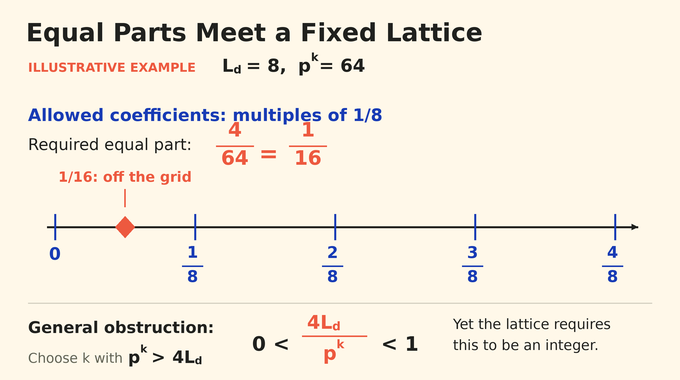
The character classes sum to . One factor of two comes from the positive real coefficient plane, and the other from the involution construction. Since their rational images are equal, each must be times the orientation class.
Membership requires . Now choose so large that . The required integer is strictly between zero and one, which is impossible. The order is decisive: fix the lattice first, then choose the quotient size.
For an arithmetic illustration only, suppose and . Each piece would have coefficient , whereas the permitted coefficients come in steps of . The paper does not assert those particular parameter values.
This excludes faithful p-adic actions for every prime, including two. Any continuous p-adic action therefore has a nonzero closed kernel. Such a kernel is open, so the action factors through a finite quotient. The classical reduction now supplies the Lie-group conclusion.
11. What the Result Establishes, and Its Precise Limits
The manuscript covers noncompact, nonorientable, and nontriangulable manifolds, with no differentiability or freeness requirement. Boundarylessness, finite dimension, Hausdorff separation, and second-countability remain explicit hypotheses. The theorem neither smooths the given action nor supplies a numerical algorithm for developers.
| Condition | Role in the Result |
|---|---|
| Connected manifold | Required. Faithfulness is a statement about the action on this whole connected space. |
| Finite dimension and no boundary | Explicit hypotheses of the stated theorem. The article asserts no infinite-dimensional extension. |
| Compactness or orientability | Not required globally. The proof obtains orientation in a local chart. |
| Free or smooth action | Not required. Fixed points and arbitrary stabilizers are permitted. |
| Finite-quotient p-adic action | Allowed. Its kernel is nonzero, so it is not faithful as a p-adic action. |
There is a dynamical consequence: for an almost periodic homeomorphism, defined here by compact closure of its cyclic subgroup in the homeomorphism group, some positive iterate lies on a continuous real flow. The mathematical output concerns allowable symmetry and dynamics, rather than measured AI performance.
For researchers, a potentially reusable contribution is the machinery connecting continuous compact-source constructions to bounded integral invariants. The manuscript explicitly identifies its cutoff description and dense-subcategory bound as useful beyond this action problem. For AI developers evaluating mathematical output, the lesson is concrete: inspect the uniform bound and its dependencies, rather than treating a persuasive final contradiction as evidence that its prerequisites hold.
OpenAI’s mathematics release includes both formalized and unformalized results. The supplied Hilbert–Smith manuscript contains no Lean proof, and its current catalogue entry does not link one. A separate Hexagon manuscript by Alexander Dabrowski reports a linked Lean formalization under second-countability assumptions. That report does not formally verify OpenAI’s different argument.
Our Fermat formalization explainer separates discovery from machine checking. Our Courtade–Kumar analysis explains the value of distinct proof routes. For this Hilbert Smith conjecture manuscript, assess the stated theorem, the fixed lattice, and the verification evidence separately. Follow Binary Verse AI for research explainers that make those distinctions explicit.
What is the Hilbert–Smith conjecture?
The Hilbert–Smith conjecture states that a locally compact group acting faithfully and continuously on a connected finite-dimensional topological manifold must be a Lie group. The OpenAI manuscript presents a proof for locally compact, second-countable Hausdorff groups and connected Hausdorff, second-countable manifolds without boundary. Faithfulness means that only the identity fixes every point.
Why are p-adic integers important to the Hilbert–Smith conjecture?
The group is compact and has arbitrarily small nontrivial subgroups. Classical structure theory, combined with restrictions on manifold actions, reduces the conjecture to excluding faithful actions of this group. The OpenAI manuscript establishes that exclusion under its stated hypotheses. Nonfaithful actions through finite quotients remain possible.
What prevented previous proofs from solving the higher-dimensional cases?
Earlier approaches used dimension-specific geometry or additional regularity assumptions that did not cover arbitrary continuous actions. John Pardon proved the three-dimensional case using incompressible surfaces and surface mapping class groups. Those tools did not directly settle the unrestricted higher-dimensional problem.
How does the OpenAI proof rule out faithful p-adic actions?
It constructs integral Witt-group classes whose rational signature images lie in a lattice with one fixed denominator. A hypothetical faithful p-adic action would produce classes with equal rational images summing to a fixed nonzero signature. For sufficiently large , the required equal pieces fall outside that lattice, giving a contradiction.
Why does the proof use odd-dimensional spheres and Witt groups?
After stabilization, odd-dimensional spheres provide rational homotopy tests that can be concentrated in suitable regions of the orbit space after a positive-degree postcomposition. Witt groups encode symmetric duality data as additive signature classes. Together, these constructions convert the hypothetical group action into an arithmetic contradiction with a fixed denominator bound.
Does the OpenAI proof apply to non-smooth manifolds and actions with fixed points?
Under its stated hypotheses, yes. The manuscript treats finite-dimensional topological manifolds without requiring differentiability, triangulability, orientability, compactness, or free actions. Fixed points and arbitrary point stabilizers are allowed. The manifold must still be connected, Hausdorff, second-countable, and without boundary.
Has the Hilbert–Smith OpenAI proof been formally verified?
The supplied September 2026 OpenAI manuscript contains no Lean formalization, and the OpenAI catalogue entry checked on October 26, 2026 does not link one. A separate AI-assisted Hexagon manuscript reports a linked Lean 4 formalization under second-countability assumptions. That is a different proof and does not establish formal verification of OpenAI’s manuscript. The reported formalization was not independently audited for this article.