An infinite network can become connected enough to support endless open paths while remaining fragmented into infinitely many endless components. That is the phenomenon behind the Benjamini–Schramm nonuniqueness conjecture. OpenAI’s September 24, 2026 preprint presents a proof for every infinite, connected, locally finite, nonamenable quasi-transitive graph under Bernoulli bond percolation.
The result separates the arrival of infinite clusters from uniqueness. A stronger operator inequality unlocks critical power laws and exponential connection decay. This is a universal mathematical guarantee across a graph class.
Table of Contents
1. What Was the Benjamini–Schramm Nonuniqueness Conjecture?
In 1996, Itai Benjamini and Oded Schramm asked whether expansion always creates a nonempty phase with multiple infinite clusters on suitably symmetric infinite graphs. Their original framework used site percolation and explicitly extended the nonplanar questions to bonds. This paper addresses the bond version.
A cluster contains vertices joined by open paths. The critical probability marks the onset of infinite clusters. The percolation uniqueness threshold marks almost-sure uniqueness. The conjecture asks whether necessarily holds.
1.1. Benjamini–Schramm Nonuniqueness Conjecture: Key Facts
| Research Detail | What the Paper Establishes |
|---|---|
| Source | OpenAI preprint dated September 24, 2026, released in the October mathematics collection. |
| Model | Bernoulli bond percolation with independently open edges. |
| Graph Class | Infinite, connected, locally finite, nonamenable and quasi-transitive. |
| Stronger Result | , with the critical connection operator bounded. |
| Coupled Conclusion | One nonempty compact interval has infinitely many infinite clusters simultaneously almost surely. |
| Formalization Record | Lean scope notes list the main theorem, Cayley consequence and selected critical laws. |
The original manuscript’s Theorem 1.1 supplies the precise statement. OpenAI’s October 6 release announcement attributes the collection to an internal frontier model. Our analysis of AI mathematical proofs explains why theorem scope and verification evidence deserve separate attention.
2. Bernoulli Bond Percolation on Nonamenable Quasi-Transitive Graphs
Write for a graph with vertices and undirected edges. Each edge independently opens with probability and closes with probability , where . Vertices stay in place. Only the available connections change.
Local finiteness means every vertex has finitely many incident edges. Quasi-transitivity means finitely many vertex orbits, or symmetry types, under graph automorphisms. Together, these conditions give a uniform degree bound while allowing several recurring vertex types.
Nonamenability is a uniform expansion condition. For a finite nonempty vertex set , its vertex boundary consists of outside vertices adjacent to it. The paper defines:
Nonamenability means . No finite region can make its boundary negligible relative to its size. Regular trees illustrate this persistent branching. Large boxes in an ordinary integer lattice have relatively small boundaries.
Our Thompson’s group F explainer discusses the related group-theoretic notion. Here, expansion is an explicit hypothesis. The percolation theorem does not prove that an arbitrary group or network is nonamenable.
3. The Three Thresholds: , and
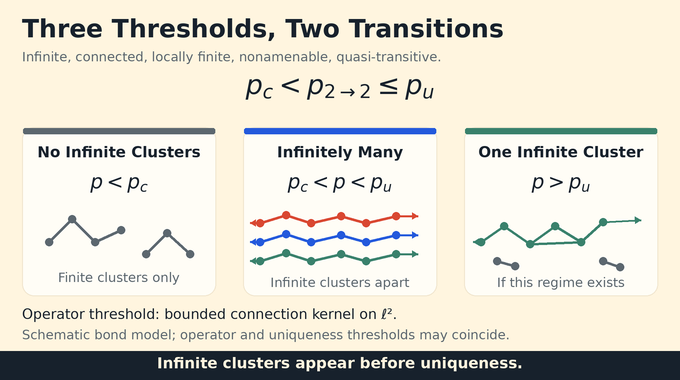
The extra threshold is the supremum of parameters where the connection-probability matrix defines a bounded operator on . This space contains vertex functions whose squared absolute values have a finite sum. Counting measure is used throughout. Operator norm measures the largest amplification of their norm.
3.1. What the Percolation Thresholds Measure
| Threshold or Regime | Meaning |
|---|---|
| Boundary between no infinite clusters and the percolating phase. | |
| Boundary of boundedness for the connection operator on . | |
| Boundary of the regime with exactly one infinite cluster almost surely. | |
| Infinitely many infinite clusters almost surely at every fixed parameter. | |
| One infinite cluster almost surely, when this regime is nonempty. |
An infinite component need not occupy every vertex or meet another infinite component. Distinct expanding branches can support endless open paths without an open route between them. Infinity supplies room for coexistence. Expansion and symmetry supply the guarantee.
Threshold endpoints require separate treatment. The theorem does not assert uniqueness exactly at , and is possible. Its strict inequality concerns the lower operator gap. The upper comparison with uniqueness need not be strict.
The operator threshold is an analytic marker. The theorem does not claim a change in cluster count there. Its value is identifying a region where connectivity remains quantitatively controlled.
4. Why Previous Proofs Could Not Establish the General Conjecture
Previous proofs required additional structure: planarity, hyperbolicity, sufficiently large girth relative to spectral radius, strong quantitative expansion, or suitable harmonic functions. These results covered substantial families without covering every graph in the conjecture.
The hyperbolic setting connects naturally with the geometry described in our Cannon conjecture explainer. However, the present theorem assumes no hyperbolic boundary or thin-triangle geometry. Removing such restrictions is the central advance.
For Cayley graphs, an earlier result could choose a suitable generating multiset. Later work obtained a suitable ordinary finite symmetric generating set. That existential choice differs from handling whichever generating set has already been prescribed. Changing generators changes the graph, even though the underlying group stays the same.
The new proof replaces special geometry with controls on critical clusters, connection operators and random-walk spreading. It incorporates existing results, particularly Hutchcroft’s treatment of nonunimodular actions.
5. OpenAI’s Main Theorem: Proving the Strict Operator Gap
The two-point kernel records the probability that two specified vertices belong to the same open cluster:
The arrow denotes connection by a finite open path, including length zero. The matrix sums vertex-function values weighted by connection probabilities.
Susceptibility, the expected size of the cluster at vertex , is a row sum:
Subcritical row sums are finite and bound the operator norm. But expected cluster size diverges as criticality approaches. That makes row-sum bounds inadequate for proving the desired critical estimate.
A matrix can spread enough mass across infinitely many vertices for its row sums to diverge while its action on square-summable functions stays controlled. The constant function is not square-summable on an infinite vertex set.
Theorem 1.1 proves critical boundedness, identifies its norm with the supremum of subcritical norms, and establishes:
This resolves the Hutchcroft operator threshold conjecture in the stated class. Hutchcroft’s earlier work on the boundedness condition and its consequences explains why the stronger result carries more information than nonuniqueness alone.
6. Reducing the Proof to Unimodular Graphs
The proof first removes loops and handles parallel edges by subdivision. Existing operator results settle the nonunimodular case. The principal new estimate therefore concerns simple graphs whose automorphism group is unimodular.
Unimodularity permits balanced mass transport: with appropriately weighted root types, expected mass sent equals expected mass received. The weights are proportional to inverse stabilizer volumes. A stabilizer consists of automorphisms fixing the vertex.
Those weights average root types. They do not replace counting measure in the operator norm. This distinction prevents a convenient averaging device from silently changing the theorem.
Averaging operator diagonal entries over root types supplies a finite normalized trace, enabling comparisons of positive operators and triangle quantities on the infinite graph.
Nonamenability gives a symmetric lazy random-walk kernel with . Its steps spread square-summable mass with exponential norm decay. This random-walk spectral gap differs from the Hamiltonian energy gap in our 2D area-law analysis.
7. Critical Clusters, Pivotal Bridges and Local Endpoint Maps
Established critical-nonpercolation results ensure the clusters used here are finite. The proof then needs control that survives deleting vertices, because later constructions repeatedly cut clusters into pieces.
A bridge is an open edge whose removal disconnects a component. Pivotal distance counts bridges separating two vertices. For clusters capped at size , the paper controls each remaining component’s bridge diameter after deletion, in terms of its contacts with the deleted set and the cap.
The exceptional event has stretched-exponentially small probability. Uniformity over deletions gives the later splicing procedure a guarantee for leftover pieces, not just intact clusters.
A local endpoint map reads a finite neighborhood and either fails or selects another vertex in the root’s critical cluster and symmetry orbit. Successful maps require a capped, well-controlled cluster. Their conditional endpoint kernel describes where the selected mass goes.
A fractional moment averages cluster size raised to a positive exponent below one. It tests how heavy the size distribution’s tail is, while tolerating more large clusters than ordinary expectation.
Assuming a critical fractional moment diverges, the authors splice pieces between independent percolation fields to amplify spreading. Inverse codes and a second-moment load estimate control how many inputs produce each output, preventing rare outputs with many preimages from masquerading as dispersion.
8. Fractional Moments, Susceptibility and the Triangle Condition
The endpoint maps become so dispersive that their operator norm shrinks faster than their success probability or cluster cap deteriorates. Running a fixed map just below criticality pushes substantial endpoint mass outside an independently sampled, size-weighted cluster.
Comparing susceptibility in that deleted domain with full susceptibility yields a differential inequality. A finite-exploration comparison then contradicts the assumed divergent moment. Consequently, critical moments are finite uniformly over roots for every .
A decision-tree covariance argument yields for every . This intermediate near-critical bound allows an arbitrarily small extra exponent. The exact final susceptibility law comes later.
The triangle diagram sums three connection probabilities around a triangle of vertices:
These are products of probabilities, not the probability that three connections occur jointly. Its finiteness at criticality is the critical triangle condition in percolation.
At this stage, the proof obtains only the subpower bound . It compares cluster explorations before and after another cluster is deleted. Centered scores of tested edge states control closed contacts between the clusters. Fractional moments and concentration then constrain triangle growth.
Subpower divergence is weaker than boundedness. It makes the next argument’s error term small enough, but does not yet establish the critical triangle condition.
9. Pivotal Corridors and the Spectral Contradiction
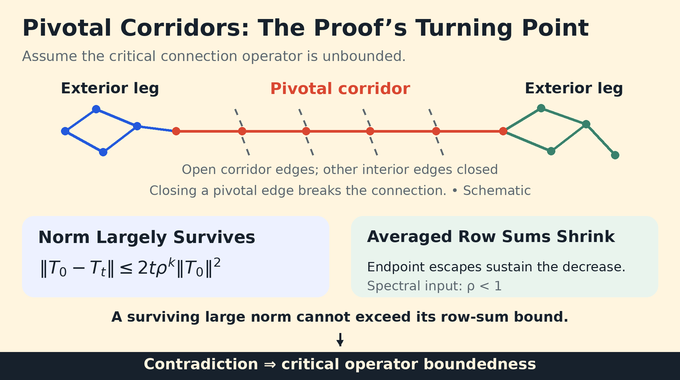
A corridor is a simple open path whose internal vertices have no other open incident edges. When its edges are all pivotal for a connection, closing any one breaks that connection. The authors penalize such connections through an auxiliary deformation parameter .
Random-walk paths specify corridor templates after loop erasure. Calibration weights compensate for forcing corridor edges open and blocking edges closed. The deformation changes a kernel analytically. It is not a physical alteration of the model.
There are two competing estimates. The operator norm loses at most , where is the raw walk length. The factor involving makes that loss small. Meanwhile, an averaged row sum decreases at a rate controlled by products of endpoint susceptibilities, subject to a triangle-diagram error.
Short geodesic escape segments and random-walk smoothing ensure a positive proportion of raw paths preserve substantial susceptibility at both ends after deleting the corridor interior.
Suppose the critical operator were unbounded. With , sprinkling would force . The earlier susceptibility and triangle bounds then permit while keeping the deformation error small.
The deformed row sums would shrink until they could no longer dominate the surviving operator norm. Yet nonnegative kernels must obey that domination, up to the fixed root-type comparison. This contradiction proves critical boundedness. Expansion supplies the spectral decay that makes the competing estimates incompatible.
10. How Sprinkling Establishes Infinitely Many Infinite Clusters
Sprinkling adds an independent field of open edges with probability . Its union with the original field has parameter . A connection expansion gives boundedness at the larger parameter whenever , where bounds the vertex degrees.
Since the critical operator is bounded and the critical probability is below one, a sufficiently small positive sprinkling opens an interval above criticality where the operator remains bounded. The standard uniqueness comparison then yields the full threshold inequality.
The coupled assertion is stronger than separate almost-sure statements. Give each edge an independent uniform label and open it when the parameter reaches that label. For some , infinitely many infinite clusters coexist throughout on one probability-one event.
It proves this by counting final clusters containing infinite clusters from the earlier parameter. Boundedness excludes one such final cluster. Finite modifications exclude any finite number greater than one. Infinitely many must survive, staying distinct at intermediate parameters.
For Cayley graph percolation, Corollary 1.2 applies to every prescribed finite symmetric generating set of a nonamenable finitely generated group, excluding the identity. Established phase theorems give infinitely many infinite clusters at each fixed parameter between existence and uniqueness.
A Cayley graph represents group elements as vertices. Edges join elements related by multiplication by a chosen generator. Symmetry of the generating set includes inverses, making these connections undirected. The theorem fixes that graph before varying the percolation parameter.
11. Critical Exponents, Exponential Connectivity and the Proof’s Limits
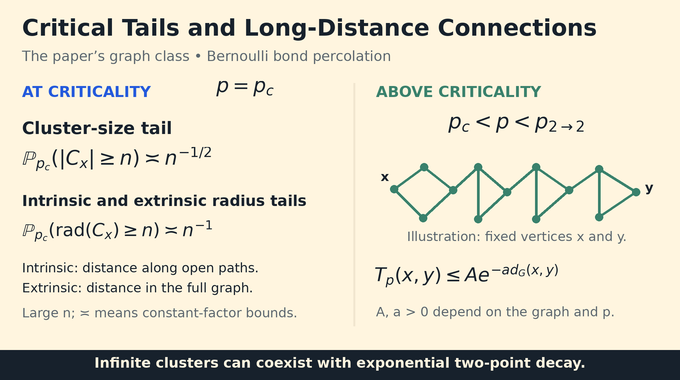
Critical boundedness makes the critical triangle diagram finite. Earlier conditional theorems then yield mean-field laws. The new contribution is establishing their operator hypothesis across the whole stated graph class.
11.1. Critical Laws and Their Meaning
| Observable | Consequence in Corollary 1.3 |
|---|---|
| Expected Cluster Size | as the parameter approaches criticality from below. |
| Infinite-Cluster Probability | as the parameter approaches criticality from above. |
| Critical Cluster-Size Tail | for positive integers tending to infinity. |
| Critical Radius Tails | Both intrinsic and extrinsic radius tails have order . |
The comparison symbol means upper and lower bounds by positive constant multiples, with graph-dependent constants. Intrinsic radius measures distance along open paths. Extrinsic radius uses the original graph. Both have the same tail power here.
Connection probabilities decay exponentially with graph distance at every fixed , including an interval with infinite clusters. Connecting two specified distant vertices can be unlikely while some infinite route exists through the many available alternatives.
As of October 14, 2026, the published Lean scope notes cover the gap, coupled interval, Cayley result and selected critical laws. The comparator configuration targets a separate solution module with restricted axioms. Challenge-file placeholders specify targets, not proofs. The library was not independently compiled or replayed for this article. Formalization remains distinct from mathematical review, as our Fermat formalization explainer discusses.
The theorem gives no universal numerical thresholds or gap width. It establishes no finite-network performance benchmark and does not cover arbitrary irregular graphs, dependent edge models or general site percolation. A developer can simulate finite approximations, but cannot infer this infinite-graph theorem from those samples.
Its immediate research value is making previously conditional results available uniformly.
The Benjamini–Schramm nonuniqueness conjecture is valuable because it separates phenomena that a single connectivity threshold conceals. Follow Binary Verse AI’s mathematical reasoning coverage for source-based explanations that keep theorem statements, proof evidence and practical claims in view.
What is the Benjamini–Schramm nonuniqueness conjecture?
It asks whether every infinite, connected, locally finite, nonamenable quasi-transitive graph satisfies under Bernoulli bond percolation. Here is the critical probability and is the uniqueness threshold. OpenAI’s September 24, 2026 preprint presents a proof of this separation and the stronger operator gap. Its published Lean scope notes cover these conclusions.
How can infinitely many infinite percolation clusters coexist?
An infinite graph can contain infinitely many disconnected components, each with infinitely many vertices. In the nonuniqueness phase , there are infinitely many infinite open clusters almost surely at every fixed parameter. The paper also proves a single probability-one event on which this holds simultaneously throughout a nonempty compact subinterval in the uniform-label coupling.
What is the difference between , , and ?
marks the onset of infinite clusters. marks the onset of almost-sure uniqueness of the infinite cluster. is the supremum of parameters where the connection-probability operator is bounded on counting-measure . The paper proves , with boundedness also at criticality. The upper inequality need not be strict.
Why was the Benjamini–Schramm conjecture difficult to prove?
Earlier approaches established nonuniqueness under additional geometric or analytic assumptions, or for suitably chosen Cayley generating sets. Expansion alone did not supply the general operator bound. The new argument combines deletion-uniform critical-cluster controls, local endpoint maps, fractional moments, pivotal-corridor deformation and a random-walk spectral contradiction to remove those restrictions.