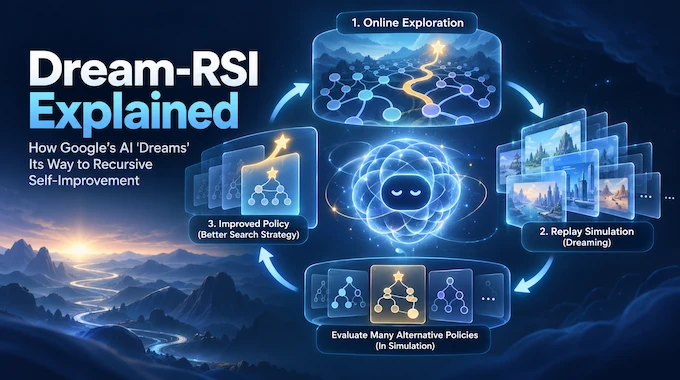
Dream-RSI sounds like the kind of system that rewrites itself into a smarter model. That is not what the paper shows.
The key idea is narrower, and more interesting. The system leaves the underlying coding model, evaluator, and execution interface fixed. What changes is the exploration policy, the layer that decides where an AI discovery agent should search next, how many branches to open, when to refine a promising path, when to stop, and how much work to run in parallel. The system then improves that policy using replay from earlier discovery runs.
That makes Dream-RSI a form of recursive self improvement AI at the meta-exploration layer. It is not a model rewriting its own weights. It is a discovery system learning how to spend its search budget more intelligently.
Table of Contents
1. What Is Dream-RSI?
The name stands for Recursive Self-Improvement through Evolving Worlds. The paper comes from researchers affiliated with Google, Google DeepMind, the University of Maryland, and the University of Virginia. Its central claim is that past discovery histories can be turned into replay simulators, allowing an AI agent to test many alternative exploration strategies without rerunning the expensive underlying discovery process.
Dream-RSI Key Facts: What the Research Paper Actually Shows
| Key Question | What the Paper Shows |
|---|---|
| What self-improves? | The exploration-policy code |
| What stays fixed? | The underlying models, evaluator, and execution interfaces |
| What is replayed? | Historical discovery trees with stored outcomes |
| What does the policy control? | Branching, ordering, parallelism, refinement, and stopping |
| Where was it tested? | Algorithm engineering, mathematical optimization, and GPU kernel engineering |
| Main practical goal | Better discovery quality with fewer costly agent calls or generations |
The paper evaluates eight tasks across those three domains. Its controlled baseline, Recursive Fixed Exploration, uses the same discovery agent, evaluator, initialization, and resource constraints. The baseline keeps its exploration strategy fixed while the new method updates that strategy across recursive rounds.
That distinction matters. Many discussions of recursive self improvement assume the model itself must change. Dream-RSI instead treats search strategy as something an agent can improve recursively.
2. How Dream-RSI Works: Explore, Replay, Dream, Improve
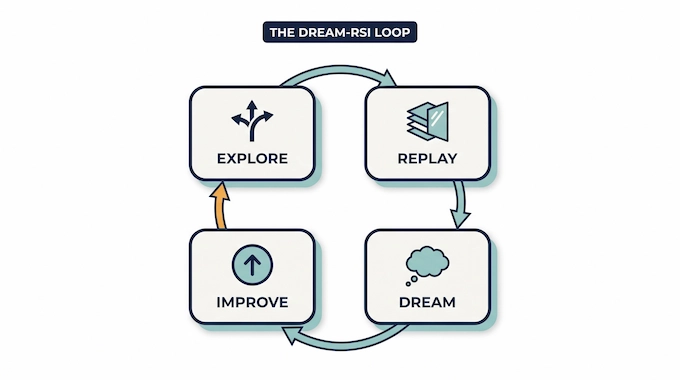
The easiest way to understand it is as a four-stage loop. Figure 1 on page 2 of the paper visualizes the same cycle, moving from online exploration to simulator construction, policy improvement, and redeployment.
Dream-RSI Workflow: Explore, Replay, Dream, and Improve
| Stage | What Happens | Why It Matters |
|---|---|---|
| Explore | The current policy runs real discovery and creates a tree of attempts | Produces fresh solutions and costly real outcomes |
| Replay | The completed tree becomes a simulator | Past execution becomes reusable feedback |
| Dream | Alternative policies navigate the stored tree | Many strategies can be tested cheaply |
| Improve | The best replay-tested policy is redeployed | New real discovery expands the next simulator pool |
2.1 Explore The Real Problem
During an online rollout, the policy chooses which nodes in the discovery tree should be extended. Each selected node gives the coding agent a saved workspace and accumulated observations. The agent proposes a new candidate, the evaluator scores it, and the result becomes a new child in the tree.
The policy is not solving the task directly. It decides how the solving process should spend its compute, so the same model can perform differently under different search strategies.
2.2 Turn Discovery History Into A Replay Simulator
Once an online run finishes, its tree is stored. Each branch contains recorded attempts, scores, diagnostics, costs, and outcomes.
The system then treats that history as an empirical world. An alternative policy can walk through the same tree in a different order, choose different branches, batch requests differently, or stop earlier. Because the outcomes are already recorded, the system can evaluate those choices without calling the discovery agent or evaluator again.
This is the “dreaming” trick. The system is not hallucinating new outcomes. It is replaying known outcomes under alternative search-control decisions.
2.3 Dream About Better Search Strategies
The paper’s replay objective balances three things: the best solution quality found, the number of generation-evaluation requests represented by the replay trajectory, and a reward for useful parallelism.
A policy-development agent then inspects the replay trajectories and scores, revises the executable policy code, and tests the new version on the same historical worlds. This repeats across multiple candidate policy versions.
The important point is economic. One expensive online search can support a large number of cheap policy evaluations afterward. The paper says thousands of candidate policies can be tested against a recorded discovery tree without additional underlying execution.
2.4 Redeploy The Better Exploration Policy
After replay evaluation, the highest-scoring policy is selected and used for the next real rollout. That new rollout creates another discovery tree, which expands the history available for the next round of dreaming.
That is the recursive loop: explore, record, replay, improve the exploration policy, then explore again.
3. A Simple Example: Why “Dreaming” Can Save Compute
Imagine a discovery agent has three search branches.
- Branch A quickly reaches a score of 90 after two refinements, then stalls.
- Branch B starts at 60 but keeps improving and eventually reaches 88.
- Branch C performs badly from the start.
A fixed policy might spend the same number of attempts on all three. The system can instead replay the history and ask what would have happened if it stopped Branch A after progress flattened, abandoned Branch C earlier, and redirected budget toward Branch B.
Because those outcomes already exist, it can compare many allocation strategies without rerunning the coding agent. This is AI agent optimization at the control layer: learning how to distribute effort, not changing model weights.
4. What Actually Self-Improves?
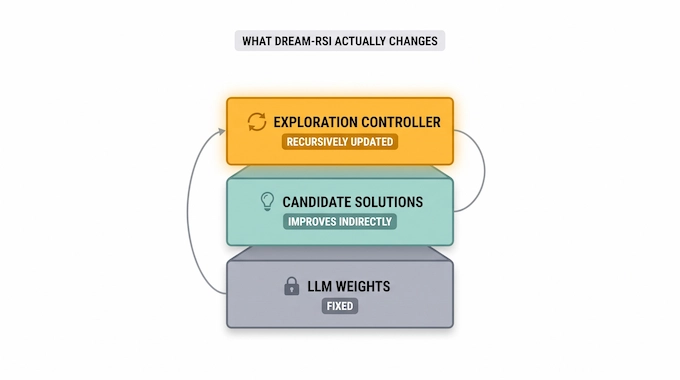
The phrase recursive self improvement is overloaded. The framework becomes much easier to evaluate once the layers are separated.
| System Layer | Does The Framework Improve It? | What That Means |
|---|---|---|
| LLM weights | No | No fine-tuning or self-rewriting of the model is required |
| Candidate solutions | Yes, indirectly | Better search can discover stronger code, algorithms, or mathematical constructions |
| Exploration controller | Yes | This is the recursively improved component |
The paper is explicit that only the exploration-policy code changes while the underlying models, evaluator, and execution interfaces remain fixed.
So, what is recursive self improvement in AI in this case? It is not “the model makes itself smarter.” It is “the system improves the procedure that governs how future improvement attempts are explored.”
That places the approach closer to self improving AI agents and evolving agent harnesses than to classic model-level RSI.
5. Is Dream-RSI Really Recursive Self-Improvement?
Three levels of RSI are useful here.
- Model-level RSI changes weights, architecture, training procedures, or successor models.
- Agent-level self-improvement changes the surrounding system, such as prompts, tools, memory, skills, or workflows.
- Meta-exploration RSI changes the strategy governing how the improvement process searches.
The framework demonstrates the third category.
This goes beyond static search optimization because the controller is improved, redeployed, used to generate new experience, then improved again from the expanded history. The feedback loop closes over the exploration policy itself.
At the same time, calling it full autonomous model RSI would overstate the evidence. The paper does not show Gemini rewriting its own weights, redesigning its own architecture, or training a superior successor model end to end.
The paper therefore demonstrates a narrower but meaningful form of RSI: recursively improving where long-horizon discovery spends its next unit of search.
6. Dream-RSI Benchmarks: What Did It Actually Achieve?
The results vary by task and baseline.
On the Lasso regularization-path task, the method with Gemini-3.1 Pro used 317 discovery-agent calls versus 550 for Recursive Fixed Exploration while reducing average runtime on six held-out datasets from 3587.1 ms to 2931.0 ms. That is roughly 1.7× fewer calls against the controlled baseline. With Gemini-3.7-Flash, it used 1879 calls instead of 3200 and reduced average runtime from 2516.7 ms to 2350.6 ms.
The headline comparison against SimpleTES is much larger. SimpleTES reports 51,200 generations, while the paper reports cuts of up to 162× in discovery-agent calls on Lasso and more than 50× in budget on the math tasks.
On mathematical optimization, the system reached 1.145427 on Sum-Difference, 1.456375 on Autocorrelation, and 2.635983 on Circle Packing. Higher is better for Sum-Difference and Circle Packing, while lower is better for Autocorrelation.
On KernelBench, it reached comparable VGG16 and LayerNorm performance with 2.43× and 1.79× fewer generations. Under comparable budgets, it achieved 2.09× and 1.44× higher performance on ConvDiv and ConvMax.
7. The 162× Claim Needs Context
“162× fewer agent calls” is real within the reported setup, but it should not be translated into “Dream-RSI makes AI 162× more efficient.”
That figure comes from a particular Lasso comparison against SimpleTES, which uses 51,200 generations. The tighter controlled comparison is Recursive Fixed Exploration, where the adaptive method and the baseline share the same models, evaluator, initialization, and resource constraints. In that setting, the savings are much smaller, although still meaningful.
The Autocorrelation result is another useful reality check. Lower is better. The method reports 1.456375, Recursive Fixed Exploration reports 1.456001, and SimpleTES reports 1.453675. In other words, the method is not best on every benchmark.
The contribution is a reusable method for improving exploration efficiency, not a claim that every task gets a dramatic win.
8. How It Differs From AlphaEvolve
AlphaEvolve-style systems focus on evolving candidate solutions. The core question is, “How can the system generate a better program, construction, or algorithm?”
This framework adds another level: “How should the system organize the search that generates those candidates?”
That means its target is not just the solution space. It is the policy over the solution-search process.
The paper compares against several automated discovery systems in mathematics, including AlphaEvolve, AlphaEvolveV2, OpenEvolve, CodeEvolve, ShinkaEvolve, TTS-Discovery, ThetaEvolve, EvoX, and SimpleTES.
The key difference is that exploration itself becomes a programmable object that can be evaluated, revised, and redeployed.
9. The Biggest Limitations
9.1 Replay Cannot Reveal Outcomes That Were Never Recorded
The simulator is grounded in historical discovery trees. During replay, the system reveals stored children from those trees. It does not invent unexplored branches or generate outcomes beyond the recorded history.
9.2 Better Replay Score Does Not Guarantee A Better Fresh Rollout
The paper proves a narrower property: because the current policy is included among the candidates, the selected policy is no worse in average replay score on the fixed historical set.
That does not guarantee the next online run will improve. Fresh discovery remains stochastic.
9.3 Historical Overfitting Is A Real Risk
A policy can become very good at navigating the kinds of trees it has already seen. That does not automatically mean it will generalize to a substantially different search landscape.
The paper does not claim this problem is solved. It is a natural risk when policies are repeatedly optimized against accumulated replay worlds.
9.4 Objective Evaluators Do Heavy Lifting
The experiments use domains with relatively crisp feedback: solver runtime, mathematical objective values, correctness checks, and kernel performance.
That makes policy comparison practical. In writing, strategic planning, open-ended research, or product design, the evaluator may itself be noisy or subjective.
9.5 “Zero-Cost Replay” Does Not Mean Zero-Cost Improvement
Replay avoids repeating expensive execution, but the system still needs costly online discovery to create new trees. Those fresh runs are what expand the world model and reveal genuinely new outcomes.
10. Can It Work Outside Coding, Math, And Science?
Possibly, but this paper does not demonstrate it.
The method depends on a feedback signal that can score outcomes well enough to distinguish better exploration policies from worse ones. In algorithm engineering, mathematics, and GPU kernels, that is relatively straightforward.
In subjective domains, the problem changes. If the evaluator is inconsistent, biased, easy to game, or only weakly correlated with the real objective, the system could become very efficient at optimizing the wrong thing.
The framework may be broader than the experiments, but the evidence is not.
11. What It Means For Self-Improving AI Agents
The practical lesson is that self improving AI agents do not need to begin with self-modifying model weights.
A great deal of capability can sit in the controller around the model: how much compute to allocate, when to branch, when to refine, which trajectory to abandon, how aggressively to parallelize, and when to stop.
One of the paper’s more revealing experiments supports this. The researchers compared interactive replay against turning historical experience into explicit semantic guidance in the prompt. The guidance versions performed worse under equivalent budgets, suggesting that simply summarizing “lessons learned” is not equivalent to letting a policy interact with the structure of the recorded search process.
For agent builders, the lesson is that memory need not be only text. History can become an environment for testing future control policies.
12. Does This Put AI On A Path Toward Full RSI?
The paper demonstrates something concrete: recursive improvement of an exploration controller using replay from accumulated discovery history.
That matters because long-horizon AI discovery can burn enormous compute on poor branch allocation. A system that gets better at deciding where to search can compound that efficiency over repeated rounds.
What it does not demonstrate is equally important. There is no autonomous rewriting of model weights, no self-designed successor architecture, and no evidence of an uncontrolled intelligence explosion. The underlying models remain fixed while the exploration policy evolves.
The most useful way to view the framework is as a building block for more capable recursive discovery systems. It makes the improvement process itself more adaptive.
For developers and researchers, that is already significant. The next frontier in AI agent optimization may not be a bigger model. It may be a smarter policy for deciding what the model should try next.
Binary Verse AI will keep tracking systems like this one by separating what the papers actually demonstrate from the headlines built around them. If you want evidence-first breakdowns of self-improving agents, AI discovery systems, and the benchmarks behind the claims, follow Binary Verse AI for the next deep dive.
1. What is Dream-RSI?
Dream-RSI, short for Recursive Self-Improvement through Evolving Worlds, is a framework that improves how AI agents explore complex search spaces. It stores previous discovery runs as replayable search trees, tests alternative exploration strategies against those histories, and deploys the better strategy in the next real discovery round. The underlying language model itself remains fixed.
2. Is Dream-RSI really recursive self-improvement?
Dream-RSI demonstrates recursive self-improvement at the exploration-policy level, not full self-improvement of the underlying AI model. Its controller repeatedly learns better ways to allocate search effort, while the model weights and evaluator stay fixed. Whether this should be called “full RSI” depends on the definition being used; it does not demonstrate an AI autonomously rewriting and retraining its own model.
3. Does Dream-RSI change the AI model’s weights?
No. Dream-RSI modifies the exploration-policy code controlling which branches to pursue, how much work to perform in parallel and when to stop. The underlying model, evaluator and execution interface remain fixed during the reported experiments.
4. How does Dream-RSI reduce AI discovery costs?
Dream-RSI turns completed discovery histories into replay simulators. Because previous outcomes are already stored, alternative exploration policies can be evaluated against those outcomes without repeatedly invoking the expensive coding agent and evaluator. The best policy is then used for the next real-world discovery round.
5. Is Dream-RSI 162× more efficient than other AI systems?
Not generally. The 162× figure refers to a specific Lasso benchmark comparison against SimpleTES. Against the paper’s controlled Recursive Fixed Exploration baseline, the reported reduction is much smaller—about 1.7× in that setting. The 162× figure should therefore not be interpreted as a universal Dream-RSI speedup.