The headline result is hard to ignore: 256K rollouts versus 512K, with a five-benchmark mean of 38.0 versus 36.3. In NVIDIA researchers’ experiments on Qwen2.5-Math-1.5B, FlashREINFORCE beat the reported GRPO baseline by 1.7 percentage points while using half as many training trajectories.
That does not mean it used half the GPUs, half the wall-clock time, or half the money. It does mean the paper has a serious result behind an unusually simple idea: what if agentic reinforcement learning stopped generating several sibling answers for every prompt and instead learned from one rollout per prompt?
FlashREINFORCE is NVIDIA’s answer. It is a critic-free reinforcement learning method built for asynchronous, long-horizon agent training, where some trajectories finish quickly and others disappear into tool calls, environment steps, or long reasoning chains. Instead of waiting for a group of sibling rollouts, it updates from fresh batches of independently completed trajectories. The real question is whether that is a better learning algorithm, or simply a smarter way to spend the rollout budget.y
Table of Contents
1. What Is FlashREINFORCE, and Why Does It Matter?
FlashREINFORCE is a single-rollout RL method for agentic language models. It uses one trajectory per prompt, does not train a critic or value model, and is designed to tolerate asynchronous rollouts that may arrive from slightly older policy snapshots. Its three core pieces are One-Batch REINFORCE, a Sequence Trust Region, and Sample-Mean Optimization.
FlashREINFORCE Key Facts, Training Design, and GRPO Results
| Key Fact | FlashREINFORCE |
|---|---|
| Rollouts per prompt | 1 |
| Critic / value model | None |
| Training style | Asynchronous, one-pass |
| Baseline | Mean reward of the fresh batch |
| Staleness control | Sequence-level trust region plus token importance sampling |
| Loss weighting | Mean within each trajectory, then mean across trajectories |
| Main reasoning result | 38.0 mean with 256K rollouts |
| Main comparison | GRPO: 36.3 mean with 512K rollouts |
| Best agentic signal | Tool use stayed active where GRPO dropped to 0 calls |
Why build this at all? Because agentic RL behaves differently from ordinary short-form reasoning. A coding agent may compile, debug, call tools, and loop several times. A browser agent may wait on pages and external systems. One rollout might take seconds while another takes minutes. Group-relative methods such as GRPO want multiple responses from the same prompt so they can compare siblings. That creates a synchronization problem and reduces the number of unique prompts covered by a fixed rollout budget. The FlashREINFORCE paper frames this as both a systems problem and a sampling problem.
2. FlashREINFORCE vs GRPO: The Fundamental Difference
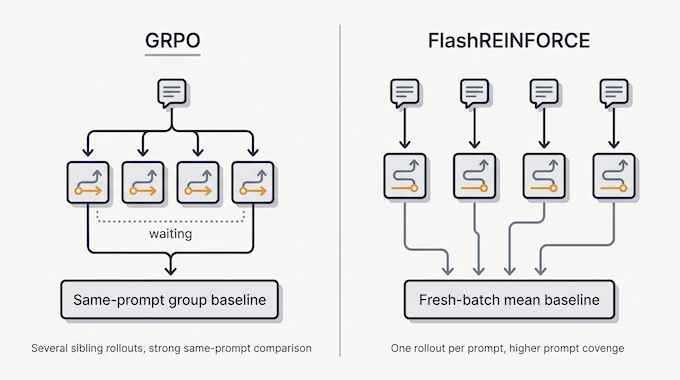
GRPO reinforcement learning gets much of its stability from relative comparison. Generate several outputs for the same prompt, compare their rewards, and use the group to estimate which actions were relatively good or bad. FlashREINFORCE removes that group.
FlashREINFORCE vs GRPO: Key Design Differences for Agentic RL
| Design Choice | GRPO | FlashREINFORCE |
|---|---|---|
| Samples per prompt | Several sibling rollouts | One rollout |
| Advantage baseline | Same-prompt group | Fresh-batch mean across prompts |
| Critic | No critic | No critic |
| Prompt coverage at equal rollout count | Lower | Higher |
| Synchronization | Waits for sibling group | Completed trajectories can arrive independently |
| Stale-rollout handling | Depends on implementation | Token IS plus sequence trust |
| Same-prompt comparison | Strong | None |
| Best fit | Grouped reasoning workloads | Irregular, long-horizon asynchronous agents |
That trade is important. GRPO sees more alternatives for the same question. FlashREINFORCE sees more questions.
In the paper’s Python-tool setup, each update used 128 trajectories. FlashREINFORCE sampled 128 prompts once each, while GRPO sampled 32 prompts four times each. That is the cleanest illustration of the design choice.
3. Why Multiple GRPO Rollouts Get Awkward for AI Agents
Grouped sampling is elegant when trajectories have similar cost. Agents are rarely that polite.
Imagine four rollouts for the same coding prompt.
- One solves the task immediately.
- One makes three Python calls.
- One enters a long debugging loop.
- One burns most of its token budget before failing.
If the learner needs the whole sibling group before computing a group-relative update, fast trajectories effectively wait for slow ones.
There is another cost. Four rollouts on one prompt are four opportunities not spent on four different prompts. That may be acceptable when same-prompt contrast is especially valuable. It is less attractive when the environment itself is expensive or when the training set contains diverse agent tasks.
This is the central bet behind single-rollout reinforcement learning: breadth of experience can sometimes be more useful than repeated sampling of the same prompt, especially when the rollout process is naturally asynchronous.
4. How FlashREINFORCE Makes One-Rollout RL Work
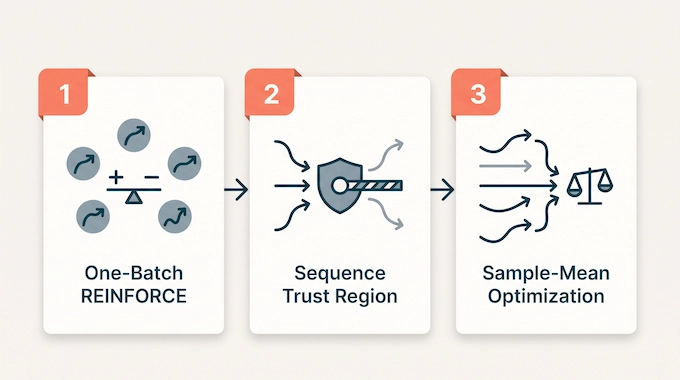
Removing sibling rollouts sounds easy. Making the resulting updates stable is the actual contribution.
4.1 One-Batch REINFORCE: Learning From Successes and Failures
FlashREINFORCE takes the next batch of completed trajectories, computes their mean reward, and centers each trajectory’s reward around that mean. A result above the batch mean gets positive advantage. A result below it gets negative advantage. The batch receives one update and is then discarded.
For binary rewards, this matters because plain positive-only REINFORCE can give failed trajectories no useful signal. Here, failures can push the policy away from what it just did.
The danger is obvious. A failed 4,000-token trajectory may contain many perfectly reasonable intermediate steps. Applying a negative signal across the whole sequence is blunt. FlashREINFORCE accepts that coarse feedback, then tries to stop sequence length from making it worse.
4.2 Sequence Trust Region: Handling Stale Asynchronous Rollouts
Asynchronous RL creates policy lag. A rollout may have been generated by a policy snapshot that is several learner updates old.
FlashREINFORCE stores the behavior probability that generated each sampled token, uses token-level importance sampling to correct action probabilities, and then applies a sequence-level gate based on a sampled-action KL proxy. If a trajectory has drifted too far from the current learner, the whole trajectory is rejected for that update.
That whole-sequence decision matters. In the paper’s Qwen2.5-Math experiment, sequence-level admission remained stable, while a token-local version collapsed, with AMC23 falling from a 51.9 peak to 26.3 and entropy rising sharply.
4.3 Sample-Mean Optimization: Stopping Long Failures From Taking Over
A token-mean loss gives long trajectories more weight simply because they contain more tokens. That is especially dangerous when a long failed trajectory carries negative advantage. FlashREINFORCE first averages loss within each trajectory, then averages across trajectories, so every trajectory gets the same top-level weight.
The ablation is unusually vivid. Starting from the same checkpoint, the sample-mean continuation stayed near a 2,518-token average length with 17.2% truncation. The token-mean variant ballooned to 3,947 tokens, while truncation hit 45.3% and tool use fell.
5. “Single Rollout, No Critic” Sounds Noisy. Is It?
Yes, that is the obvious objection.
GRPO’s sibling rollouts provide a variance-reducing baseline tied to the same prompt. FlashREINFORCE gives that up. The paper explicitly acknowledges that one rollout per prompt makes updates noisier and potentially less stable.
Its answer is not a new critic. It is a bundle of simpler controls:
- batch reward centering for signed feedback
- one fresh update per batch
- sequence-level drift screening
- token importance sampling, and
- sample-level weighting.
That is enough to produce convincing empirical stability in the reported experiments. It is not the same as proving that gradient variance is low. The paper’s evidence is accuracy, reward, response length, entropy, tool use, and long-run training behavior rather than a direct gradient-variance measurement.
So the right interpretation is modest: FlashREINFORCE shows that critic-free, one-rollout training can be stable enough to work well, not that the variance problem has somehow vanished.
6. Does FlashREINFORCE Actually Beat GRPO?
On the reported comparisons, yes, several results are strong.
The headline Qwen2.5-Math-1.5B experiment used a five-benchmark mean across MATH-500, AMC23, Minerva, AIME2025, and OlympiadBench. GRPO reached 36.3 with 512K rollouts. FlashREINFORCE reached 38.0 with 256K.
The tool-use results are more interesting for agent builders. On Qwen2.5-7B-Instruct, GRPO scored a 30.3 three-task mean and reached 0.00 Python calls per trajectory. FlashREINFORCE scored 37.0 and maintained 3.25 calls. On Qwen3-30B-A3B, it scored 67.1 versus GRPO’s 60.3 at the same 102.4K-rollout budget, although FlashREINFORCE ran at roughly policy lag 8 and GRPO at lag 1.
ALFWorld adds a different kind of evidence. FlashREINFORCE reached 98.3% seen and 96.5% unseen success, compared with 90.5% and 86.3% for the strongest published single-rollout baseline listed in the paper.
7. Half the Rollouts Does Not Mean Half the Training Cost
This is where the headline needs restraint.
The paper demonstrates half as many training trajectories in one major reasoning comparison. It does not demonstrate 50% fewer GPU-hours, 50% lower wall-clock time, 50% lower cloud spend, or 50% fewer accelerators.
Those quantities depend on rollout length, inference throughput, learner utilization, synchronization overhead, model size, tool latency, and infrastructure. A method can use fewer rollouts and still spend more compute elsewhere.
Critic removal is also directionally attractive. FlashREINFORCE does not require a value model, and its update uses no critic or reference-model forward pass. That should remove some model-state and training overhead compared with actor-critic approaches. But the paper does not publish a controlled percentage for end-to-end GPU memory or dollar savings.
So “half the rollouts” is a real result. “Half the compute” is not.
8. Why Did GRPO Stop Calling the Python Tool?
This may be the paper’s most revealing result.
On Qwen2.5-7B-Instruct, GRPO stopped calling the Python tool within roughly 200 steps and reached 0.00 calls per trajectory at the reported checkpoint. FlashREINFORCE kept using the tool, averaging 3.25 calls, while also posting higher mean accuracy.
The signed-feedback ablation gives a clue. With batch-centered signed advantages, the model achieved a 36.2 mean and 3.30 tool calls. With positive-only feedback, mean accuracy collapsed to 9.8 and tool calls went to zero.
That makes a plausible story: failures need to teach the policy something, and long-horizon behavior may degrade when the learning signal treats unsuccessful trajectories poorly.
But the experiment does not prove a single causal explanation for GRPO abandoning the tool. It establishes the behavioral difference much more strongly than the mechanism behind it.
9. Is It Better Because of the Algorithm, or Because It Sees More Prompts?
Prompt coverage is the strongest alternative explanation.
If you spend 128 rollouts on 128 unique prompts instead of 32 prompts sampled four times, you expose the model to more distinct training situations. That alone could improve generalization.
The paper contains two useful checks against an overly simple prompt-diversity story.
First, ALFWorld compares FlashREINFORCE with C-RF + NTF, another single-rollout method. C-RF + NTF reached 90.5% seen and 86.3% unseen success, while FlashREINFORCE reached 98.3% and 96.5%. Since both use one rollout, prompt coverage cannot explain that entire gap.
Second, a fresh-batch ablation held the data and optimization budget fixed at 102.4K trajectories and 800 updates. Using a fresh batch for every update scored 28.45, while splitting collected data into four sequential minibatches scored 26.80.
That points to update freshness and staleness control as genuine parts of the result.
10. How Stable Is FlashREINFORCE When Rollouts Get Stale?
On DeepSeek-R1-Distill-Qwen-1.5B, the method stayed stable through 6,000 cumulative updates at policy lag about 4, with AIME24/25 mean rising from 21.7 to 33.7 by the last evaluation in that horizon.
The larger Qwen3-30B-A3B tool-use run pushed to approximately lag 8. The routing-replay configuration stayed in a 63.7 to 66.8 three-benchmark mean range from updates 1,000 to 1,450 and ended at 66.4.
That is strong evidence that the Sequence Trust Region is doing useful work. It is not a universal staleness guarantee. The paper also says its sampled-action proxy does not certify full-policy closeness, and its threshold remains an empirical design choice.
One practical unknown is batch-size sensitivity. The reported experiments use specific batch sizes, but there is no systematic sweep showing how the trust region behaves as batch size changes. That matters because the batch mean is also the baseline.
11. What FlashREINFORCE Still Hasn’t Proven
Several questions remain open.
The paper does not establish that its 6,000-step stability will transfer unchanged to long browser or computer-use agents. It explicitly says OSWorld has not yet been evaluated and calls for broader validation across models and tasks.
It also leaves room for harder tests:
- noisy or subjective rewards instead of exact answers and terminal success
- matched policy-lag comparisons against GRPO at larger scale
- independent replication outside NVIDIA, and
- controlled end-to-end measurements of memory, throughput, wall-clock time, and cost.
Those are not small details. Agentic RL lives or dies on systems behavior. A method that looks elegant at the objective level can still be awkward once browser latency, tool failures, environment resets, and non-deterministic graders enter the loop.
12. Does FlashREINFORCE Replace GRPO for Agentic RL?
Not yet. The evidence supports a narrower and more useful conclusion.
FlashREINFORCE shows that single-rollout asynchronous RL can be surprisingly competitive without a critic, and that grouped rollout training has real weaknesses when trajectories are long, irregular, and tool-heavy. In the reported Qwen2.5-Math comparison, it did outperform GRPO with half the rollouts. In tool-use experiments, it also preserved behavior that GRPO lost.
What it has not shown is that GRPO is obsolete, or that one rollout per prompt will always be the better allocation. Same-prompt sibling comparison remains valuable, especially when reward noise is high or the training task benefits from direct contrast among multiple candidate answers.
The encouraging part is that the idea is already usable. NVIDIA’s Molt repository exposes FlashREINFORCE as a critic-free single-rollout configuration with sequence-level correction and sample-mean aggregation. OpenRLHF has also added flash_reinforce as an advantage-estimator option for asynchronous agentic RL with one sample per prompt. (GitHub)
For builders, that makes this more than an interesting paper. It is now a testable training choice.
If you follow Binary Verse AI for evidence-first analysis, the next step is simple: watch for independent replications, matched-compute comparisons, and real browser or coding-agent runs. FlashREINFORCE has cleared the first bar. The harder question is whether its rollout efficiency survives contact with messy production agents.
1. What is FlashREINFORCE?
FlashREINFORCE is NVIDIA’s critic-free reinforcement-learning method for asynchronous AI-agent training. Unlike GRPO, which typically generates multiple sibling rollouts for the same prompt, FlashREINFORCE trains from one rollout per prompt using batch-centered rewards, a Sequence Trust Region and Sample-Mean Optimization.
2. How is FlashREINFORCE different from GRPO?
GRPO compares several responses to the same prompt to construct relative advantages. FlashREINFORCE instead compares rewards across a fresh batch of independent prompts, allowing every rollout to cover a different task and avoiding the need to wait for sibling trajectories. This is particularly useful for asynchronous, tool-using agents whose trajectories finish at different times.
3. Does FlashREINFORCE really use half the rollouts of GRPO?
In the Qwen2.5-Math-1.5B comparison, yes: FlashREINFORCE reached 38.0 mean accuracy using 256,000 rollouts, while the published GRPO baseline reached 36.3 using 512,000. However, this demonstrates half the rollout count—not necessarily half the total GPU-hours, wall-clock time or training cost.
4. How can FlashREINFORCE train from one rollout without a critic?
It replaces the learned critic and same-prompt group baseline with a batch-mean reward baseline. Above-average trajectories receive positive advantage and below-average trajectories receive negative advantage. Sequence-level drift screening and trajectory-normalized updates then address two major stability problems introduced by asynchronous single-rollout training.
5. Is FlashREINFORCE better than GRPO for AI agents?
The reported experiments favor FlashREINFORCE on several tested settings, including mathematical reasoning, Python tool use and ALFWorld. But the evidence does not establish that FlashREINFORCE universally replaces GRPO: some comparisons use published baselines, policy lag differs in the 30B experiment, and complex environments such as OSWorld have not yet been tested.