

Most Transformers get more computation by stacking more layers, generating more tokens, or running extra test-time passes. The Recurrent Looped Transformer takes a different route. It carries a continuous decoder state from one token to the next, including across the boundary between the prompt and the model’s response. In principle, that creates a computation path whose depth keeps growing as the sequence grows, without adding a fresh set of parameters at every step.
That is the source of the project’s eye-catching phrase, “infinite reasoning depth.” It does not mean infinite compute, infinite context, or a model that keeps thinking until it solves a problem. It means there is no fixed architectural ceiling on the length of the recurrent state path. Every real sequence still uses finite computation. The paper is explicit about this distinction, and equally explicit that structural depth is not the same thing as learned reasoning ability.
What makes RLT interesting now is that the architecture is no longer only a diagram and a set of equations. The project repository includes preliminary synthetic experiments that test whether the recurrent design can generalize beyond the sequence lengths it saw during training. The early results are promising on one task and sobering on another. That mix is exactly why this is worth examining carefully.
Table of Contents
1. Recurrent Looped Transformer at a Glance
RLT is built around a causal encoder and a recurrent Transformer decoder. The encoder turns the observed token history into global key-value memory. The decoder then combines that memory with local sliding-window attention and the previous token’s final decoder state. Crucially, the decoder state does not reset when the prompt ends and generation begins.
Recurrent Looped Transformer: Key Architecture Facts at a Glance
| Question | Short Answer |
|---|---|
| What is RLT? | A Transformer architecture that carries decoder state across every prompt and response token. |
| What is looped? | The decoder computation reuses prior hidden state across token transitions. |
| What persists? | The recurrent output plus layerwise sliding-window attention KV state. |
| What does “infinite depth” mean? | The temporal state path can keep growing with sequence length. |
| Is compute infinite? | No. Every finite sequence still runs a finite amount of work. |
| Reference configuration | 48 encoder layers plus 48 decoder layers, with compatible weights optionally shared. |
| Main promise | Longer latent computation paths without increasing the number of stored layers. |
| Main unresolved question | Whether that structural path becomes useful reasoning at realistic language-model scale. |
The easiest mental model is:
causal encoder → global KV memory → recurrent decoder → carry state into the next token
A standard decoder-only Transformer also has a KV cache, but that cache is not the same thing as a learned recurrent hidden state passed through the full decoder transition. In RLT, each token receives the current encoder representation, the previous final decoder output, global encoder-derived memory, and local decoder history. The architecture therefore behaves less like “run a fixed stack independently at each position” and more like “keep updating a continuous computational state as the sequence unfolds.”
In the paper’s concrete tied configuration, 48 encoder layers and 48 decoder layers produce 96 logical block evaluations per token. Compatible attention and feed-forward weights can be shared across the two stages, which reduces stored parameters, but the two logical passes still exist. Weight sharing is not free computation.
2. New RLT Benchmarks Show Both Promise and Limits
The most useful new evidence comes from preliminary independent state-tracking experiments in the project repository. The small implementation has about 79,000 parameters, was run across three seeds, trained on sequences of 32 operations, and was evaluated out to 128 operations, four times the training length. Each task and length used 2,048 test programs.
Recurrent Looped Transformer Benchmark: RLT vs Transformer at 32, 64, and 128 Operations
| Task | Model | 32 Ops | 64 Ops | 128 Ops |
|---|---|---|---|---|
| Parity | RLT | ≈100% | ≈82% | 60.8% |
| Parity | Transformer | ≈72% | ≈50% | ≈48% |
| Five-state transitions | RLT | ≈100% | ≈49% | 20.7% |
| Five-state transitions | Transformer | ≈24% | ≈20% | ≈21% |
The parity result is the headline. RLT fits the training length, then remains meaningfully above the Transformer as sequences grow. At 128 operations, RLT scores 60.8% while the baseline Transformer sits around 48%, close to the 50% chance level.
The five-state task is a useful antidote to overclaiming. RLT again fits the training length, but its advantage collapses as sequences get longer. At 128 operations it reaches 20.7%, almost exactly the 20% chance baseline. The Transformer is already near chance much earlier.
That gives us a much narrower and more defensible conclusion than “RLT beats Transformers.” The Recurrent Looped Transformer benchmark suggests that recurrence can improve length generalization on some small algorithmic state-tracking problems. It does not establish a general reasoning advantage, and it says nothing yet about natural-language modeling at scale.
There is another important caveat. Parameter and data budgets were matched, but FLOPs were not. The repository itself labels these results as synthetic proof-of-concept evidence rather than validation of large-scale reasoning or reinforcement-learning scaling.
3. What “Infinite Reasoning Depth” Really Means
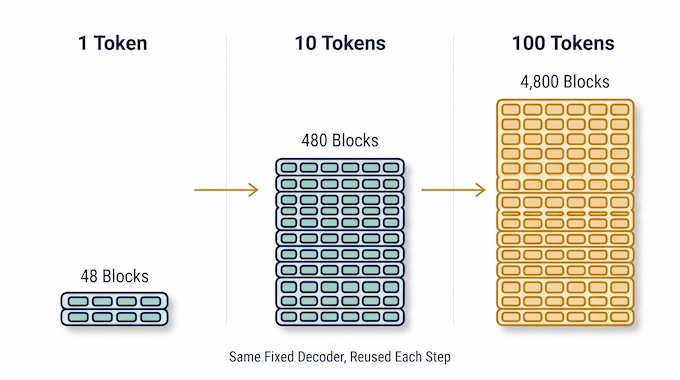
The phrase sounds grander than the mechanism. The mechanism is actually straightforward.
Suppose the recurrent decoder has 48 layers. After one processed token, the state path has passed through 48 decoder blocks. After 10 tokens, there is a possible path through 480 decoder-block applications. After 100 tokens, that path can span 4,800 applications.
The model has not magically turned into a 4,800-layer network with 4,800 unique sets of weights. It is repeatedly applying the recurrent decoder transition as new tokens arrive. The number of decoder blocks executed for each token stays fixed, while the temporal dependency path grows with the history. The paper describes this as unbounded temporal depth and warns that gates, contraction, or learned projections may weaken the influence of very long paths. Structural depth alone is not a reasoning guarantee.
So “infinite reasoning depth” is best read as an architectural property, not a measured capability claim.
3.1 What Infinite Depth Does Not Mean
It does not mean infinite compute per token. It does not mean the model adaptively loops until an answer stabilizes. It does not create unlimited context. It does not prove that latent reasoning becomes more accurate just because a longer hidden-state path exists.
That distinction matters because RLT’s latent reasoning is tied to ordinary token progression. This is different from approaches that insert dedicated hidden “thought” steps or allocate extra recurrent passes before producing the next visible token. RLT’s depth grows because the conversation or sequence grows.
4. How the Looped Transformer Architecture Actually Works
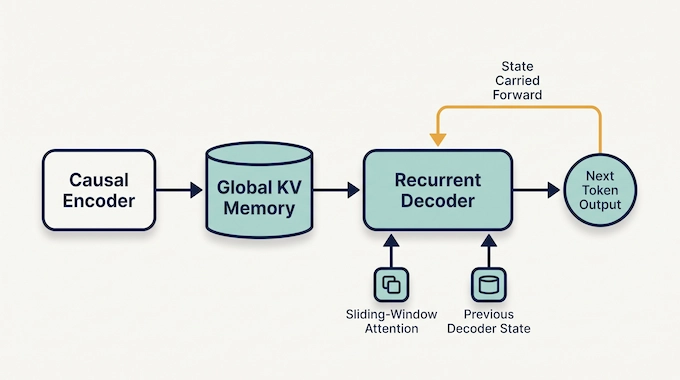
The architecture has two kinds of memory doing different jobs.
First, the causal encoder processes observed tokens and produces encoder representations. From those representations, the model builds global KV memory. The decoder can cross-attend to that memory, but only to the valid prefix at the current position.
Second, the decoder maintains its own sliding-window attention cache. That local cache contains decoder-derived KV from recent positions. Alongside it sits the previous final decoder output, which is merged into the current token’s computation.
This separation is important. Encoder memory gives broad access to the token history. Decoder SWA gives bounded local decoder context. The recurrent hidden state provides continuous cross-token feedback.
The most unusual design choice is that all of this continues through the prompt-response boundary. The final prompt token is not treated as a special reset point. The first generated token is simply the next transition in the same state machine. That same rule is meant to hold during pretraining, supervised fine-tuning, sampling, and current-policy RL replay.
For reinforcement learning, that consistency has a practical motivation. If model states depend on previous hidden states, replaying old actions under updated parameters cannot safely reuse stale recurrent states. RLT reconstructs the full history under the current parameters, while retaining the behavior log-probabilities from the sampler. This does not solve every RL problem, but it removes one architectural mismatch between sampling and training.
5. Why Length Generalization Is the Most Interesting Result
The strongest argument for looped transformers for length generalization is not that recurrence makes a model deeper on paper. It is that recurrence might encourage the network to learn a reusable state-transition procedure.
Training at 32 operations and testing at 64 or 128 asks a hard question: did the model learn the algorithm, or did it mostly learn the distribution of sequence lengths it saw during training?
Parity is a clean example. A successful solver can maintain a compact state and update it as each operation arrives. A recurrent architecture is naturally suited to that pattern. RLT’s advantage over the baseline at 64 and 128 operations is therefore interesting because it is consistent with the model carrying useful state farther than a standard Transformer baseline.
But the five-state result shows why one benchmark cannot carry the whole claim. A recurrent depth transformer can have the right inductive bias and still fail to preserve a useful computation over much longer sequences. Recurrence creates a path. Training must still teach the model what to keep, what to discard, and how to keep that state stable.
This is the gap between a promising architectural idea and a proven reasoning system.
6. Is RLT Actually New?
Not in the sense that nobody has ever made a Transformer recurrent. The paper is unusually clear about its precedents.
Feedback Transformer, Recurrent Transformer, Full-bandwidth Transformer, T2MLR, Latent Recurrent Transformer, block-recurrent systems, Recurrent Memory Transformer, Coconut, and Universal Transformer all explore some form of feedback, state reuse, recurrent depth, or latent computation. The RLT paper explicitly says that neither temporal recurrence nor weight tying alone establishes novelty or improved quality.
What is distinctive is the particular combination: a causal encoder that builds global memory, a full recurrent decoder transition on every token, separate decoder SWA state, no reset at the prompt-response boundary, and an RL replay definition designed around the same history-dependent transition.
That makes the RLT transformer less a claim that recurrence has been invented again, and more a specific answer to a design question: what would a Transformer look like if recurrent latent state were treated as a first-class part of both model execution and policy training?
The closest comparisons matter because they also expose alternatives. T2MLR, for example, reports that localized middle-layer recurrence can outperform recurrence across the full network in its own experiments. Latent Recurrent Transformer keeps a standard decoder-only backbone while reusing high-level state. Coconut uses dedicated continuous latent reasoning steps. RLT chooses a heavier, all-token recurrent path instead.
7. The Cost of Recurrence Is Real
RLT is not a free depth trick.
The encoder can process known tokens with causal parallelism, and independent sequences can contribute ready decoder steps to a shared batch. Those are useful hardware opportunities. But the decoder’s recurrent state still creates an ordered dependency through the sequence. Every prompt token must receive its decoder update before the next dependent state exists.
The paper explicitly says encoder parallelism does not make the full prefill parallel, that recurrence can reduce hardware utilization, and that no reduced-prefill speedup is being claimed. Parameter tying can lower stored weight footprint, but it does not remove the second logical pass or the KV structures.
That is the main engineering tension in the design. The architecture buys a longer computational path by accepting sequential work. Batching across independent requests, memory reuse, checkpointing, and kernel fusion may recover some efficiency, but the report presents these as implementation targets, not measured wins.
For builders, that means latency and throughput should be treated as open questions, not hidden footnotes.
8. Can Recurrent Looped Transformer Scale to Real LLMs?
Right now, we do not know.
A roughly 79K-parameter synthetic model can tell us whether an idea is alive. It cannot tell us whether the same idea survives billion-parameter training, noisy language data, long contexts, RL post-training, and production inference.
The next convincing experiment would compare RLT against a strong Transformer baseline while matching not only parameters and training data, but also training FLOPs. From there, the evaluation should expand in layers:
- length generalization on controlled algorithmic tasks,
- language-modeling quality,
- standard reasoning benchmarks,
- out-of-distribution generalization,
- training stability,
- inference latency, throughput, and memory,
- ablations that isolate whether recurrent state is actually responsible for any gain.
The stop-rule question also deserves a clean answer. RLT does not currently decide to “think longer” on a difficult token. Its recurrent path grows with the sequence. That is very different from adaptive test-time compute, where a system dynamically spends extra internal steps before answering.
This is where future evidence will either turn the architecture into a serious alternative or narrow it to a useful research idea. The paper’s own conclusion is appropriately restrained: reasoning quality, hardware efficiency, and scaling behavior still need validation.
9. The Real Test Is Not Whether RLT Is Clever, but Whether It Scales
The Recurrent Looped Transformer is interesting because it attacks a real weakness in fixed-depth sequence models: useful computation does not obviously need to stop at the edge of a layer stack. Carrying learned state across every token creates a plausible route to deeper temporal computation without inventing thousands of unique layers.
The first benchmarks give that idea a small but meaningful piece of evidence. Parity generalization improves well beyond the training length. Five-state tracking does not. That split result is healthier than a perfect demo because it tells us where the claim currently stops.
For now, RLT should be read as a technically serious architecture with an intriguing inductive bias, not as proof of unlimited reasoning. The decisive story will be whether the same mechanism survives matched-FLOP comparisons, real language modeling, large-scale training, and production hardware.
Follow Binary Verse AI for evidence-first breakdowns of new AI architectures, benchmarks, and research claims, especially when the headline is much bigger than the experiment.
1. What is a looped transformer?
A looped transformer reuses Transformer computation recurrently instead of relying only on a fixed stack of unique layers. Reusing blocks or hidden states can increase the model’s effective computation depth without increasing parameters proportionally. RLT is a particular design that carries decoder state across successive prompt and response tokens.
2. What is the Recurrent Looped Transformer?
The Recurrent Looped Transformer (RLT) is an architecture proposed by Yifan Zhang in 2026. A causal encoder creates global context memory, while a recurrent Transformer decoder carries its final hidden state and sliding-window KV cache from one token to the next. The recurrence continues across both the prompt and generated response.
3. What does “infinite reasoning depth” mean in RLT?
It means the recurrent computation path has no fixed architectural depth limit as more tokens are processed. For a 48-layer recurrent decoder, the state path spans 48t decoder blocks after t tokens. It does not mean the model performs infinite computation, has infinitely many layers, or is guaranteed to reason better.
4. Does Recurrent Looped Transformer outperform a normal Transformer?
The first small synthetic experiments show better length generalization on some tasks, particularly parity. RLT achieved 60.8% at 128 operations versus roughly 48% for the Transformer. However, on the harder five-state task, RLT fell to 20.7% at 128 operations—approximately chance. These results are promising proof-of-concept evidence, not proof that RLT improves general LLM reasoning.
5. What is the biggest limitation of Recurrent Looped Transformer?
The biggest limitation is lack of large-scale validation. There is not yet a demonstrated pretrained large language model showing that RLT beats a conventional Transformer under matched parameters, training data and FLOPs. Its sequential recurrent decoder may also introduce substantial training and prompt-prefill costs.