Updated August 29, 2026
1. Introduction And Promise
GPTZero is one of the best-known AI writing detectors, but the useful question is not simply whether it can spot obvious AI text. The real questions are how often GPTZero falsely flags human writing, how often it misses AI-generated text, and whether its current pricing makes sense for students, educators, publishers, and teams.
This GPTZero review uses the September 2025 NBER working paper Artificial Writing and Automated Detection as its main independent evidence source. That benchmark compared GPTZero, Pangram, and OriginalityAI across human and AI-generated writing, short texts, different model families, policy-level false-positive thresholds, and “humanizer” rewrites. I also separate those independent findings from GPTZero’s newer 2026 vendor-run benchmarks and keep the pricing section updated, so you can see both the historical independent evidence and what has changed since.
Table of Contents
2. What GPTZero Is And Who It Serves
GPTZero is an AI writing detector built for classrooms, publishers, and teams that need a practical sanity check on authorship. It reports the likelihood that a passage was generated by an AI model, and it can highlight regions that look synthetic. Educators use it to guard against AI-ghostwritten homework. Editors use it to protect brand trust. Security and compliance teams add it to intake workflows. That scope matters for any gptzero review, because the stakes change the threshold choices you will make.
In daily use you care about three things. First, low false positives, since accusing a human of cheating is costly. Second, high recall, so AI-generated content does not slip through. Third, sensible behavior on short text, snippets, and messy drafts. This gptzero review will keep those goals in view.
3. Is GPTZero Accurate? Independent Study + 2026 Update
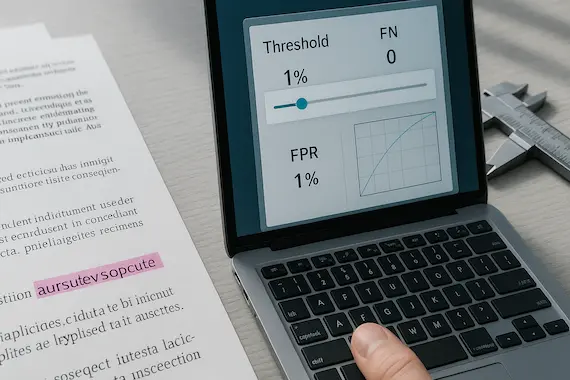
The heart of any review is accuracy. The independent audit compared detectors using area under the ROC curve and, more importantly, the real errors decision makers feel, false positives and false negatives. GPTZero delivers very low false positives on standard prose. In threshold sweeps across models, its false positive rate sits near 0.007, which is less than one percent, and it holds steady across conservative or loose cuts. Its false negative rate ranges from roughly 0.002 to 0.030 depending on model and threshold, so it is strong at catching typical AI text when you accept a modest false positive budget.
This is why many readers ask, is GPTZero accurate. For long and medium passages, the answer is yes, within the constraints above. For short text and adversarial rewrites, keep reading.
3.1 What Changed in 2026?
There is an important update to the original benchmark. GPTZero later argued that the 2025 study used its average_generated_prob API field rather than the class_probabilities field intended for document-level classification. GPTZero then reran the Chicago Booth benchmark with a newer version of its detector.
In that January 2026 rerun, GPTZero reported 99.5% overall accuracy, 99.3% recall, and a 0.05% false-positive rate. Pangram reached 99.1% accuracy with the same 0.05% false-positive rate. These results suggest that newer GPTZero versions may perform substantially better than the version represented in the original study.
There is an important evidence distinction, however. The 2025 NBER study is independent research; the 2026 re-evaluation was conducted and published by GPTZero itself. I therefore treat the newer numbers as useful vendor-reported evidence rather than replacing the independent NBER findings with them.
3.2 False Positives And False Negatives, A Quick Primer
False positives are human passages flagged as AI. You want them low. False negatives are AI passages missed. You also want them low. There is a tension, since tightening the cut to protect humans typically raises misses, and loosening it to catch more AI can accuse humans. The study reports both sides and also shows how each tool behaves when you fix a policy cap, for example an FPR at or below one percent, then let the vendor set an internal threshold that meets that cap. That frame lets you tune the detector to your environment rather than accept a default.
4. Head To Head, Pangram Vs OriginalityAI Vs GPTZero
A review that stops at features misses the point. You care about ranking. The audit’s headline will not surprise engineers. Pangram dominates on raw discrimination and policy-friendly error tradeoffs across models and genres. OriginalityAI is close on some metrics and behind on others. GPTZero forms a solid second tier with a consistent advantage on low false positives. This gptzero review treats the comparison as the core buyer question.
4.1 What The Numbers Say
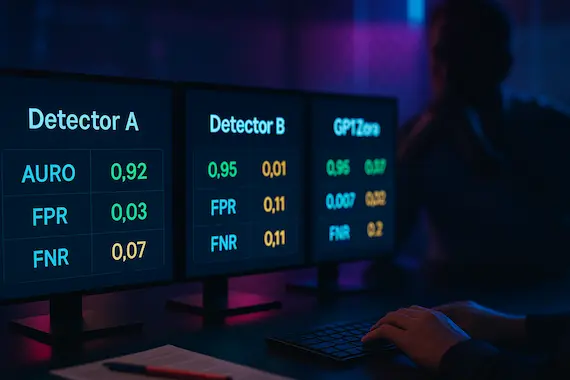
On medium to long passages, Pangram’s AUROC is essentially perfect and its errors are near zero in the sample. OriginalityAI is high, often around 0.99. GPTZero is also high, often just below that top tier. The more meaningful view appears when you map errors to stakes.
Table 1, Detector Snapshot From An Independent Benchmark
| Detector | Overall AUROC, Medium To Long | Typical FPR Range, Policy Friendly | Typical FNR Range, Policy Friendly | Robust To “Humanizers” | Short Texts, Under 50 Words | Notes |
|---|---|---|---|---|---|---|
| Pangram AI detector | ≈ 1.00 | ≈ 0.000 to 0.001 | ≈ 0.004 to 0.038 | Yes, low misses under Stealth-style rewrites | Strong for stubs | Consistent across models and genres |
| Originality AI | ≈ 0.99 | ≈ 0.001 to 0.003 | Can rise, up to double-digit percent on stricter cuts | Moderately robust, misses grow on short text | Limited by length filters on some stubs | Strong second, depends on model and genre |
| GPTZero | ≈ 0.96 to ≈ 1.00 | ≈ 0.007 | ≈ 0.002 to 0.030 | Degrades on “humanizers,” miss rates can spike | Good on many stubs, not all | Lowest FPR among the second tier |
Numbers summarized from the NBER audit across genres, models, and thresholds.
This is the part of the gptzero review where preferences matter. If your primary risk is false accusations, GPTZero’s stubbornly low FPR is attractive. If your priority is catching everything with policy-tight caps, Pangram’s ceiling is higher.
5. Short Texts, Stubs, And Humanizers
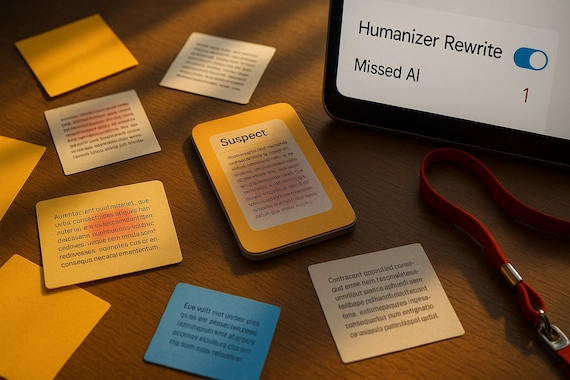
One more truth most gptzero review posts skip, performance changes on short passages and on adversarial rewrites. Many real workflows contain snippets, reviews, resumes, and chat fragments. In the study’s “stubs” analysis under 50 words, Pangram stayed conservative on false positives and kept false negatives low in most categories, with a few model-specific exceptions. GPTZero kept false positives low, yet missed more AI on certain short genres, especially news, where miss rates rose.
Now the tough one, “humanizers.” Tools that rewrite AI text to mimic human signals create the hardest case for any detector. Pangram remained surprisingly robust, with low misses even when passages were rewritten. In the 2025 NBER benchmark, GPTZero’s miss rate rose sharply under these rewrites, often landing around fifty percent across models and genres. OriginalityAI also lost ground, though not as severely. If your workflow will face rewritten content, plan accordingly.
6. Policy Caps, How Admins Should Set Thresholds
For a gptzero review aimed at admins, this is the most useful idea. Fix an acceptable false positive ceiling first, then compare tools on the resulting misses. Reasonable false positive caps, for example 0.5 to 1 percent, barely move Pangram’s miss rate. OriginalityAI and GPTZero degrade as the cap tightens, then recover once you relax the cap. This policy-cap framing is scale free and makes cross-tool comparisons fair. It also aligns the detector to your actual risk tolerance rather than a vendor default.
7. GPTZero Vs Turnitin, What Educators Need To Know
Educators search gptzero review posts for a Turnitin answer. Here is the straight talk. The independent benchmark evaluated Pangram, OriginalityAI, and GPTZero. It did not evaluate Turnitin. That means you cannot draw apples-to-apples claims about “GPTZero vs Turnitin” from that study. What you can say is practical. Dedicated AI detection tools tend to move faster than general plagiarism suites, they expose thresholds more clearly, and they often publish API options that let schools tune policy caps. If you use Turnitin for plagiarism and GPTZero for AI detection, treat them as complementary. Do not conflate their results.
8. GPTZero Pricing, Plans, Free Tier and API
Pricing is one of the most frequently searched parts of this GPTZero review. GPTZero has a free plan plus Essential, Premium, and Professional paid tiers. The annual plans are substantially cheaper than paying month to month.
Table 2, GPTZero Plans At A Glance
GPTZero Pricing & Plans at a Glance
Compare GPTZero’s free, Essential, Premium, and Professional plans, including monthly pricing, annual pricing, word limits, and key features.
| Plan | Monthly Billing | Annual Billing | Words / Month | Best For / Key Features |
|---|---|---|---|---|
| Free | $0 | $0 | 10,000 | Occasional AI detection and basic scanning for light personal use. |
| Essential | $14.99 per month | $8.33 per month, billed annually Lower annual rate | 150,000 | AI scanning, grammar tools, AI vocabulary checks, and Chrome extension access. |
| Premium | $23.99 per month | $12.99 per month, billed annually Lower annual rate | 300,000 | Everything in Essential plus advanced scans, writing feedback, plagiarism checking, and source and citation tools. |
| Professional | $45.99 per month | $24.99 per month, billed annually Lower annual rate | 500,000 | Everything in Premium plus batch workflows, page-level scanning, team features, enterprise security, and LMS-oriented tools. |
Teams can add seats and unify billing. There is also an API with tiered word allotments if you want to integrate detectors directly into a platform. This gptzero review focuses on accuracy first, yet value is not just sticker price. The independent study translated vendor fees into cost per true positive, the dollars you spend for each correctly caught AI passage. On that measure, Pangram was the cheapest on average. GPTZero was the priciest among the three. If you buy for scale and strict policy caps, this cost metric is the one to watch.
8.1 GPTZero API Pricing
GPTZero also offers an API for developers and organizations. Unlike its normal subscription prices, GPTZero does not currently expose a stable public table of API dollar tiers on its support pages. Its official documentation directs users to sign in to the GPTZero dashboard to view current API subscription pricing. Organizations requiring more than 5 million words per month are directed to contact GPTZero for custom arrangements.
For that reason, I would not hard-code an API price into this review unless it can be verified from the current GPTZero account dashboard.
9. Realistic Buying Advice
Here is the practical buying advice. If you want the conclusion supported by independent evidence, the 2025 NBER benchmark favored Pangram when false-positive limits were extremely strict and in the humanizer tests used in that study. GPTZero remains attractive for classrooms and editorial workflows because it combines a free tier, convenient browser and education workflows, and strong detection on conventional prose.
However, GPTZero’s newer 2026 self-run evaluation now reports its current detector slightly ahead of Pangram on the Chicago Booth benchmark. I would therefore no longer describe Pangram as simply “the safest bet today.” In a high-stakes environment, test the current versions of both tools on your own documents and use detector results as evidence to investigate, not as proof by themselves.
Engineers who want the best AI content detector for policy-heavy environments will gravitate toward Pangram. Editorial teams who live in the browser and want a practical, conservative signal will like GPTZero. Research groups that want a middle path will test OriginalityAI alongside one of the others. This gptzero review balances those tradeoffs so you can choose based on risk, not rhetoric.
10. How To Run Your Own Audit In One Afternoon
Run your own mini gptzero review before you pick a vendor.
10.1 Pick Samples That Look Like Your Work
Gather about one hundred human passages and one hundred AI passages that match your real use case. Mix long, medium, and short lengths. Include tricky genres like résumés or review stubs if those matter to you.
10.2 Set A False Positive Cap Up Front
Decide the maximum acceptable false positives. For many schools and publishers, one percent is a hard ceiling. Lock that in before you touch thresholds.
10.3 Measure Misses At Your Cap
Ask each tool to meet your FPR cap, then record the false negatives. That shows you which detector catches more AI at your acceptable risk level. This is the same policy-cap logic used in the independent audit.
10.4 Test Adversarial Rewrites
Run a batch of your AI passages through a humanizer rewrite and re-score. If you are in a high-stakes setting, this step is not optional.
10.5 Price It As Cost Per Correct Catch
Translate fees into cost per true positive. Now your budget matches your risk.
11. Limitations And What Changes Next
Any honest gptzero review should admit the obvious. Detection is an arms race. Models improve. Writers adapt. “Humanizers” evolve. The audit itself says results will shift over time and recommends routine, transparent re-tests. Treat your policy caps as dials, not one-time decisions, and keep a quarterly audit on the calendar.
12. Verdict And Call To Action
The verdict of this GPTZero review is more nuanced than a simple accuracy percentage. GPTZero performs strongly on conventional AI-generated prose, but results depend on text length, detector version, threshold, writing style, and whether the text has been edited or humanized. The independent 2025 NBER benchmark favored Pangram under the strictest policy caps, while GPTZero’s own 2026 re-evaluation reports that its newer detector has closed or reversed that gap on newer tests.
The practical conclusion is that GPTZero is a strong screening tool, not a standalone verdict on authorship. For schools, publishers, or organizations making consequential decisions, combine the detector score with other evidence and periodically re-test the current model on your own writing samples.
If this gptzero review helped you, run the one-afternoon audit above with your own data. Set a clear false positive cap. Measure misses at that cap. Price your winners as cost per correct catch. Then pick the detector that serves your risk, not someone else’s marketing. Share this gptzero review with your policy team so they can tune thresholds with a clear goal in mind. Bookmark this gptzero review and revisit it after your first quarter in production. Your readers, your students, and your future self will thank you.
Evidence source, NBER Working Paper 34223, “Artificial Writing and Automated Detection,” which evaluated Pangram, OriginalityAI, and GPTZero across genres, passage lengths, model families, policy caps, stubs, and humanizer rewrites.
1) Is GPTZero the best AI detector available?
No single tool is “best” for every case. Independent benchmarking puts Pangram slightly ahead on raw accuracy and strict false-positive caps, while GPTZero performs well and is popular with educators. Choose based on your tolerance for false positives, text length, and workflow.
2) How accurate is GPTZero at detecting AI content?
GPTZero is a high-performing AI detector, but there is no single accuracy percentage that applies to every type of writing. The independent 2025 NBER benchmark found low false-positive rates on typical prose but showed weaker performance than Pangram under some strict thresholds and humanizer tests. GPTZero’s own 2026 re-evaluation using a newer detector reported 99.5% accuracy and a 0.05% false-positive rate on the Chicago Booth benchmark. Because the newer evaluation was conducted by GPTZero, it is best viewed alongside rather than as a replacement for independent testing.
3) Does GPTZero really work against the latest models like GPT-5?
Yes, according to GPTZero’s own benchmarks. After training on GPT-5 family data, GPTZero reports 97 percent or better recall at a 1 percent false-positive rate on GPT-5 variants, which are vendor-reported results, not a third-party audit.
4) Is GPTZero more accurate than Turnitin for academic use?
There is no apples-to-apples independent study that compares them directly. GPTZero appears in recent third-party benchmarks, Turnitin does not. Turnitin’s guidance also says its AI indicator is not foolproof and should not be the sole basis for action, which is why many schools pair similarity checking with a dedicated detector.
5) What is a good alternative to GPTZero?
Pangram and OriginalityAI are the closest like-for-like alternatives. In recent independent testing, Pangram led on accuracy and robustness at strict false-positive caps, and OriginalityAI formed a strong second tier. Evaluate all three on your own corpus before deciding.
Is GPTZero free, and how much does GPTZero cost?
Yes. GPTZero has a free plan with up to 10,000 words per month. Paid plans currently start at $8.33 per month for Essential when billed annually, followed by Premium at $12.99 and Professional at $24.99 per month on annual billing. Monthly billing costs more. Because pricing can change, check the official GPTZero pricing page before subscribing.