Why a popcorn-serving machine in Hollywood might be the smartest move in the race for embodied intelligence.
Updated August 29, 2026
Tesla Optimus is not available to buy yet. As of August 2026, Tesla has decommissioned the Model S and Model X manufacturing lines at Fremont and is installing its first-generation Optimus production lines there. Tesla says production is anticipated later in 2026, with the first builds going to its internal Optimus Academy for training-data collection and further functionality development rather than to customers.
Tesla has also not announced an official retail price, preorder program or customer delivery date. Elon Musk has previously discussed a long-term Optimus price in the roughly $20,000–$30,000 range, but that is a future target at manufacturing scale, not a confirmed launch MSRP. In January 2026, Musk said Tesla could begin selling humanoid robots to the public by the end of 2027, conditional on achieving high reliability, high safety and a sufficiently broad range of functionality.
Prelude: A Robot Walks Into a Diner

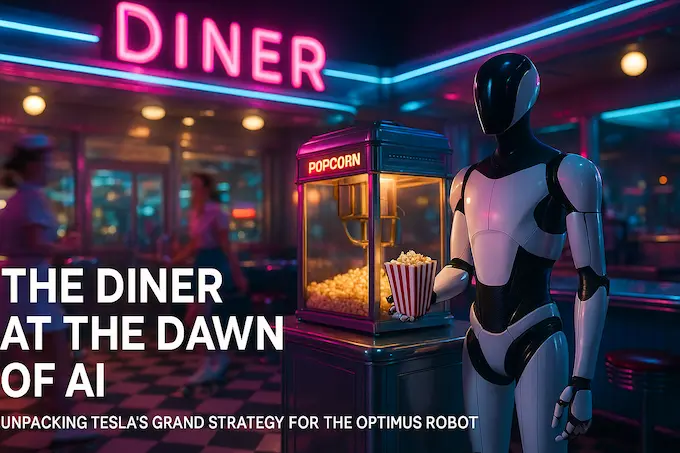
Neon washes over chrome, roller skates glide past booths, and a humanoid offers popcorn like it has been doing it forever. The Tesla robot didn’t debut on a sterile stage with a clicker and a slide deck. It clocked in at a diner. That choice tells you everything about Tesla’s strategy. Wrap the future in nostalgia, slip embodied AI into a place people already understand, and let real-world chaos start teaching the machine. The Tesla robot is not just performing, it’s learning in public.
People aren’t scared of servers. They know the script. You reach, it offers, the exchange happens. That choreography shrinks the risk of the uncanny valley. The Tesla robot stands there, white and black, mechanical face, friendly motion. No silicone cheeks. No attempt to fake a soul. It’s a confident, capable machine in a playful space. Acceptance follows familiarity, and the Hollywood Drive-In Diner is engineered familiarity with a neon halo. It turns Optimus into a character instead of a threat.
Hollywood is a clever backdrop. This is a narrative factory that turns moments into memes. The Tesla robot didn’t need another AI Day presentation. It needed selfies, short clips, commentary from people who came for burgers and left with robot lore. Elon Musk knows that mass adoption starts with soft landings, not technical proofs. The Tesla Optimus team didn’t just design joints. They staged a cultural handshake.
Table of Contents
Inside the Machine That Hands Out Snacks
Strip away the popcorn and you find serious engineering. The Tesla robot is built on the same DNA that drives Tesla’s cars. Vision-first neural networks. Custom silicon. Vertical integration. Optimus is being developed around Tesla’s broader autonomy playbook: vision-based AI, custom hardware, vertical integration and an increasingly end-to-end software stack.
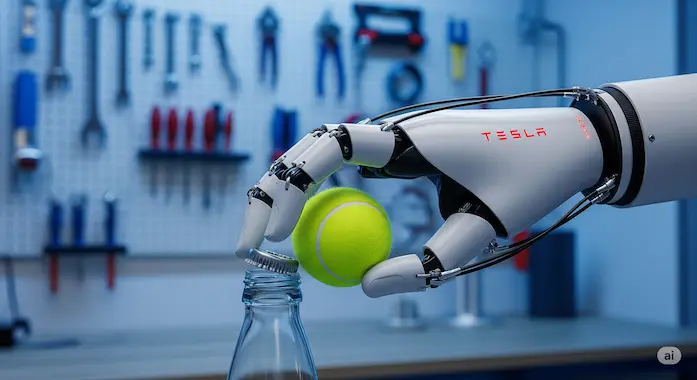
The hands took center stage in this generation. Twenty-two degrees of freedom per hand is not a press-friendly number, it’s a statement of dexterity. Motors moved to the forearm to lighten the fingers. Tendon-like cables route power and finesse where they matter. A robotic hand that can catch a tennis ball can twist a cap, flip a pancake, adjust a valve, or fold laundry. That breadth is the point. The Tesla robot isn’t built for one chore, it’s built for many.
Balance, stability, and self-calibration ride on cameras and embedded sensors. Like a self-driving car, the Tesla robot sees, decides, and acts within tight loops. No external supercomputer holding its hand during a shift. That constraint forces efficiency. Tesla’s hardware stack, from FSD boards to batteries, slides neatly into the robot’s body. It’s the same playbook, repurposed. Train on massive data. Iterate fast. Push software updates to the fleet.
The actuators inside each joint are Tesla-designed. Off-the-shelf wasn’t good enough. That choice adds cost now and slashes it later. Make your own muscles, tune them for your tasks, then build them by the thousand. Quiet electric servos handle the work. Hydraulics roar and leak. Servos whisper and persist. The Tesla robot needs to operate around people without sounding like a jackhammer. That’s not just comfort, it’s safety. People flinch when machines scream. They relax when the hum blends into the soundtrack.
Tesla Robot Price, Release Date and Availability
The two questions surrounding Optimus are simple: how much will the Tesla robot cost, and when will it actually be available? As of August 2026, neither has a final commercial answer. Tesla has not announced an MSRP, opened reservations or provided a firm customer delivery schedule for Optimus.
What Tesla has confirmed is the manufacturing roadmap. In its Q2 2026 update, the company said it had decommissioned the Model S and Model X lines at Fremont and was installing the first-generation production lines for Optimus. Tesla expects production to begin in 2026, but the initial robots are intended for its Optimus Academy, where they will be used for training-data collection and further functionality development. Tesla is also constructing Optimus manufacturing capacity at Gigafactory Texas.
The widely quoted $20,000–$30,000 Tesla robot price is a long-term target rather than an announced launch price. Musk has argued that Optimus can become inexpensive once production reaches very high volumes, but the eventual selling price will depend on manufacturing scale and market demand. For consumers, Musk said at the World Economic Forum in January 2026 that Tesla could begin selling humanoid robots to the public by the end of 2027, provided Optimus first achieves very high reliability, safety and useful functionality. That makes end-2027 a target, not a guaranteed Tesla Optimus release date.
Three Visions of the Humanoid Future
Tesla isn’t alone. Three philosophies dominate the humanoid robot arena right now, and they couldn’t be more distinct.
Tesla: The Scale-First Pragmatist
The Tesla robot is designed for the middle of the bell curve. Not glamorous. Not extreme. Just useful, affordable, and trainable. Tesla Optimus skips backflips and focuses on the tasks that actually pay rent: lifting, carrying, grasping, queuing, interacting with humans without scaring them. The advantage is a tight loop of data, design, and deployment. The risk is that general usefulness is the hardest corner to cut. Fail there and you lose the mass market you aimed for.
Boston Dynamics: The Athletic Virtuoso
Boston Dynamics Atlas is a marvel. It flips, runs, jumps, rotates at the waist like a cat, then stands up with elegance. The new electric Atlas sheds hydraulics for industry readiness, yet the focus remains performance. Atlas is built to tackle jobs where agility and strength outweigh cost. It will start in Hyundai factories, where complexity and load matter. Atlas won’t be cheap. It might not need to be. If you need a robotic athlete for hazardous zones or dynamic assembly lines, you pay for capability. The catch: scaling to millions is tough when each unit is a masterpiece.
NVIDIA: The Brain Merchant
NVIDIA GR00T sits on the other axis. It’s a foundation model for humanoid robots, a shared brain any hardware maker can load. Instead of one body with one mind, GR00T aims to be the mind for many bodies. NVIDIA sells the chips, the models, and the development stack. If a hundred startups ship humanoids using GR00T, NVIDIA wins on volume without touching sheet metal. This strategy bets that embodied AI will need a common OS. The Tesla robot runs Tesla’s proprietary stack. Atlas runs Boston Dynamics’ internal software. GR00T wants to be the Android of bipedal bodies. It’s a bet on breadth over depth.
These approaches will collide and cross-pollinate. You might see a future where a Tesla-like body runs GR00T-style models tuned by Boston Dynamics-grade control systems. For now, each company plays to its strengths. The Tesla robot centers on data and manufacturing. Atlas centers on mechanics. GR00T centers on intelligence as a service.
The Diner as a Data Siphon
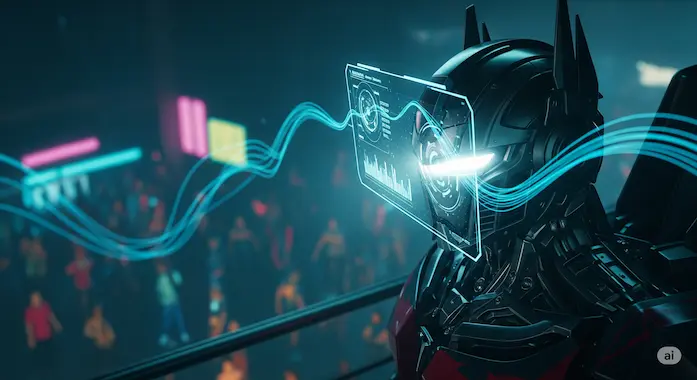
The Hollywood diner is a goldmine. Tesla didn’t put Optimus there only to trend on TikTok. It put the Tesla robot in a chaotic social scene because no simulation captures what a four-year-old with sticky fingers does to your model. Each shift logs thousands of interactions. Cameras record angles, gestures, lighting quirks. Force sensors feel odd grabs and near drops. The Tesla robot brain eats that stream and software engineers feed it back into training runs.
This is a data moat. Waymo geofenced its cars and collected perfect data in a sandbox. Tesla threw Autopilot at the world and learned from every mistake. It’s repeating the pattern. While competitors hold their humanoid robots close, the Tesla robot quietly accrues live experience. You can’t buy that shortcut. You need bodies in the field, making errors, getting patched, and trying again.
A robot that serves popcorn learns grasp stability, timing, social cues, and crowd flow. Upgrade the task and the same lessons apply. Now it’s stocking shelves. Now it’s handing medication. Now it’s lifting heavy parts on a line. The Tesla robot cost goes down as reliability goes up. That only happens if the model sees the weird edges. The diner supplies those edges in spades.
Ethics, Jobs, and the Quiet Friction Ahead
Put enough Tesla robots into public spaces and you collide with policy, labor, and liability. The Tesla robot release date for consumers invites uncomfortable questions. Who’s responsible if a humanoid bumps someone off a ladder? How is on-robot video stored and audited? Which jurisdictions classify a service robot as an “employee”? The moment the Tesla robot price makes it a realistic buy for small businesses, you get an avalanche of regulation. Tesla will need answers, not slogans.
Then there’s labor displacement. The official line says the Tesla robot will handle dangerous, repetitive, boring work. That’s true and incomplete. Any technology that cuts cost reshapes job markets. People don’t vanish. They shift roles. The friction is real. Unions will push back. Governments will debate tax policy for robotic labor. Tesla will need the same deft mix of narrative control and engineering that it used to shift climate debates around EVs. The Tesla robot must be seen as an enabler, not an eraser.
Ethics also extend to AI behavior. The Tesla robot is powered by massive models trained on human data. Bias, safety, misuse, all show up in embodied form. A misaligned chatbot is annoying. A misaligned robot can be dangerous. Tesla’s choice to roll out in controlled venues first is smart. It lets them build safety layers before a bot walks into your living room beside your toddler and your dog.
Two Snapshots in Table Form
Table 1: Philosophical Split in Humanoid Robotics
Tesla Robot vs Atlas, Digit and NVIDIA GR00T
How Tesla Optimus compares with Boston Dynamics Atlas, Agility Robotics Digit and NVIDIA’s humanoid AI platform across strategy, strengths, limitations and near-term use cases.
| Robot / Platform | Core Strategy | Strengths | Current Limitations | Near-Term Use Cases |
|---|---|---|---|---|
Tesla Optimus
Production Buildout
| Scale-first, vertically integrated humanoid designed around Tesla’s real-world AI, manufacturing and autonomy stack. | Mass-production ambitions, in-house hardware and software, access to Tesla manufacturing infrastructure and a data-driven development strategy. | Not commercially available yet. First-generation production lines are being installed and initial builds are intended primarily for Tesla’s internal Optimus Academy. | Internal training and data collection, factory support, material handling and repetitive industrial work. |
Boston Dynamics Atlas
2026 Deployments
| Build a highly capable industrial humanoid around mobility, manipulation and robustness. | Advanced whole-body movement, strong manipulation research, mature robotics engineering and industrial backing from Hyundai. | 2026 deployments remain limited to selected partners, and public pricing or broad commercial availability has not been announced. | Automotive manufacturing, complex material handling, industrial manipulation and physically demanding workflows. |
Agility Robotics Digit
Commercially Deployed
| Solve practical logistics and manufacturing tasks first, using a humanoid form that fits into existing human workspaces. | Proven commercial deployment, more than 100,000 tote movements in a live GXO operation, and a Robots-as-a-Service model for enterprise customers. | Current deployments emphasize industrial and logistics workflows rather than the broad household-assistant vision Tesla has outlined for Optimus. | Tote handling, warehouse logistics, manufacturing support, material movement and repetitive industrial tasks. |
NVIDIA Isaac GR00T
AI Platform
| Provide AI models, simulation, compute and development tools that can power humanoid robots from many manufacturers. | Broad robotics ecosystem, vision-language-action models, simulation infrastructure, Jetson compute and an end-to-end humanoid development platform. | GR00T is primarily a robotics AI platform rather than one vertically integrated mass-market humanoid, so real-world performance depends heavily on partner hardware and deployment. | Humanoid model training, manipulation policies, simulation, robot learning and AI deployment across third-party platforms. |
Table 2: Tesla robot Price and Release Roadmap
Tesla Robot Release Date, Price and Availability
The latest Optimus production roadmap, consumer availability target and long-term Tesla robot price goal.
| Milestone | Latest Status | Timing | What It Means |
|---|---|---|---|
Public Availability
Current Status
| Optimus is not currently for sale. Tesla has not opened an official preorder, reservation or deposit program. | August 2026 | Consumers cannot currently order a Tesla robot, and no firm customer delivery date has been announced. |
Fremont Production
Production Buildout
| Tesla is installing its first-generation Optimus production lines after decommissioning the Model S and Model X lines. | Production anticipated in 2026 | Initial robots are intended for Tesla’s internal Optimus Academy for training-data collection and further functionality development. |
Gigafactory Texas
Capacity Expansion
| Tesla is also developing Optimus manufacturing capacity in Texas . | No customer release date announced | Tesla is preparing for much larger manufacturing scale, but factory construction should not be confused with public Optimus availability. |
Consumer Availability
Musk Target
| Elon Musk has said public sales could begin once Optimus achieves sufficiently high reliability, safety and functionality . | Target: by end of 2027 | End-2027 is a target rather than a guaranteed Tesla Optimus release date. Timing can change as development and validation continue. |
Tesla Robot Price
Long-Term Goal
| Tesla has not announced an official MSRP . Musk has discussed a future price of roughly $20,000–$30,000 at manufacturing scale. | No confirmed launch price | The widely quoted $20K–$30K figure is a long-term Tesla robot price target, not the price consumers can pay today. |
What Matters After the Buzz
The Tesla robot doesn’t have to thrill you forever. It just has to fade into your mental furniture. The moment your brain files it under “normal” is the moment Tesla wins. The diner was about reaching that moment faster. The Tesla robot took a human space and played by human rules until people shrugged and said “cool” instead of “yikes.” That shrug is priceless.
From there, the game becomes boring in the best way. How many hours can a Tesla robot work without maintenance. How quickly do its models adapt to a new task. How low does the Tesla robot cost drop when you stamp out actuator number 10,000. How do you insure a humanoid. How do you push OTA updates that tweak grip strength without dropping plates. The future of humanoid robots will be paved with questions that feel more like operations than magic.
That’s where Tesla’s genes matter. The company loves repetition, automation, and dashboards that shout at engineers. The Tesla robot is a natural extension of that obsession. You track fault codes on elbows like you track battery failures in a fleet. You run weekly model improvements. You treat humans and robots as nodes in a system, then keep tuning the system.
There’s a philosophical angle here too. Embodied AI changes how people perceive intelligence. A chatbot is brain-in-a-jar. A humanoid is a brain with a body. Body changes everything. The Tesla robot in a diner isn’t smart because it talks about feelings. It’s “smart” because it anticipates a hand-off, adjusts grip, and doesn’t bump a chair. Intelligence starts to look like graceful action under sensory uncertainty. That shift will ripple back into how we design AI. We’ll care less about word games and more about contact dynamics on slippery floors.
Closing Thoughts Without Saying “In Conclusion”
The Tesla robot walked into a diner and the internet lost a few cycles. That’s the shiny part. The real story is underneath. A company with a proven taste for scale is turning humanoid robots into a product line early, messy, and in front of everyone. The Tesla robot price is audacious. The Tesla robot release date is aggressive. The bet is that the first mover with a huge data advantage will lock in a lead that pure performance or pure software can’t catch.
Boston Dynamics will keep wowing engineers. NVIDIA will keep arming the industry with brains. Tesla will keep rolling out units, collecting data, and telling a story people want to hear. You can already feel the shift. The Tesla robot is no longer a press-render. It handed out popcorn. It did a peace sign. It returned to a charging dock. It learned a few things. Tomorrow it learns a few more.
Whether you cheer for it or not, the machine is already working the night shift. And it’s not alone. Humanoid robots are about to leave labs in numbers. The first one you meet might offer you a snack. The second might stock your warehouse. The third might clean your hall at 3 a.m. The Tesla robot simply got there first with a smile and a bag of popcorn. The rest of the story now depends on how fast it can learn, how low the Tesla robot cost can drop, and how smoothly it can walk from novelty to necessity.
Azmat — Founder of Binary Verse AI | Tech Explorer and Observer of the Machine Mind Revolution.
Looking for the smartest AI models ranked by real benchmarks? Explore our AI IQ Test 2025 results to see how today’s top models stack up. Stay updated with our Weekly AI News Roundup, where we break down the latest breakthroughs, product launches, and controversies. Don’t miss our in-depth Grok 4 Review, a critical look at xAI’s most ambitious model to date.
For questions or feedback, feel free to contact us or browse more insights on BinaryVerseAI.com.
- Business Insider – Tesla Diner Grand Opening
- iMotions – The Uncanny Valley
- InvestorPlace – Optimus in Action
- Wired – Tesla Diner and the Future
- Times of India – Tesla Optimus Popcorn
- InsideEVs – Optimus Robot Tasks
- Robots Guide – Tesla Optimus
- CyberNews – Optimus Hand Upgrade
- WebProNews – Optimus Gen 3 Hands
- Teslarati – Optimus Hand Upgrade
- InsideEVs – Limited Optimus Units
- Fox Business – Billion Robots Projection
- IEEE Spectrum – Expert Critiques
- Teslarati – Pilot Production
- Business Insider – Musk on AI Robots
- TechCrunch – Boston Dynamics Electric Atlas
- IEEE Spectrum – NVIDIA GR00T
- Electrek – Tesla Teleoperated Robot Fail
What is the Tesla robot release date?
Tesla has not announced one single public release date for Optimus. As of August 2026, Tesla is installing its first-generation Optimus production lines at Fremont and says production is anticipated later in 2026. The first builds are intended for Tesla’s internal Optimus Academy rather than consumers. Elon Musk has said Tesla could begin selling humanoid robots to the public by the end of 2027 if Optimus reaches sufficiently high levels of reliability, safety and functionality.
How much is the Tesla robot?
Tesla has not announced an official retail price for Optimus. Elon Musk has discussed a long-term price target of roughly $20,000 to $30,000 once Optimus reaches large-scale manufacturing, but that should not be treated as its confirmed launch price. The eventual selling price will depend on production costs, manufacturing volume and market demand.
When can I buy a Tesla robot?
You cannot currently buy or preorder Tesla Optimus. Tesla’s 2026 production plans are focused first on internal robots for training and development. Elon Musk has said public sales could begin by the end of 2027, but Tesla has not announced a consumer order date, reservation system or delivery schedule.
What is the Tesla robot used for?
The Tesla robot, Optimus, is designed to handle “dangerous, repetitive, and boring” tasks, starting with simple service roles. Its current capabilities include walking, balancing, and performing basic manipulation tasks like handing out objects, sorting items by color, and self-calibrating its limbs using computer vision. In the future, Tesla envisions Optimus working in factories, warehouses, retail, and eventually private homes. Long-term applications may include caregiving, domestic chores, and even personal assistance. The robot’s hardware and software are engineered to learn and adapt, allowing it to eventually perform any task a human can, within reason.
What is the official name of the Tesla robot?
Tesla’s humanoid robot is officially named Tesla Optimus, though it’s often informally referred to as the Tesla Bot. The name “Optimus” is a nod to the iconic leader of the Autobots from the Transformers franchise. Tesla has consistently used “Optimus” in product demos, press releases, and engineering updates to refer to the robot.
How does Tesla’s Optimus compare to other humanoid robots?
Tesla Optimus takes a different approach compared to rivals. Unlike Boston Dynamics’ Atlas, which focuses on high-performance agility and gymnastic feats, Tesla is prioritizing scale, affordability, and general-purpose utility. Optimus is not designed to do backflips, it’s built to handle everyday tasks reliably and safely. On the other end of the spectrum is NVIDIA’s GR00T, a foundation model for humanoid robotics. Instead of building physical robots, NVIDIA provides AI brains that power a wide ecosystem of robot platforms. Tesla, by contrast, controls both the hardware and software stack, enabling tight integration and faster iteration. In short, Tesla Optimus aims to be the first mass-market humanoid robot, while Atlas showcases elite physical capability and GR00T supplies intelligence as a platform.
Is it possible to pre-order the Tesla robot?
No. As of August 2026, Tesla has not opened an official preorder, reservation or deposit program for Optimus. While many are eager to get in line, the company is still refining the product for internal and enterprise use. Until the Tesla robot release date for consumers gets closer, and Tesla officially announces availability, there is no legitimate way to place a pre-order. Any websites claiming to offer early reservations should be treated with caution.