Debate around AI and mathematics has mostly centered on whether models can solve olympiad problems, formalize proofs, or assist mathematicians. The Station asks a harder question: can AI agents behave less like answer machines and more like a research community?
The new evidence is unusually strong. In Autonomous Mathematical Discovery in an Open-World Multi-Agent Environment, Stephen Chung, Wenyu Du, and William J. Wesley report a system where six AI research agents choose their own directions, run experiments, communicate, publish papers, review one another’s work, and build on an internal literature. Across 12 construction problems drawn from the AlphaEvolve study, five runs produced results the authors report as novel relative to prior literature. The agents also contributed new results in Book Ramsey numbers and independently reconstructed a recent Jacobian Conjecture counterexample.
So, can AI discover new mathematics? In this controlled environment, the answer is increasingly yes. But The Station does not show that AI can replace mathematicians or reliably exercise expert taste. It shows something narrower: autonomous mathematical discovery can emerge from persistent knowledge, model diversity, open-ended exploration, and independent verification.
Table of Contents
1. What The Station Actually Did
The Station is not a single model asked to “solve this problem.” It is an environment designed to let AI research agents behave like independent researchers. A standard run starts with two GPT-5.5 agents, two Claude Opus 4.8 agents, and two Gemini 3.1 Pro agents. They receive a task statement, an evaluator, and a simple baseline. In most experiments they have no web access, no supplied literature review, and no external expert directing their research path. Runs typically last one to two weeks of continuous wall-clock time.
AI and Mathematics: Key Facts About The Station’s Research System
| Key Fact | What It Means |
|---|---|
| 6 agents from 3 model families | The system tests collaborative discovery, not one-model performance. |
| 12 AlphaEvolve construction problems | The tasks span geometry, analysis, combinatorics, and number theory. |
| 5 problems with novel results | The authors report new literature-level constructions or bounds. |
| Shared reviewed paper archive | Agents can publish, cite, criticize, and extend earlier work. |
| Formal verification | Presented discoveries are backed by exact constructions or Lean-verified proofs. |
| Open research traces | Code, agent dialogues, papers, and verification artifacts are released. |
The most useful way to understand the result is to look at what changed mathematically, not just how many tokens or agents were involved.
AI and Mathematics: The Station’s Most Important Mathematical Discoveries
| Problem | Earlier Reference Point | Station Result | Why It Matters |
|---|---|---|---|
| Finite-field Kakeya | Earlier AlphaEvolve infinite family | Improved infinite family for primes p ≡ 3 (mod 4) | General theorem, not only a finite score. |
| Kissing number in dimension 11 | AlphaEvolve: 593 | 604 points | Three exact configurations, two apparently new isometry classes. |
| Discretized Kakeya needle | 0.109148 later benchmark | 0.107067 | New upper bound. |
| Sign uncertainty | 0.3102 human-announced value | 0.3089 | New reported record. |
| Erdős minimum overlap | Lower bound 0.37912 | 0.380552 | Closed about 82% of the published gap. |
| Book Ramsey numbers | Multiple open cases | New infinite families | 28 previously open cases resolved for n ≤ 200. |
The paper reports that, among the seven AlphaEvolve tasks without novel literature results, the Station beat AlphaEvolve on three, tied on two, and lost on two. That balance matters. This is not a story where one agent architecture dominates every kind of mathematics.
2. Why This Is More Than a Better Math Solver
A normal math system takes a problem and returns an answer. The Station uses a different unit of work.
An agent can choose a direction, test an idea, write a paper, revise after rejection, read another agent’s result, or build a theorem on earlier work. Accepted papers persist in an Archive Room as a miniature scientific literature. In one kissing-number run, 125 papers accumulated with 923 citation links, and 55 accepted papers had been rejected at least once before publication.
That architecture is the real contribution to AI and mathematics. The agents aren’t only sharing raw logs or passing tasks through a rigid pipeline. They’re creating durable abstractions that later agents can reuse.
This also helps explain why some discoveries arrived late. Of 28 findings analyzed by the authors, 21 depended on earlier Station papers, and 13 emerged after tick 1,000. In other words, accumulated research history was not decorative memory. It often became part of the causal path to a result.
3. The 604-Point Kissing Number Result Is the Clearest Test
The eleven-dimensional kissing-number result is the easiest place to see the difference between brute optimization and mathematical discovery.
A kissing-number problem asks how many equal, non-overlapping spheres can touch a central sphere of the same size. In dimension 11, AlphaEvolve had improved a known lower bound from 592 to 593. The Station produced three exact 604-point configurations. One matched an independently reported concurrent construction, while two appear to define previously unknown isometry classes.
The important part is not only 593 to 604.
The agents initially searched computationally, but then analyzed the structure of promising configurations. One route reduced the problem to a finite compatibility search around a structured integer core. Later, the agents turned one 604-point solution into an explicit algebraic construction that generates the points without computer search. The paper contrasts this with AlphaEvolve’s 593-point solution, whose irregular coordinates did not expose an equally compact structure.
That addresses a fair objection to “AI discovers new mathematics.” If the system only finds a larger numerical object through enormous search, the result may be useful without feeling like mathematics in the usual explanatory sense. Here, the system did both: it found a better construction and extracted structure from it.
4. Was the Discovery Really Autonomous?
“Autonomous” is doing a lot of work in this story, so it needs a precise definition.
The researchers selected the problems, built the Station, provided the evaluator and baseline, and later checked validity and novelty. That is real human involvement. But during the main AlphaEvolve experiments, agents generally received no web access, no external literature survey, and no expert guidance about which research direction to pursue. The paper says the authors’ post-run role for the main new results was limited to checking proofs and novelty.
That makes this autonomous mathematical discovery, but not human-free mathematics.
The distinction is important because autonomy here describes the research process inside a prepared environment. Humans still define the world in which the agents operate. A good analogy is an automated laboratory: the experiment can be self-directed after launch even though people designed the equipment, chose the broad question, and inspect the result.
5. Why Multiple Model Families Seem to Matter
The Station’s six-agent setup is not just a way to spend more compute. The authors analyzed 28 selected findings and found that 19 involved more than one agent. Thirteen involved more than one model family. Only nine were attributed to a single agent working alone.
The models did not contribute identical things. In the finite-field Kakeya result, Gemini introduced a construction, GPT narrowed the parameter choices, and Claude used the accumulated work to derive an exact size and prove validity for every odd prime.
This is a stronger case for AI agents mathematics than “six copies of the same model are better than one.” The Station is betting that different model families bring different research habits, blind spots, and strengths.
6. The Ablation Tests Make the Multi-Agent Claim More Convincing
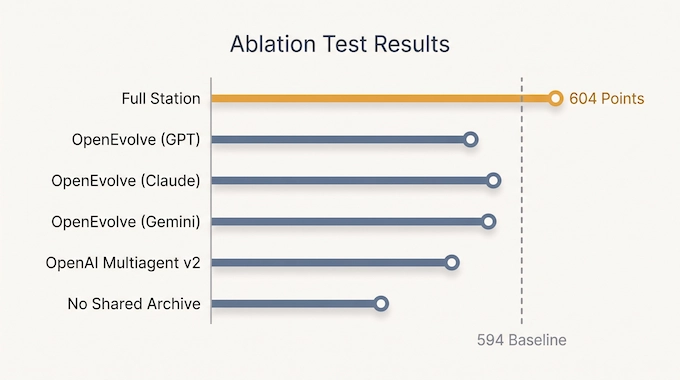
The paper does something many agent demos skip: it removes parts of the system and checks what breaks.
On the eleven-dimensional kissing-number task, the researchers compared the full Station with OpenEvolve powered by each of the three model families, OpenAI multiagent v2, a Station using only Claude agents, and a Station without the shared paper archive. Under a matched budget of 8,000 cumulative evaluator minutes, none of the 12 baseline runs produced a valid 594-point configuration. All three full Station seeds reached 604. Removing the archive or replacing model diversity with six Claude agents also sharply reduced performance.
That doesn’t prove the architecture will win on every task. It does support a narrower claim: for this structured discovery problem, persistent scientific knowledge plus diverse decentralized exploration mattered.
The Station was also reproducible at the result level. Three independent runs without web access eventually reached 604, though they took different routes and different amounts of time. Same destination, different research trajectories.
7. Why AI “Holidays” Helped
One of the paper’s strangest design choices is also one of its most memorable.
During the final two ticks of each ten-tick period, agents enter a “holiday.” They cannot submit normal experiments or archive papers. Instead, they receive prompts encouraging broader reflection, alternative interpretations, metaphors, and ideas from other fields. The Station also has a stagnation protocol that pushes agents to revisit assumptions when progress stalls.
The authors judged holidays to have contributed directly or indirectly to 23 of the 28 analyzed findings. Archive papers contributed to 21.
The models are not getting tired or inspired in a human sense. An AI “holiday” is a prompting mechanism that interrupts local optimization and pushes search into a different conceptual neighborhood. For builders of AI research agents, the lesson is simple: more inference is not always the same as better exploration.
8. Is This Creativity or Sophisticated Recombination?
The paper supports three claims at different confidence levels.
- First, novel mathematical output is supported. The authors report new constructions, bounds, and infinite families, with released verification artifacts.
- Second, autonomous exploration is substantially supported within the Station environment. Agents chose directions and produced results that were not always directly rewarded by the evaluator. Of the 28 selected findings, 12 were neither scored nor requested in the task.
- Third, human-like creativity is not established.
Whether such behavior counts as “creativity” is partly philosophical. The more useful technical question is whether the system can generate new, valid, explanatory mathematics that experts did not hand it.
On that narrower test, The Station AI has meaningful evidence in its favor.
9. Can We Trust AI-Discovered Mathematics?
The right standard is not whether an LLM sounds confident. It is whether the final object can be checked without trusting the narration.
The paper says all presented discoveries are supported by exact constructions or proofs formally verified in Lean, and the authors released source code, full dialogues, papers, and verification code.
Hallucination still exists. The Station’s own review system rejected submissions for overstated claims, missing references, incomplete manuscripts, and factual errors. A research system can be unreliable at the language-model layer while still producing outputs that pass independent mathematical verification.
For AI and mathematics, this separation may be more important than trying to make every intermediate sentence perfectly trustworthy. Discovery can be probabilistic. Acceptance should be exact.
10. The Station vs AlphaEvolve
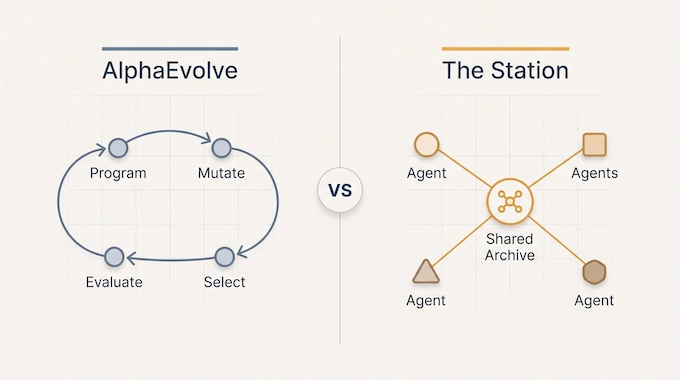
The comparison with AlphaEvolve is useful because the two systems optimize different things.
AlphaEvolve uses an evolutionary program-search pipeline. Earlier programs are selected, modified, evaluated, and reused. That can be extremely effective when the target is a hard numerical optimization problem with irregular solutions.
The Station is closer to a decentralized research ecosystem. Its agents can pursue theory, prove obstructions, explain structures, and publish results that are not directly reflected in the evaluator score. The authors argue that this theory-guided style helped on problems such as the kissing number and finite-field Kakeya.
But The Station did not universally beat AlphaEvolve. It underperformed on peak and flat autoconvolution, where long-running heuristic optimization of irregular objects appears to be a better fit.
The lesson is not “agents beat evolution.” AI and mathematics may need different architectures for different mathematical landscapes. Search-heavy and structure-heavy problems reward different machinery.
11. Where The Station Still Falls Short of Mathematicians
The strongest reason not to overhype this paper is that the authors document the system’s weaknesses themselves.
They identify four recurring limitations:
- weak expert intuition,
- narrow research tastes within the same model family,
- limited ability to absorb an ever-growing internal literature,
- and “attractor traps” where agents spend too much effort on locally rewarding but scientifically unimportant work.
The authors say substantial gaps remain between the agents and human experts on all four dimensions, and suggest that lightweight expert guidance could improve the system.
The Book Ramsey case makes that limitation concrete. Station agents discovered two new infinite families autonomously. They also had the finite examples and an earlier identity needed for a third family, but failed to connect them. An external expert recognized the shared Yamada-Pott structure and completed the synthesis.
That is a good snapshot of where human mathematicians still add unusual value: not only proving things, but noticing which pieces belong together.
12. What This Changes for AI and Mathematics
The Station does not settle the future of mathematics, but it moves the line.
We now have evidence that a group of AI research agents can do more than answer supplied questions. They can accumulate a literature, pursue unscored ideas, produce new mathematical objects and bounds, rediscover known structure independently, and turn computational findings into explicit theorems or constructions.
At the same time, AI and mathematics is not at the “replace the mathematician” stage. The system still depends on problem selection, evaluators, verification infrastructure, and human judgment about significance. It can miss connections an expert sees quickly, wander into unproductive attractors, and perform worse than specialized search systems on problems that reward raw optimization.
The most credible near-term picture is collaborative. AI systems can explore more branches, preserve intermediate work, and surface candidates worth human attention. Mathematicians can supply taste, context, synthesis, and judgment.
That division of labor is already more consequential than another benchmark score.
Binary Verse AI will keep tracking the systems that move AI from solving problems to doing research, with the verification details and limitations left intact. If you care about where autonomous mathematical discovery is actually working, and where the demos still outrun the evidence, follow our next deep dive.
1. Can AI discover new mathematics?
Yes, AI systems can now produce mathematical results that appear novel relative to existing literature. In The Station experiments, AI agents produced novel results on five of 12 problems drawn from the AlphaEvolve catalogue, including new Kakeya constructions, 604-point kissing configurations in 11 dimensions, improved bounds and additional Book Ramsey families. However, this does not establish that AI possesses human-like mathematical creativity or can conduct all mathematical research independently.
2. Has AI solved any previously unsolved math problems?
Yes, although “solved” needs qualification. The Station established new bounds, constructions and infinite families for several open mathematical problems. For example, its Book Ramsey families resolved 28 previously open cases for n ≤ 200, while its Erdős minimum-overlap result closed roughly 82% of a previously open gap rather than completely solving that problem.
3. How were The Station’s AI-generated mathematical discoveries verified?
The final discoveries were not accepted merely because an LLM said they were correct. The researchers provide exact constructions or proofs, with the presented discoveries formally verified in Lean where applicable, along with verification code, agent papers and research dialogues. This separates mathematical correctness from the reliability of an LLM’s prose explanation.
4. Is The Station better than AlphaEvolve at discovering mathematics?
Not universally. The Station achieved stronger results on several problems where theory-guided reasoning and interpretable structures were useful, including the 11-dimensional kissing-number task. AlphaEvolve performed better on some irregular numerical-optimization problems. The two systems therefore appear suited to different kinds of mathematical search rather than one simply replacing the other.
5. Will AI replace mathematicians?
Current evidence does not justify that conclusion. The Station still showed weak expert intuition, limited ability to connect some accumulated ideas, narrow research tastes and tendencies to waste effort on unproductive directions. Human experts also remained important for checking novelty and, in one Book Ramsey result, recognizing a connection that the agents themselves missed.