
The headline is simple. An advanced version of Google’s Gemini 2.5 Deep Think hit gold-medal performance at the International Collegiate Programming Contest, the Olympics of algorithmic programming. If you care about Gemini coding, this is the moment you bookmark. It is not a demo reel. It is five hours, a brutal scoreboard, and judged submissions that either pass or fail. No partial credit. No vibes.
So here is the real question. Is this the ChatGPT moment for hard reasoning, the point where Gemini coding moves from autocomplete to a competitive problem solver that invents plans under pressure and gets them right? In this piece I will unpack what happened, why the ICPC is different from benchmarks, and how the win changes the arc of Gemini coding for developers, researchers, and teams that build real systems.
Table of Contents
1. Why The International Collegiate Programming Contest Matters
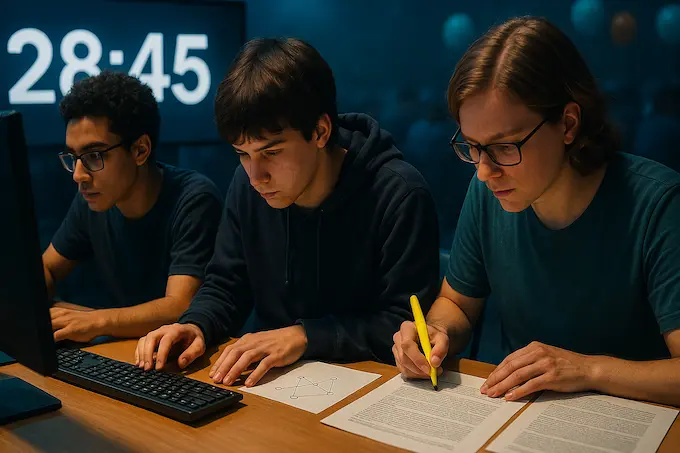
The International Collegiate Programming Contest is the longest running, most prestigious arena for algorithmic problem solving at the university level. Teams of three share one computer, work under a fixed time limit, and are ranked by problems solved, then by total time with penalties. Only perfect solutions score. That rule is the soul of ICPC. It rewards clarity, correctness, and the discipline to prune bad ideas quickly.
Think of the problems as pressure-tested slices of computer science. Dynamic programming, graph theory, combinatorics, computational geometry, number theory, string algorithms. Each task masquerades as a story about trains, flows, grids, or factories. Under the hood, it tests how fast you can translate that story into the right data structures and a plan that terminates within strict limits. This is the stage where talk stops and engineering begins.
2. What Exactly Happened, And Why It Matters
Gemini started ten minutes after the humans. It solved eight problems in the first forty-five minutes, then two more within three hours, for a total of ten out of twelve. On time and penalty scoring, that performance maps to a second-place finish against the world’s best teams. More importantly, it produced a correct solution for Problem C, which no university team solved during the contest window.
If you follow Google DeepMind news, you saw the splash. Strip away the marketing and you still have a solid result that transfers to practice. The ICPC format forces end-to-end thinking. Parse the problem, derive a plan, code it, test it, fix corner cases, resubmit, all within minutes. That loop is the working definition of Gemini coding under pressure. For people shipping software, that is the part that matters.
3. Inside The “Impossible” Problem C
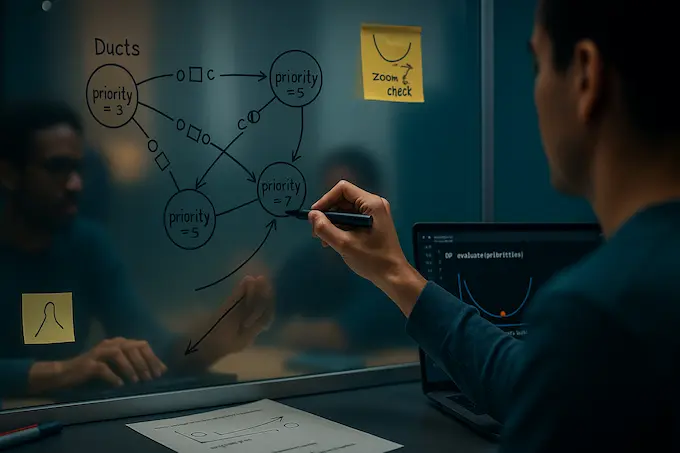
Problem C reads like a civil-engineering riddle. You have a network of ducts feeding reservoirs. Each duct can be closed, open, or partially open. The goal is to choose settings that fill all reservoirs as quickly as possible. The space of settings is continuous and huge. We need a way to search it that does not explode.
The key insight is to flip the perspective. Assign each reservoir a priority value that expresses how much it should be favored. Given a fixed set of priorities, a dynamic program can compute the best duct configuration for that priority assignment. Now bring in the minimax viewpoint. We want priorities that make the resulting flow most constrained, because solving that hardest case implies we can solve the rest. That transforms a hard combinatorial search into a smooth optimization over priorities.
The last ingredient is structure. The objective behaves like a convex bowl in priority space. That shape invites efficient search. A nested ternary search, one dimension at a time, pinpoints the optimum quickly. You can think of it as “zoom and check,” where each zoom halves your uncertainty, then halves it again.
3.1 From Intuition To Plan
- Reparameterize the problem with reservoir priorities.
- For a given set of priorities, compute the best configuration using dynamic programming.
- Define the worst-case objective over that configuration, in the minimax sense.
- Exploit convexity, perform nested ternary searches over the priority space.
- Return the configuration that corresponds to the optimum.
3.2 The Core Idea In Code
Below is a lightly annotated simplification of the Gemini solution strategy for Problem C, showing the convex search over a one-dimensional slice. The full contest version generalizes the idea across dimensions and integrates the dynamic programming subroutine that evaluates a proposed priority vector.
// Problem C: convex search over priority parameter
// Simplified to illustrate the nested ternary-search idea

#include <bits/stdc++.h>
using namespace std;

static constexpr double EPS = 1e-9;

int main() {
    ios::sync_with_stdio(false);
    cin.tie(nullptr);

    int n;
    cin >> n;
    vector<double> a(n), b(n);
    for (int i = 0; i < n; ++i) {
        cin >> a[i] >> b[i]; // toy linear model for "response" under priority x
    }

    auto objective = [&](double x) {
        // In the contest code, this is where a DP evaluates the best flow
        // for a given priority parameter x. Here we show a convex proxy.
        double mn = 1e18, mx = -1e18;
        for (int i = 0; i < n; ++i) {
            double val = a[i] * x + b[i];
            mn = min(mn, val);
            mx = max(mx, val);
        }
        return mx - mn; // width we want to minimize
    };

    double L = 0.0, R = 1000.0;
    for (int it = 0; it < 100; ++it) {
        double m1 = L + (R - L) / 3.0;
        double m2 = R - (R - L) / 3.0;
        if (objective(m1) < objective(m2)) {
            R = m2;
        } else {
            L = m1;
        }
    }

    cout << fixed << setprecision(10) << objective(L) << "\n";
    return 0;
}
That code does not show the dynamic programming subroutine described in the official write-up, yet it captures the convex search principle that made the approach viable. The point is not syntax. The point is the plan.
4. The Engine Behind The Win: What Is Gemini 2.5 Deep Think
Gemini 2.5 Deep Think combines three capabilities that matter in practice. First, long-horizon chain-of-thought planning that sticks to a path once it finds a promising direction. Second, multi-agent parallel thinking where several solvers propose different plans, run code, test, critique, and merge improvements. Third, reinforcement learning tuned on hard, noisy targets, not just internet text, which teaches the system to recover from failed attempts and converge.
This is what Gemini coding looks like when you include the boring yet essential loop. Propose. Execute. Inspect logs. Patch. Re-run. Submit. Competitive programming makes that loop visible at scale. It is not brute force. It is disciplined iteration that converges.
5. What The Win Says About Reasoning
There is a useful distinction between remembering and reasoning. Remembering is pattern recall with surface tweaks. Reasoning is building and testing plans that work in new settings. The ICPC result leans toward the second. The model needed AI abstract reasoning to reframe a fluid-flow problem into an optimization over priorities, then to spot convex structure and pick a search that terminates quickly. That is the essence of AI problem solving.
When you zoom out, the skills align with scientific practice. Define variables that make the system tractable. Pick a representation that reduces complexity. Exploit geometry, symmetry, or monotonicity. Verify with tight tests. The exact same habits power discovery in materials, biology, and chip design.
6. Another Concrete Example: Distances On A Tree
Not every accepted submission was exotic. Many were clean, textbook-quality solutions implemented under time pressure. Consider a classic rerooting trick on trees, which computes the sum of distances from every node to all others in linear time. This is a crisp example of ICPC craft that Gemini executed correctly.
// Tree rerooting: sum of distances from every node to all others
// Two DFS passes: gather subtree info, then reroot to populate answers

#include <bits/stdc++.h>
using namespace std;

int main() {
    ios::sync_with_stdio(false);
    cin.tie(nullptr);

    int n;
    cin >> n;
    vector<vector<int>> adj(n);
    for (int i = 0; i < n - 1; ++i) {
        int u, v;
        cin >> u >> v;
        --u; --v;
        adj[u].push_back(v);
        adj[v].push_back(u);
    }

    vector<long long> subSize(n, 0), subDist(n, 0);

    function<void(int,int)> dfs1 = [&](int u, int p) {
        subSize[u] = 1;
        subDist[u] = 0;
        for (int v : adj[u]) if (v != p) {
            dfs1(v, u);
            subSize[u] += subSize[v];
            subDist[u] += subDist[v] + subSize[v];
        }
    };

    dfs1(0, -1);

    vector<long long> ans(n, 0);
    ans[0] = subDist[0];

    function<void(int,int)> dfs2 = [&](int u, int p) {
        for (int v : adj[u]) if (v != p) {
            // Move root from u to v
            ans[v] = ans[u] - subSize[v] + (n - subSize[v]);
            dfs2(v, u);
        }
    };

    dfs2(0, -1);

    for (int i = 0; i < n; ++i) {
        cout << ans[i] << (i + 1 == n ? '\n' : ' ');
    }
    return 0;
}
Two passes. First, gather subtree sizes and the sum of distances from the root to its subtree. Second, reroot each child by a constant-time update. It is the kind of solution that separates strong competitors from casual users. It is also a glimpse of Gemini coding as a reliable teammate that remembers the trick and applies it cleanly.
7. What Gemini Coding Means For Developers Right Now
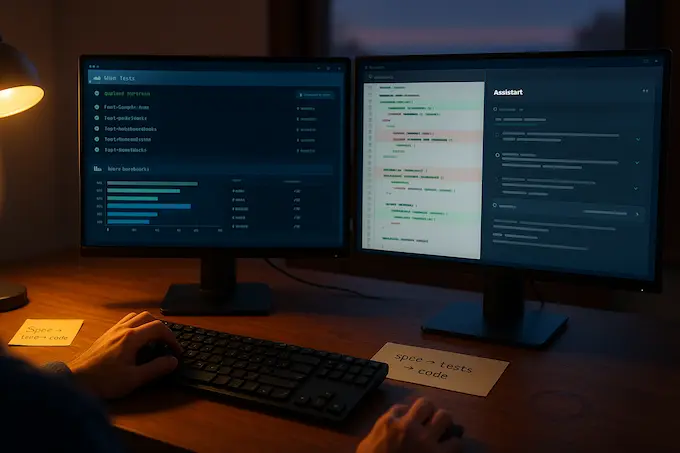
You do not need a contest badge to benefit. The workflows that produced this result translate directly to daily engineering.
- Good Gemini coding is not a code dump. It starts with the interface and the invariants, then helps pick the simplest structure that meets latency, memory, and clarity goals.
- Strong Gemini coding can deliver a correct draft, plus test scaffolding.
- The system can run unit tests and micro-benchmarks locally or in a sandbox, report the failure modes, and propose focused patches. That is Gemini coding as a fast pair programmer.
- The best Gemini coding does not just spit out an answer. It explains the idea in plain language with a few invariants you can check. That speeds up reviews and keeps standards high.
Treat it like a junior engineer who can also read the CLRS index at light speed. Pair with it. Keep ownership of design decisions. You will ship faster without lowering the bar.
8. From AI Competitive Programming To Science
This is not only a sports story. AI competitive programming is a clean, scalable way to measure reasoning under pressure. The skills that win here are precisely the skills scientists need in the lab. Model a system. Choose the right representation. Search a large space without getting lost. That is why the result matters outside code golf.
The International Collegiate Programming Contest builds a culture of precise thinking that carries into research. When Gemini coding shows it can operate at that level, you can start asking for help on tasks that used to live only on whiteboards, from experimental design to parameter sweeps that respect physical constraints.
9. Limits, Open Questions, And A Useful Reality Check
Two problems, B and G, remained unsolved. That matters. The win does not make reasoning a solved problem. It shows a system that can generalize and recover from errors, but not infallibly. Practical questions remain. How much compute sits behind the result. How reproducible are the runs. How do we detect silent errors before deployment. Engineering is the art of controlled doubt, and Gemini coding should inherit that habit.
We should also expect the target to move. Problem setters will adapt to models and design tasks that resist pattern replay. That is good. It will push the field toward deeper AI abstract reasoning and cleaner evaluation.
10. A Collaboration Playbook That Works
Humans bring priors, intuition, and the sense to stop chasing a bad path. The model brings breadth, a perfect memory for techniques, and the patience to try five reasonable approaches without ego. The most productive pattern is simple.
- Humans set the interface and define what “done” means.
- The model proposes two or three plans with trade-offs.
- Humans pick one, add edge cases, tighten constraints.
- The model implements, tests, and iterates.
- Humans own the final review.
This is Gemini coding as a partnership, not a replacement. In the ICPC run, a combined human plus model team would have solved all twelve tasks. That is a useful north star for teams building products today with Gemini coding in the loop.
11. How To Get Real Value From Gemini Coding
You can raise your team’s output with a few habits.
- Write The Spec First. Two paragraphs in plain language, inputs, outputs, and failure modes. Feed that to your assistant. The quality of Gemini coding improves when the target is crisp.
- Name The Tools. Tell it the library and version you want. If it picks an algorithm, ask for the one you would teach a new hire. Clean, known approaches beat obscure tricks. That is still Gemini coding at its best.
- Ask For Tests Before Code. Unit tests frame the problem and reduce back-and-forth. Good Gemini coding will surface corner cases you missed.
- Force Trade-Offs. Request two designs under clear constraints, for example memory-light versus latency-light. Then choose. This keeps Gemini coding honest and keeps you in charge.
With that discipline, the assistant is not a toy. It is a lever.
12. The Road Ahead, And A Friendly Challenge
The narrative is broader than one contest. The same system hit gold-level performance at the International Mathematical Olympiad months earlier, and now it has shipped a convincing live run at ICPC. Both hinge on AI problem solving that builds plans, tests them, and adapts. That trajectory suggests more than a headline. It suggests a method.
Here is my challenge. Set aside an afternoon this week and run a live session on a problem that has been sitting on your backlog. A tricky scheduling bug. A small optimization you have avoided. A one-off data pipeline you need for analysis. Write a tight spec. Pair with Gemini coding in the loop. Hold the line on tests. Ship something that matters to you.
If it helps, start with the two examples above. Use the convex search idea when you see a bowl-shaped objective. Use the rerooting trick any time a tree asks for all-pairs distance sums. These are simple moves with high leverage. They represent what Gemini coding can already do without drama.
We will keep reading the papers. We will keep an eye on Google DeepMind news. But the way you will feel the shift is not in a headline. It is in a repo where the review is shorter, the diff is cleaner, and the production graph gets steadier. That is the payoff. If you want more of it, plug Gemini coding into your day and measure what changes. Then tell your team what worked, and what did not. That is how we get better, together.
1) How good is Gemini for coding and competitive programming?
Gemini coding has reached gold-medal level at the 2025 International Collegiate Programming Contest (ICPC), solving 10 of 12 tasks in contest conditions and, on scoring, mapping to second place overall. It also uniquely cracked one problem no human team solved during the event.
2) Is Gemini’s performance at the ICPC a breakthrough for AI reasoning?
Yes, it signals stronger AI problem solving under pressure. DeepMind frames it as a leap in AI abstract reasoning, and independent coverage called the result “historic,” while also noting open questions about real-world generalization.
3) How prestigious is the International Collegiate Programming Contest (ICPC)?
ICPC is widely described by organizers as the world’s oldest, largest, most prestigious algorithmic programming contest, with strict scoring and global World Finals that bring together elite university teams.
4) Can AI like Gemini solve problems that humans can’t?
In ICPC 2025, Gemini coding produced a correct solution for “Problem C” that no human team solved during the contest window, a concrete example of AI reaching solutions beyond the field on the day.
5) What is Gemini 2.5 Deep Think and how is it different from other models?
Gemini 2.5 Deep Think extends reasoning time, runs parallel solution paths, and uses novel reinforcement learning to plan, verify, and iterate code. That combo improves complex reasoning compared with prior Gemini releases.